Anas platyrhynchos
Mallard (Anas platyrhynchos)
 Featured photomallard.jpg
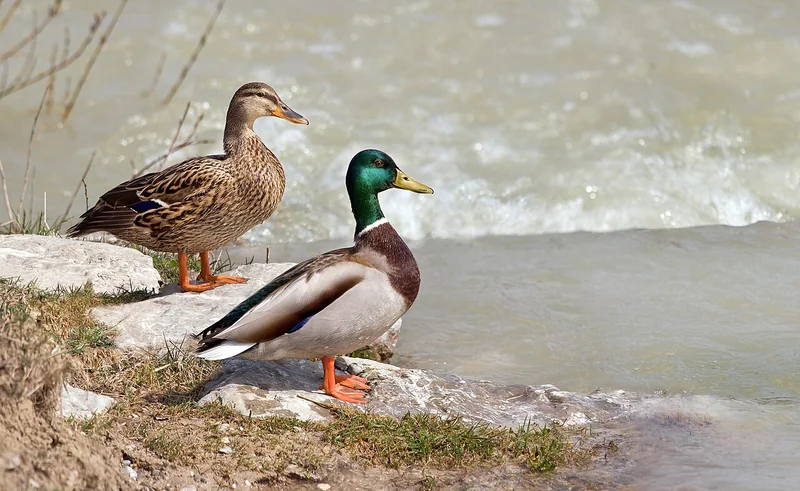
Anas platyrhynchos, the mallard, is a medium-large dabbling duck of the family Anatidae, distributed across the Northern Hemisphere. Adults are 50 to 65 cm long with a wingspan of 81 to 98 cm and weigh 720 to 1,580 g. Adult males in breeding plumage show a glossy green head, white neck-ring, chestnut breast, and grey body; females are mottled brown throughout. The IUCN lists the species as Least Concern. The mallard is the ancestor of nearly all domestic duck breeds and the most numerous duck species on Earth.
Quick facts
- Habitat
- Almost any wetland with shallow water — marshes, lakes, rivers, urban park ponds. The species adapts readily to human-modified environments and is among the commonest urban waterbirds across the temperate Northern Hemisphere.
- Range
- Across most of the Northern Hemisphere — Europe, North Africa, Asia, and North America. Introduced to South America, Australia, and New Zealand. The mallard is the most widely distributed duck in the world; introduced populations are often locally invasive.
- Size
- 50–65 cm body · 81–98 cm wingspan · 720–1580 g
- Plumage
- Adult males in breeding plumage show a glossy iridescent green head, narrow white neck-ring, chestnut breast, pale grey body, white tail, and a curl of upturned black feathers above the tail. Adult females are mottled buff-brown throughout, with a paler face and an orange bill marked with darker patches. Both sexes show a blue speculum on the wing edged in white.
- Song
- Females give the typical loud 'quack quack quack' that humans associate with ducks generally; males have a much quieter, raspy 'kreep' or 'rab'. Most of what laypeople call 'duck quacking' is specifically female mallard.
- Migration
- Highly variable. Northern populations migrate; many central and southern populations are resident. Urban populations are often year-round residents on park ponds and small wetlands.
- Conservation
- Least Concern (LC)
Overview
Anas platyrhynchos is the type species of the genus Anas and the most numerous and widely distributed duck on Earth. The species is the wild ancestor of nearly all domestic duck breeds — the original domestication occurred in southern China several thousand years ago and has been repeated independently in several other regions. The species hybridizes readily with several closely related species, both wild (American black duck, Mexican duck) and domestic, and the resulting introgression has affected the genetic integrity of several specialist relatives.
Distribution
The native range covers most of the Northern Hemisphere. Introduced populations are established across South America, Australia, and New Zealand, often hybridizing with native ducks (the New Zealand grey duck, the Hawaiian duck, the Mexican duck) and reducing those species' genetic distinctness. The mallard's tolerance of human-modified habitat has made it one of the most successful waterfowl in urban settings worldwide.
Hybridization
Mallards hybridize readily with several closely related Anas species, both in the wild and through escaped domestic stock. Documented hybrids exist with the American black duck, mottled duck, Pacific black duck, Hawaiian duck, Mexican duck, and New Zealand grey duck. In some cases — particularly the Hawaiian and New Zealand populations — extensive introgression has threatened the genetic distinctness of the smaller native species.
Sources & further reading (2)
- iucn-red-list — accessed 2026-04-29
- encyclopedia — accessed 2026-04-29
Frequently asked questions
Why does only the female mallard quack?
Only the adult female mallard gives the classic loud 'quack quack quack' that humans associate with ducks generally. Males give a much quieter, raspier 'kreep' or 'rab' call. The vocal dimorphism is a function of the larger syrinx and resonating chamber of the female. The 'duck quack' of folklore and cartoons is therefore specifically the female mallard's call.
Are mallards the ancestors of domestic ducks?
Almost all domestic duck breeds — Pekin, Rouen, Cayuga, Khaki Campbell, and dozens of others — descend from the wild mallard. The original domestication occurred in southern China several thousand years ago. The Muscovy duck (Cairina moschata), an unrelated South American species, is the only widely-kept domestic duck not derived from the mallard.
Why is mallard hybridization a conservation concern?
Mallards readily hybridize with several closely related Anas species. Where mallards are introduced into the range of a smaller relative — notably the Hawaiian duck, the Mexican duck, and the New Zealand grey duck — extensive hybridization can swamp the native species' gene pool with mallard genes, reducing or eliminating its genetic distinctness. The phenomenon is one of the most-cited examples of hybridization-as-extinction in conservation biology.