Setophaga magnolia
Magnolia Warbler (Setophaga magnolia)
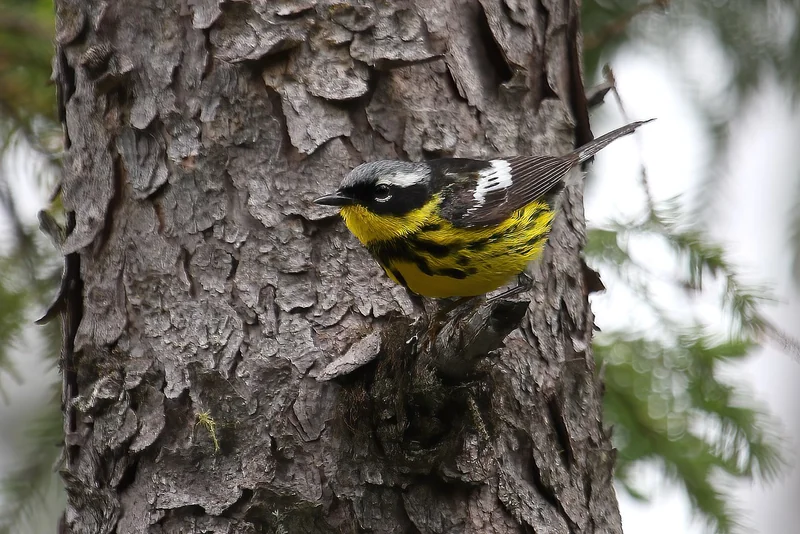 Featured photomagnolia-warbler.jpg
Setophaga magnolia, the magnolia warbler, is a small Parulidae warbler distributed across boreal North America. Adults are 11 to 13 cm long with a wingspan of 16 to 20 cm and weigh 7 to 12 g. The plumage shows striking yellow underparts heavily streaked with black, a black face mask in males, and a yellow rump. The IUCN lists the species as Least Concern. The magnolia warbler is one of the most familiar Neotropical migrants of eastern boreal North America in spring and autumn.
Quick facts
- Habitat
- Young coniferous forest, especially black spruce and balsam fir thickets in regenerating logged or burned areas, across the boreal zone. The species favours dense low-canopy conifer cover with small open patches.
- Range
- Breeds across boreal Canada and the northeastern United States from Alaska east to Newfoundland and south through the Appalachians. Winters across the Caribbean basin, Central America, and parts of northern South America.
- Size
- 11–13 cm body · 16–20 cm wingspan · 7–12 g
- Plumage
- Adult males in breeding plumage show a black face mask, grey crown, white supercilium, black back, white wing-bars, and bright yellow underparts heavily streaked with black across the breast and flanks. The bright yellow rump is conspicuous in flight. Females and non-breeding males are duller, with grey instead of black on the face and lighter streaking.
- Song
- A short, cheerful 'weeta-weeta-weeta' or 'see-see-suey' delivered from a high conifer perch. The song is one of the most familiar boreal-warbler voices during the brief northern breeding season.
- Migration
- Long-distance Neotropical migrant. Breeds across boreal Canada and the northeastern United States; winters across the Caribbean, Central America, and parts of northern South America. Migration timing is highly synchronized in spring and autumn.
- Conservation
- Least Concern (LC)
Overview
Setophaga magnolia belongs to the family Parulidae. The species' English name 'magnolia warbler' is misleading — the species was named by the American naturalist Alexander Wilson, who collected the type specimen from a magnolia tree in Mississippi during migration. The species' actual breeding habitat is boreal-zone spruce-fir conifer forest, far from the Mississippi magnolias. Wilson considered renaming the species but the original name stuck.
Distribution
The breeding range covers the boreal zone of North America from Alaska east to Newfoundland and south through the Appalachians. The species is most abundant in young regenerating conifer forest after logging or fire — habitat patches that are increasingly common across the modern Canadian boreal landscape. Population trends are stable to slightly increasing across most of the range.
Migration
Magnolia warblers are highly migratory. Breeding birds depart the boreal range in late August and September, crossing the Gulf of Mexico in autumn to wintering grounds across the Caribbean, Central America, and northern South America. Spring return migration brings birds back to the breeding range by mid-May. Major nights of passage at well-known migration hotspots can include thousands of magnolia warblers among the broader spring migration pulse.
Sources & further reading (2)
- iucn-red-list — accessed 2026-04-30
- encyclopedia — accessed 2026-04-30
Frequently asked questions
Why is it called the 'magnolia' warbler if it doesn't live in magnolias?
The American naturalist Alexander Wilson named the species after collecting the type specimen from a magnolia tree in Mississippi during spring migration in 1810. The bird was simply passing through the magnolia on its way north, but Wilson's location-of-collection naming convention stuck. The species' actual breeding habitat is boreal-zone spruce-fir conifer forest, far from the original Mississippi magnolia collection site.
Why are warblers so brightly coloured?
Most New World warblers (family Parulidae) breed at high northern latitudes during a brief summer pulse and need to attract mates quickly through visually striking plumage. The bright yellow, black, orange, and chestnut patterns of male warblers in breeding plumage are sexually selected and signal male quality to females. Females are typically duller — they incubate and brood close to nest height and benefit from cryptic colouration.
How can magnolia warblers cross the Gulf of Mexico?
Magnolia warblers and many other small Neotropical migrants cross the Gulf of Mexico in single non-stop flights of 800 km or more. The crossing typically takes 18-22 hours and is fuelled by pre-migration fat-loading that can double the bird's body mass. Hurricane-related mortality during the crossing is documented. The crossing is one of the most extraordinary migrations relative to body size of any bird group.