Fregata magnificens
Magnificent Frigatebird (Fregata magnificens)
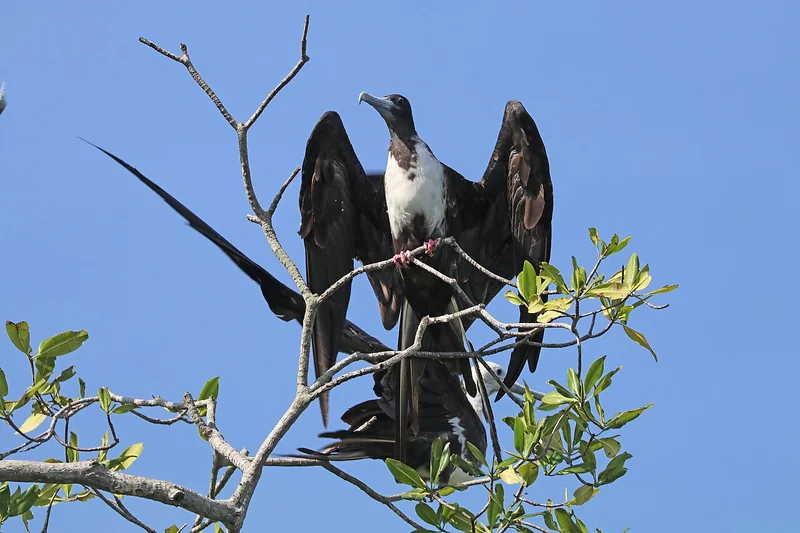 Featured photomagnificent-frigatebird.jpg
Fregata magnificens, the magnificent frigatebird, is a large seabird of the family Fregatidae, found throughout the tropical and subtropical Americas. Adults have a wingspan of 217 to 244 cm — the largest wingspan-to-body-mass ratio of any bird — and weigh 1.1 to 1.6 kg. Males inflate a brilliant scarlet gular sac for courtship display. The species is a notorious kleptoparasite, harassing other seabirds into dropping their catch. The IUCN lists the species as Least Concern.
Quick facts
- Habitat
- Tropical and subtropical oceans of the Americas, nesting colonially on low-lying oceanic islands, mangroves, and coastal shrubland. Forages over open ocean, coastal waters, and lagoons — never lands on the water.
- Range
- Breeds on islands and coasts from Baja California and Florida south through the Caribbean and Pacific coast of Central and South America to Ecuador and the Galapagos. Also breeds on Atlantic islands including the Cape Verde Islands. Wanders widely after the breeding season.
- Size
- 89–114 cm body · 217–244 cm wingspan · 1100–1590 g
- Plumage
- Males are entirely glossy black with a bright iridescent green gloss on the back and a scarlet inflatable gular sac (deflated to a small red pouch when not displaying). Females are black with a white chest patch and brownish wing-coverts. Juveniles show a white head and underparts. The wings are sharply angled, the tail is deeply forked, and the hook-tipped bill is long and grey.
- Song
- Males on nest give a warbling, drumming rattle during display. In flight largely silent. At colonies produces rattling bill-clapping and low croaking.
- Migration
- Non-migratory but highly mobile. After the breeding season, birds range widely over the tropical Pacific and Atlantic. Juveniles and sub-adults wander far from natal colonies and have occasionally been recorded thousands of kilometres from their breeding range.
- Conservation
- Least Concern (LC)
Overview
Fregata magnificens is the largest of the five frigatebird species and is restricted to the Americas (the other species occur in the Pacific and Indian Oceans). The species was called the 'man-o'-war bird' by mariners, who noted its piratical behaviour toward other seabirds. The genus name Fregata is the Spanish and French word for frigate — a fast, manoeuvrable warship — reflecting the species' aerial agility and aggressive foraging strategy. The magnificent frigatebird holds the record for the largest wingspan relative to body mass of any bird.
Gular sac display and courtship
Male magnificent frigatebirds gather in colonies on low shrubs or mangroves and inflate their brilliant scarlet gular sac — a large, membranous throat pouch — into a balloon-like sphere up to 25 cm in diameter. Males raise their wings, rattle their bills, and vibrate the inflated sac while females fly overhead inspecting potential mates. The display can last for 20 minutes or more. Females select males based on the size and redness of the sac, which signals testosterone levels and body condition. After pairing, the male sac deflates and the scarlet colour fades outside the breeding season.
Kleptoparasitism and flight ability
Magnificent frigatebirds are consummate aerial pirates — pursuing and harassing boobies, terns, and other seabirds in flight until they drop or regurgitate their catch, which the frigatebird then snatches in mid-air. The species is also capable of snatching prey directly from the sea surface while remaining airborne — but cannot land on the water or take off from it. If a frigatebird ditches at sea, it risks drowning. The combination of exceptional aerial agility (the largest wingspan:body mass ratio of any bird), the deeply forked tail (used as a rudder), and the hook-tipped bill make it one of the most effective avian aerial pirates.
Sources & further reading (2)
- iucn-red-list — accessed 2026-05-07
- encyclopedia — accessed 2026-05-07
Frequently asked questions
What is the red throat sac used for?
The brilliant scarlet gular sac is inflated by breeding males during the courtship display to attract females — the sac can reach 25 cm in diameter and is one of the most dramatic avian courtship ornaments. The redness signals testosterone levels and body condition; females use sac size and coloration to select mates. Outside the breeding season the sac deflates and becomes a small, less colourful pouch.
Can frigatebirds swim?
No. Magnificent frigatebirds have heavily waterproofed feathers but cannot take off from the water surface; if they ditch at sea, they typically cannot escape. Their flight anatomy is so specialised for aerial manoeuvre and soaring that the muscles needed for swimming are reduced. They avoid landing on water and snatch prey from the surface while remaining airborne.
Why are frigatebirds called 'man-o'-war birds'?
The popular name refers to the frigatebird's aggressive piracy — pursuing and harassing other seabirds (boobies, terns, pelicans) into dropping their catch mid-air. Mariners compared this behaviour to the man-o'-war warship, which would overhaul slower vessels to steal their cargo. The scientific genus name Fregata (Spanish/French for 'frigate') makes the same comparison to a fast, manoeuvrable warship.