Aegithalos caudatus
Long-tailed Tit (Aegithalos caudatus)
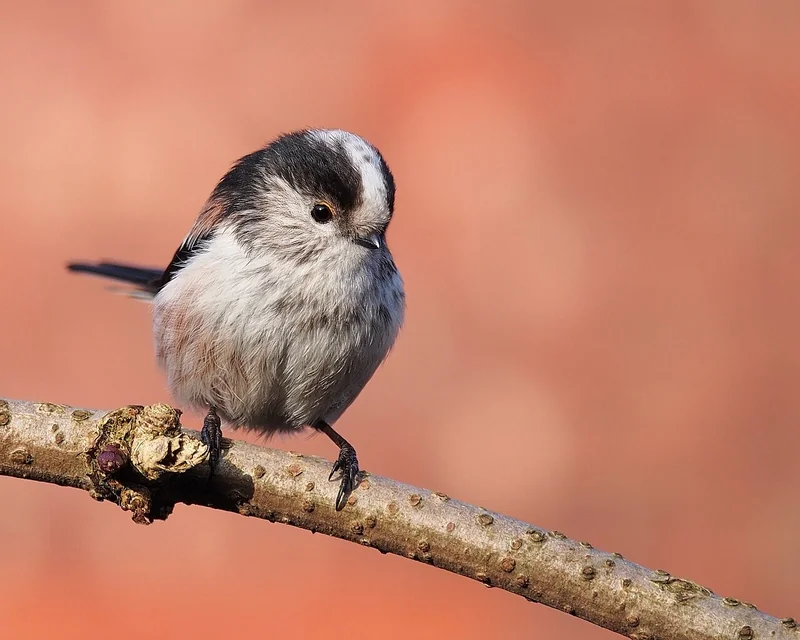 Featured photolong-tailed-tit.jpg
Aegithalos caudatus, the long-tailed tit, is a tiny songbird of the family Aegithalidae, distributed across Europe and across temperate Asia. Adults are 13 to 15 cm long including the long tail (which is about half the total length) and weigh 7 to 9 g. The plumage is mostly black-and-white with a small body and an extraordinarily long graduated tail. The IUCN lists the species as Least Concern. Long-tailed tits travel in tight family flocks and roost in close-pressed huddles to share warmth through cold European winters.
Quick facts
- Habitat
- Mixed and deciduous woodland, hedgerows, scrub, parks, and gardens with low cover across Europe and northern Asia. The species favours dense low vegetation for nesting and feeds in mixed flocks across forest canopy.
- Range
- Across most of Europe and across temperate Asia to Japan. Multiple subspecies span the range, with the all-white-headed northern European nominate and the black-streaked Iberian and central European forms among the most distinctive.
- Size
- 13–15 cm body · 16–19 cm wingspan · 7–9 g
- Plumage
- Adults show a tiny round body with a strikingly long graduated tail (about half the bird's total length). The northern European nominate form is mostly black-and-white with a clean white head; the central and southern European forms have a black supercilium and black-streaked crown. All forms share the distinctive long tail and round body silhouette. Both sexes look alike.
- Song
- A high-pitched 'tsee-tsee-tsee' contact call delivered constantly by family flocks as they move through woodland. The species has no loud territorial song; the constant flock chatter is the species' acoustic signature.
- Migration
- Sedentary across the entire range. Local movements occur but no regular migration.
- Conservation
- Least Concern (LC)
Overview
Aegithalos caudatus is one of about twelve Aegithalos species worldwide. The Latin epithet 'caudatus' means 'tailed', a reference to the species' extraordinarily long tail. The species was historically classified in the family Paridae but is now placed in its own family Aegithalidae on molecular grounds. The European populations show striking subspecific plumage variation across a relatively short geographic distance.
Family flocks
Outside the breeding season, long-tailed tits move in tight family flocks of 10 to 20 birds — typically a breeding pair plus the previous year's offspring plus occasional unrelated 'helpers'. The flocks forage cooperatively, defend territory together, and roost in close-pressed huddles on the same branch each night to share body warmth. The flock structure is one of the most cooperative documented among small European songbirds and supports the species' winter survival.
Cooperative breeding
Long-tailed tit pairs that fail to fledge their own brood (frequently — the species' nest is open and predator-vulnerable) often join close relatives' nests as 'helpers'. Helpers feed the brood, defend the nest, and contribute to the family's overall reproductive success. The behaviour is one of the textbook examples of cooperative breeding in small temperate songbirds and is supported by long-running ringed-population studies in Britain and Japan.
Sources & further reading (2)
- iucn-red-list — accessed 2026-04-30
- encyclopedia — accessed 2026-04-30
Frequently asked questions
Why is the tail so long?
The long graduated tail is about half the bird's total length and gives the species its English name. Functions are debated. The long tail may aid manoeuvring through dense outer foliage where the bird forages, may serve as a flock-coordination visual signal in family flocks, or may simply reflect phylogenetic legacy within the genus Aegithalos. The trait is shared with several other Aegithalos species.
Do long-tailed tits really cuddle to keep warm?
Yes. Family flocks roost on the same branch each night, pressing tightly together in a row to share body warmth through cold European winter nights. The behaviour is well-documented and is one of the species' key adaptations to surviving winter on a tiny body mass. Roost branches sometimes show the flock arrangement clearly when the birds depart at dawn — a row of small birds compressed into a few tens of centimetres.
Why does the European subspecies vary so much?
Long-tailed tits show striking plumage variation across European subspecies. The northern European nominate form has a clean all-white head; the central European subspecies has a strong black supercilium; the Mediterranean form has a black-streaked crown. The pattern reflects post-glacial recolonization of Europe from multiple Pleistocene refugia, with each population's plumage characteristics retained where the populations re-met.