Clangula hyemalis
Long-tailed Duck (Clangula hyemalis)
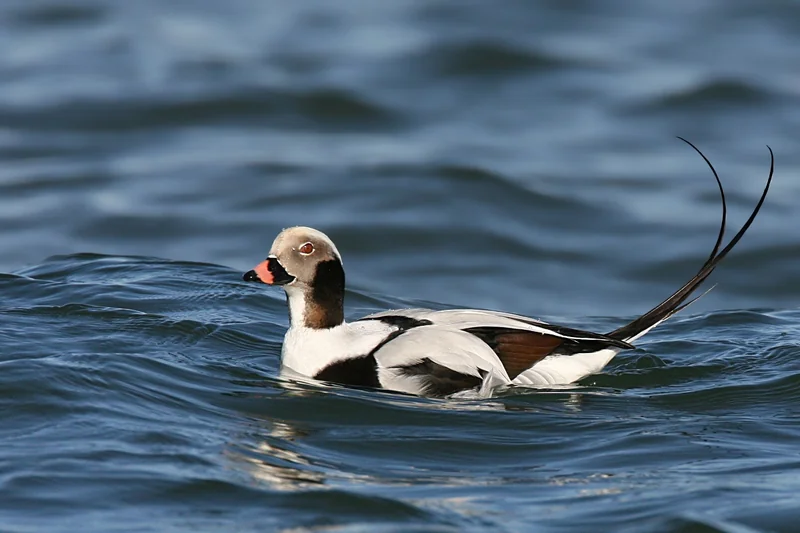 Featured photolong-tailed-duck.jpg
Clangula hyemalis, the long-tailed duck, is a small sea duck of the family Anatidae, breeding across the circumpolar Arctic and wintering on cold coastal seas. Adult males are 39 to 60 cm long (including the elongated central tail feathers) with a wingspan of 73 to 79 cm and weigh 540 to 950 g. The species is the deepest-diving duck, regularly plunging to 40 m to pursue prey on the seafloor. The IUCN lists the species as Vulnerable, with a declining global population.
Quick facts
- Habitat
- Breeds on Arctic tundra pools, lake shores, and coastal wetlands. Winters almost entirely at sea on cold temperate and subarctic coastal waters, often in large concentrations on shallower coastal seas and estuaries.
- Range
- Breeds across the circumpolar Arctic from Iceland, Scandinavia, and Russia to Alaska and northern Canada. Winters on the North Atlantic coast, Baltic Sea, North Sea, and North Pacific coast south to New England and Japan.
- Size
- 39–60 cm body · 73–79 cm wingspan · 540–950 g
- Plumage
- Males are boldly patterned with complex seasonal plumage changes — four distinct plumages per year, more than any other duck. Winter males show white head and neck with a dark cheek patch, brown-and-white back, and elongated central black tail feathers. Females are duller brown-and-white without the long tail. Both sexes moulted between summer and winter plumage show intermediate patterns.
- Song
- The male's call is a loud, far-carrying yodelling 'ow-ow-owleeee' or 'a-ha-a-lik' — one of the most evocative sounds of Arctic winter. Wintering flocks on cold coastal seas can be detected by their constant calling.
- Migration
- Migratory, moving from Arctic breeding grounds to coastal wintering areas in the North Atlantic and North Pacific. Often concentrates in large rafts of thousands on shallow coastal seas in winter.
- Conservation
- Vulnerable (VU)
Overview
Clangula hyemalis is the sole member of the genus Clangula and is one of the most numerous sea ducks of the Northern Hemisphere, with a global population estimated at around 3–4 million individuals — though this figure is declining. The species' old English name 'oldsquaw' (still used in North America) was replaced by 'long-tailed duck' in 2000 by the American Ornithological Society. The species is unique among ducks for having four distinct seasonal plumages annually, rather than the two (breeding and non-breeding) typical of most ducks.
Deepest-diving duck
Long-tailed ducks are the deepest-diving sea ducks, regularly reaching 40 m and occasionally recorded to 60 m — depths comparable to those achieved by diving alcids such as common murres. The birds dive with wing-propulsion rather than foot-propulsion, using the wings in the same way as penguins and alcids. At such depths, the birds target benthic molluscs (mussels, clams) and crustaceans unavailable to shallower-diving competitors. Dive durations of 60–90 seconds are recorded at full depth.
Conservation concern
The long-tailed duck is classified as Vulnerable by the IUCN following documented population declines of approximately 50–65% over three generations. The largest wintering concentration — the Baltic Sea, which holds over one million individuals — has declined sharply since the 1990s. Threats include bycatch in bottom-set gill nets (the species dives into fishing gear set for cod and flounder), oil pollution, and possible reductions in prey availability linked to changing Arctic sea conditions. Monitoring programmes in the Baltic and North Atlantic continue to track population trends.
Sources & further reading (2)
- iucn-red-list — accessed 2026-05-07
- encyclopedia — accessed 2026-05-07
Frequently asked questions
How deep can a long-tailed duck dive?
Long-tailed ducks regularly dive to 40 m and have been recorded at 60 m — deeper than any other duck species. They use wing-propulsion for diving rather than foot-propulsion, and can remain submerged for 60–90 seconds at depth. At these depths they target benthic molluscs such as mussels and clams on the seafloor, out of reach of shallower-diving competitors.
Why does the long-tailed duck have four plumages a year?
The long-tailed duck is unique among ducks in undergoing four full or partial moults per year, producing distinct summer breeding, eclipse (post-breeding), transition, and winter plumages in both sexes. This contrasts with most ducks, which have two plumages annually. The adaptive reason for the unusual number of moults is not fully understood but may relate to the extreme seasonal contrast of Arctic breeding environments versus marine wintering habitats.
Why is the long-tailed duck Vulnerable?
The global population has declined by roughly 50–65% over three generations (about 25 years), primarily due to bycatch in bottom-set fishing gill nets in the Baltic Sea and North Atlantic. The Baltic holds the largest winter concentration (over one million birds), and monitoring has shown sharp declines there since the 1990s. Additional threats include oil pollution and changes in benthic prey availability linked to shifting Arctic conditions.