Athene noctua
Little Owl (Athene noctua)
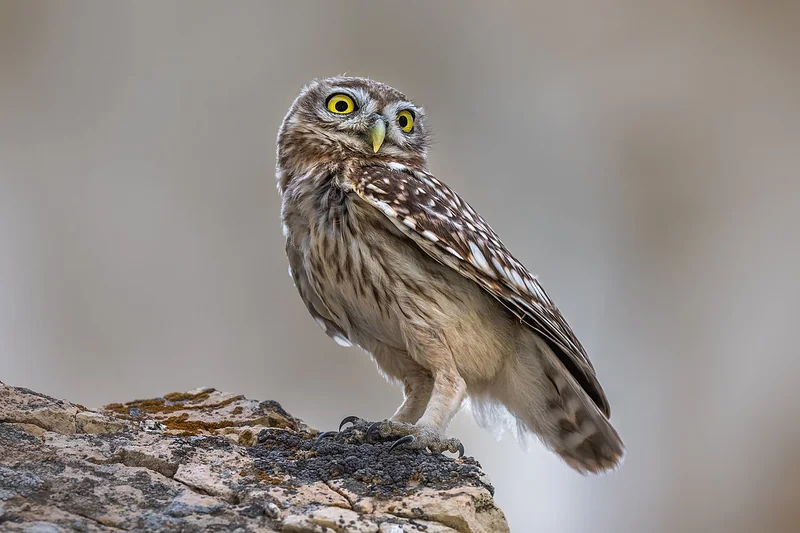 Featured photolittle-owl.jpg
Athene noctua, the little owl, is a compact owl of the family Strigidae, the most widespread small owl across Europe, the Middle East, and Central Asia. Adults are 21 to 23 cm long with a wingspan of 54 to 58 cm and weigh 100 to 190 g. The species is the owl of ancient Athenian coinage — Athena's companion — and was introduced to Britain in the 19th century. The IUCN lists the species as Least Concern.
Quick facts
- Habitat
- Open and semi-open habitats across the Palearctic — farmland, hedgerows, orchards, olive groves, steppe, rocky hillsides, and villages with old trees and stone walls. Avoids dense forest. Highly associated with traditional agricultural landscapes in Europe.
- Range
- Breeds across Europe from the Iberian Peninsula and British Isles east through the Palearctic to China and Korea. Also widespread in North Africa, the Middle East, and Central Asia. Introduced to Britain in the 1870s–1880s, where it is now a familiar breeding bird.
- Size
- 21–23 cm body · 54–58 cm wingspan · 100–190 g
- Plumage
- Adults are dark brown above with white spots on the crown and upperparts, white-streaked brown underparts, and a bold white supercilium. The round head lacks ear tufts. The facial disc is whitish with brown framing. The eyes are bright lemon-yellow, giving the bird a characteristic fierce, almost scowling expression. The species often bobs its head when alarmed — a diagnostic behaviour.
- Song
- A mournful, far-carrying 'kee-yew' or 'poo-poo' whistle, repeated at regular intervals from a prominent perch. Also produces a sharp 'wuut' alarm call and a barking 'kek-kek-kek' when disturbed.
- Migration
- Largely sedentary. The species maintains year-round territories and only undertakes short local movements. Some juvenile dispersal occurs in autumn.
- Conservation
- Least Concern (LC)
Overview
Athene noctua is the type species of the genus Athene, named after the Greek goddess of wisdom who was associated with the owl in antiquity. The little owl (or a closely related ancestor) appeared on Athenian silver tetradrachm coins from the 5th century BCE — making it the most historically significant owl in Western cultural history. Despite subsequent population declines in parts of northwestern Europe linked to changes in agricultural land use, the species remains widespread and is still commonly encountered in olive groves, orchards, and traditional farmland across southern and central Europe.
Introduction to Britain
The little owl was not native to Britain but was introduced from continental Europe in the 19th century — most successfully from 1879 onward in Kent and Northamptonshire. By the mid-20th century the species had spread across most of England and Wales and into lowland Scotland. The introduction is one of the most studied in British ornithology. Current UK breeding populations have declined since the 1980s, likely due to changes in agricultural practice reducing earthworm and large invertebrate prey availability. The species is still widespread in England but is on the amber list of Birds of Conservation Concern.
Head-bobbing behaviour and detection
Little owls are well known for their characteristic head-bobbing behaviour — rapid up-and-down and side-to-side movements of the head when the bird is alert or suspicious. This stereoscopic scanning movement helps the owl judge distance and locate potential threats or prey more accurately. Because owls have fixed eyes that cannot move in their sockets (unlike most birds), head movements provide the parallax information needed to judge distances precisely. The little owl's head-bobbing is one of the most distinctive field behaviours of any European owl.
Sources & further reading (2)
- iucn-red-list — accessed 2026-05-07
- encyclopedia — accessed 2026-05-07
Frequently asked questions
Is the little owl native to Britain?
No. The little owl was introduced to Britain from continental Europe in the 19th century — most successfully beginning in 1879 in Kent and the 1880s in Northamptonshire. The introduced population spread rapidly and became established across most of England and Wales by the mid-20th century. The species is not native to the British Isles despite being common there today, which occasionally creates controversy in conservation discussions about its status.
What is the connection between the little owl and ancient Athens?
The little owl (or its ancestor) was the companion of Athena, the Greek goddess of wisdom, and appeared on the silver tetradrachm coins of ancient Athens from at least the 5th century BCE. The owl on the coin became one of the most recognisable symbols of classical Athens — so common that 'owls' became the colloquial name for Athenian coins throughout the ancient Mediterranean. The scientific genus name Athene and the species name noctua (Latin for 'night owl') both reference this ancient association.
Why does the little owl bob its head?
Little owls (and most owls) bob their heads rapidly up and down and side to side when alert or focused on something. This movement creates parallax — the apparent shift in an object's position against a background when viewed from slightly different positions. Because owl eyes are fixed in their sockets and cannot rotate, the owl must move its whole head to achieve the same parallax information that a mammal gets by moving its eyes. The head-bobbing provides precise distance information needed for accurately judging the position of prey or a threat.