Coracias caudatus
Lilac-breasted Roller (Coracias caudatus)
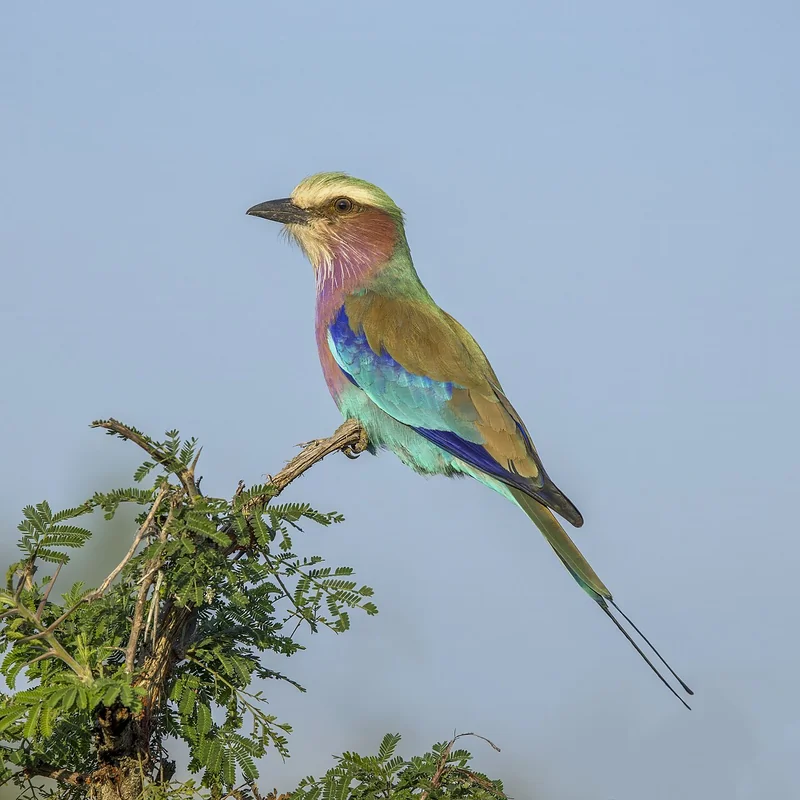 Featured photolilac-breasted-roller.jpg
Coracias caudatus, the lilac-breasted roller, is a medium-sized roller of the family Coraciidae, distributed across sub-Saharan Africa. Adults are 36 to 38 cm long including the long tail-streamers, with a wingspan of 50 to 58 cm, and weigh 90 to 110 g. The plumage is among the most spectacular in any bird — lilac breast, turquoise belly and wings, chestnut back, and dark blue flight feathers. The IUCN lists the species as Least Concern. The species is the unofficial national bird of both Kenya and Botswana.
Quick facts
- Habitat
- Open savanna, woodland edges, and mosaic landscapes across sub-Saharan Africa. The species hunts from elevated perches and is one of the most visible birds in the African savanna landscape.
- Range
- Sub-Saharan Africa from Ethiopia and Somalia south through East Africa to South Africa. The species is broadly distributed across the savanna belt and is one of the most-encountered roller species across African game reserves.
- Size
- 36–38 cm body · 50–58 cm wingspan · 90–110 g
- Plumage
- Adults show a striking multicoloured pattern — green crown, white face, lilac breast, turquoise belly and underwings, chestnut back, and dark blue flight feathers and tail. The two outer tail-streamers extend several centimetres beyond the rest of the tail. Both sexes look alike. The colour combination is among the most spectacular in any bird and makes the species unmistakable in African savanna habitat.
- Song
- A loud, harsh, raven-like 'zaaak' or 'krak' call delivered both in flight and from a perch. The Coraciidae family English name 'roller' comes from the male's tumbling courtship flight; the lilac-breasted roller performs the typical roller display.
- Migration
- Largely sedentary across the breeding range. Some local seasonal movements occur but no regular long-distance migration.
- Conservation
- Least Concern (LC)
Overview
Coracias caudatus is one of about a dozen Coracias roller species worldwide. The species' English name 'roller' comes from the family-typical tumbling courtship flight — males ascend high above the territory, then tumble, twist, and roll back-and-forth through the air while calling. The lilac-breasted roller performs the typical roller display, and the brilliant plumage is most visible during the aerial tumbling sequence.
Distribution
The breeding range covers sub-Saharan Africa from Ethiopia and Somalia south through East Africa to South Africa. The species is one of the most-encountered birds across African savanna game reserves and is widely depicted in African wildlife photography and tourism imagery. Population trends are stable across most of the range; some regional declines linked to land-use change have occurred but the broader range remains intact.
Cultural significance
The lilac-breasted roller is the unofficial national bird of both Kenya and Botswana. The species' brilliant plumage has made it a frequent subject of African folk art, conservation imagery, and wildlife photography. The species is one of the most-identifiable African birds and is used in tourism marketing across most of its range.
Sources & further reading (2)
- iucn-red-list — accessed 2026-04-30
- encyclopedia — accessed 2026-04-30
Frequently asked questions
Why is it called a 'roller'?
The English family name 'roller' comes from the male's spectacular tumbling courtship flight. Ascending high above the territory, the bird tumbles, twists, and rolls back-and-forth through the air while calling loudly. The lilac-breasted roller performs the typical roller display, and the brilliant plumage is most visible during the aerial tumbling sequence. The Coraciidae family is named for this distinctive flight behaviour shared across roller species worldwide.
Why is the lilac-breasted roller so colourful?
The species shows one of the most spectacular plumage combinations in any bird — lilac breast, turquoise belly, chestnut back, dark blue flight feathers. The colours are partly structural (the blue and turquoise from feather microstructure scattering light) and partly carotenoid-pigmented (the lilac and chestnut from dietary pigments). The bright colouration probably functions in conspecific signalling rather than crypsis — the species is an open-country aerial-pursuit predator that does not depend on background-matching camouflage.
Is the lilac-breasted roller really a national bird?
The species is the unofficial national bird of both Kenya and Botswana — both countries have informally adopted it as a national symbol given the species' striking plumage and broad distribution across the East African savanna. Kenya has not formally adopted any national bird, but the lilac-breasted roller is the most commonly cited candidate. The species is one of the most-identifiable African birds across game reserves and is used in tourism imagery throughout its range.