Aptenodytes patagonicus
King Penguin (Aptenodytes patagonicus)
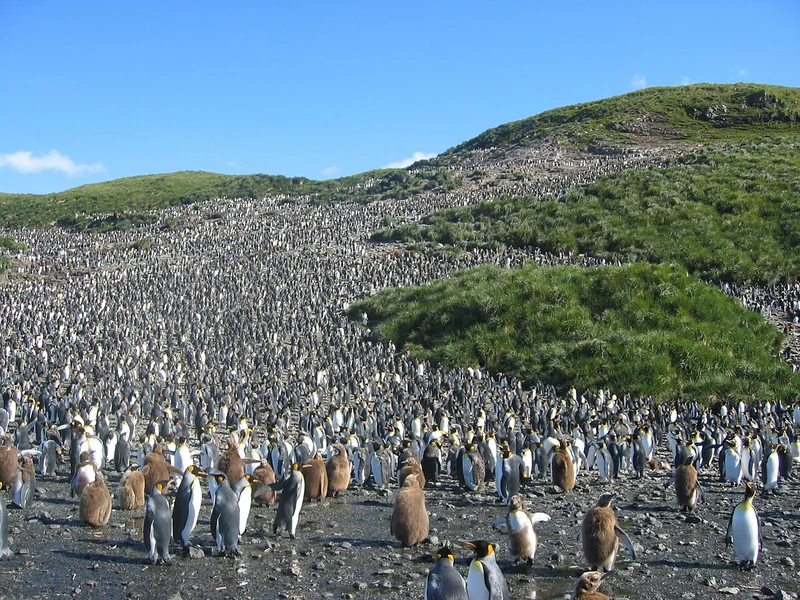 Featured photoking-penguin.jpg
Aptenodytes patagonicus, the king penguin, is the second-largest of the seventeen modern penguin species. Adults are 85 to 95 cm tall and weigh 9.3 to 18 kg. The plumage is silver-grey on the back with a black head and white belly, and the cheeks and upper breast carry vivid orange-yellow patches. The IUCN lists the species as Least Concern. King penguins are widely distributed across the subantarctic Southern Ocean and have one of the longest chick-rearing periods (14-16 months) of any bird species.
Quick facts
- Habitat
- Subantarctic islands and adjacent open ocean. The species breeds on flat or gently sloping beaches and grassy slopes free of permanent ice; the surrounding ocean must support abundant fish and squid prey.
- Range
- Subantarctic islands of the Southern Ocean — South Georgia, the Falkland Islands, the Crozet, Kerguelen, and Heard Islands, Marion and Prince Edward Islands, and Macquarie Island. The species' breeding range is sharply restricted to small offshore islands.
- Size
- 85–95 cm body · 70–80 cm wingspan · 9.3–18 kg
- Plumage
- Adults show a glossy black head and chin, silver-grey back and wings, white belly and underwings, and brilliant orange-yellow auricular patches and an orange-pink upper-breast wash. The bill is long and thin with a pinkish-orange line along the lower mandible. Chicks are covered in dense brown down for over a year — long enough that the brown 'oakum boys' were originally described as a separate species before nineteenth-century observers realized they were juvenile king penguins.
- Song
- Adults give multi-note 'trumpet' calls of two-tone resonant phrases used for individual recognition between mates and parent-chick pairs in the dense colony. The colony soundscape during the breeding season is one of the most acoustically complex among seabirds.
- Migration
- Sedentary on the breeding islands during the chick-rearing period. Adults disperse widely across the Southern Ocean during the inter-breeding period to feed.
- Conservation
- Least Concern (LC)
Overview
Aptenodytes patagonicus is the second-largest penguin (after the emperor) and the only other Aptenodytes species. The two are sister species and share the orange-yellow auricular patches and similar diving ecology, but differ dramatically in breeding cycle: emperor penguins breed on antarctic sea ice through the winter, while king penguins breed on subantarctic island beaches over a 14-16 month cycle. King penguin populations have grown substantially over the twentieth century after recovery from nineteenth-century industrial-scale exploitation for oil.
Distribution
The breeding range covers subantarctic islands of the Southern Ocean — South Georgia, the Falklands, Crozet, Kerguelen, Heard, Marion, Prince Edward, and Macquarie. Several colonies number in the hundreds of thousands of pairs; St. Andrews Bay on South Georgia hosts perhaps the largest seabird colony on Earth (approximately 150,000 pairs). The species' breeding-island distribution is sharply restricted, but the population on each island is among the largest seabird aggregations anywhere.
Long chick-rearing cycle
King penguins have one of the longest chick-rearing cycles of any bird — 14 to 16 months from egg-laying to chick fledging. The chick is fed continuously through one antarctic summer, fasts through most of the following winter (when parents must feed at sea), and finally fledges in the second summer. The long cycle means each pair can only produce two chicks every three years, and chick survival through the winter fast is highly variable. Brown-down 'oakum boy' chicks were originally described as a separate species in the 1840s before nineteenth-century observers realized they were juvenile king penguins.
Sources & further reading (2)
- iucn-red-list — accessed 2026-04-30
- encyclopedia — accessed 2026-04-30
Frequently asked questions
Why are king penguin chicks brown?
King penguin chicks are covered in dense brown down for over a year — much longer than most penguin chicks. The 'oakum boys' (after the brown caulking material used in nineteenth-century shipbuilding) are insulated for the long chick-rearing cycle that spans an antarctic winter on the breeding island. The brown plumage is replaced by adult silver-grey-and-white feathers in the chick's second year. The unusual length of the brown phase originally led nineteenth-century observers to describe the chicks as a separate species.
How long does it take a king penguin chick to fledge?
14 to 16 months — one of the longest chick-rearing cycles of any bird. The chick is fed continuously through one antarctic summer, fasts for much of the following winter while parents must feed at sea (chicks lose substantial body mass during the fast), and finally fledges in the second summer. The long cycle means king penguin pairs can only successfully raise two chicks every three years.
Are king and emperor penguins the same species?
No, they are sister species in the same genus Aptenodytes. The two are similar in shape and the orange-yellow auricular patches but differ dramatically in breeding cycle and habitat. Emperor penguins (A. forsteri) breed on antarctic sea ice through the winter; king penguins (A. patagonicus) breed on subantarctic island beaches over a 14-16-month cycle. Emperor penguins are larger and heavier; king penguins are second-largest among modern penguins.