Strigops habroptilus
Kakapo (Strigops habroptilus)
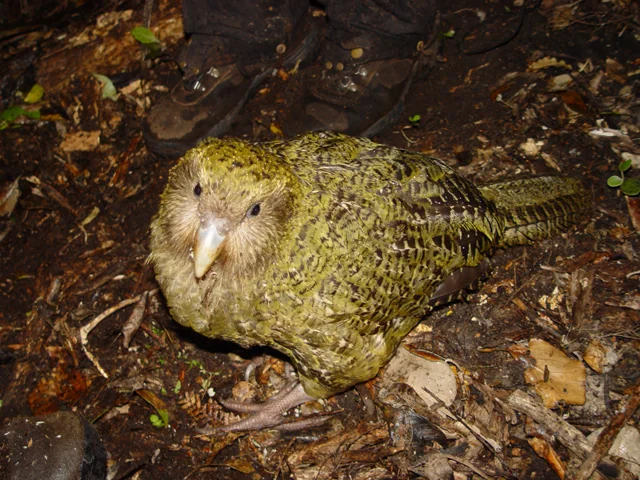 Featured photokakapo.jpg
Strigops habroptilus, the kakapo, is a large flightless parrot of the family Strigopidae, endemic to New Zealand. Adults are 58 to 64 cm long and weigh 1.5 to 4 kg — making the kakapo the heaviest parrot in the world. The plumage is mottled green-and-yellow with a soft owl-like facial disc. The IUCN lists the species as Critically Endangered. The total population is fewer than 250 individuals, all of which are individually known and intensively monitored under New Zealand's Kakapo Recovery Programme.
Quick facts
- Habitat
- Native New Zealand forest with abundant rimu and other podocarp trees. The species is now restricted to several predator-free offshore islands where the entire wild population has been translocated.
- Range
- Endemic to New Zealand. Historically distributed across both North and South Islands and Stewart Island; now restricted by the Kakapo Recovery Programme to a few predator-free offshore islands (Codfish Island, Anchor Island, and others).
- Size
- 58–64 cm body · 60–90 cm wingspan · 1.5–4 kg
- Plumage
- Adults show mottled green, yellow, and black plumage above (excellent camouflage in New Zealand forest), pale yellow underparts with green flecking, and a distinctive soft owl-like facial disc with bristly rictal whiskers around the bill. The bill is pale grey, the legs grey, and the eyes dark. Both sexes look alike but males are substantially larger than females. The wings are functional but cannot support sustained flight; the species can glide short distances downhill.
- Song
- Males give a deep booming 'boom' call during the breeding-season lek display, repeated every few seconds for hours each night. The booming carries up to 5 km across hilly New Zealand forest. Females and chicks are mostly silent.
- Migration
- Sedentary. The species' flightlessness and small island ranges preclude any migration.
- Conservation
- Critically Endangered (CR)
Overview
Strigops habroptilus is the only living species in the family Strigopidae and one of three modern Strigopiformes parrots (with the kea and kaka of New Zealand). The kakapo is the heaviest parrot in the world, the only flightless parrot, and one of the most genetically distinct parrots — the lineage diverged from other parrots over 80 million years ago. The species is also one of the longest-lived birds, with documented lifespans exceeding 90 years.
Critically Endangered
The kakapo's total population is fewer than 250 mature individuals, all of which are individually known by name and monitored under New Zealand's Kakapo Recovery Programme. The species was reduced to as few as 51 birds by 1995 through introduced-mammal predation (cats, rats, stoats) on flightless ground-nesting birds. The Recovery Programme — translocation to predator-free offshore islands, hand-rearing of chicks, supplementary feeding, and intensive monitoring — has driven a slow but real recovery. Recent breeding seasons have produced multi-decade peaks in population growth.
Mast-fruit breeding
Kakapo breeding is tightly coupled to mast-fruiting events of rimu (Dacrydium cupressinum), a New Zealand podocarp that produces large fruit crops only every 2-7 years. Kakapo only attempt to breed in mast years; in non-mast years the population skips reproduction entirely. The breeding system is one of the most extreme examples of mast-driven reproduction in any vertebrate, and the long inter-breeding intervals contribute to the species' slow population recovery.
Sources & further reading (2)
- iucn-red-list — accessed 2026-04-30
- encyclopedia — accessed 2026-04-30
Frequently asked questions
Why can't kakapo fly?
Kakapo are the only flightless parrots in the world. The species evolved on New Zealand islands without native mammalian predators, and flight was unnecessary for survival on the ground. Over millennia the wings became smaller and the flight-muscle attachment reduced — the bird can glide short distances downhill but cannot sustain powered flight. The flightlessness made the species highly vulnerable when introduced mammalian predators (cats, rats, stoats) arrived with European settlement.
How many kakapo are left in the wild?
Fewer than 250 mature individuals as of recent counts — all individually known by name and monitored under New Zealand's Kakapo Recovery Programme. The species was reduced to as few as 51 birds by 1995 through introduced-mammal predation. Concerted conservation since — translocation to predator-free offshore islands, hand-rearing of chicks, supplementary feeding, and intensive monitoring — has driven a slow recovery, with recent breeding seasons producing multi-decade peaks in population growth.
Why do kakapo only breed every few years?
Kakapo breeding is tightly coupled to mast-fruiting events of rimu (Dacrydium cupressinum), a New Zealand podocarp that produces large fruit crops only every 2-7 years. In non-mast years the population skips reproduction entirely. The breeding system is one of the most extreme examples of mast-driven reproduction in any vertebrate, and the long inter-breeding intervals contribute to the species' slow population recovery — most years simply produce no chicks at all.