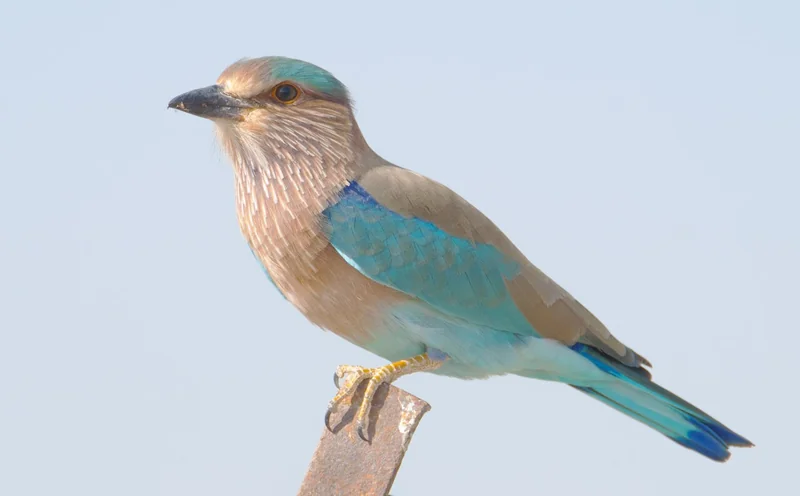
Coracias benghalensis, the Indian roller, is a medium-sized roller of the family Coraciidae, distributed across the Indian subcontinent and parts of Southeast Asia. Adults are 30 to 34 cm long with a wingspan of about 65 cm and weigh 100 to 200 g. The plumage shows brilliant turquoise wings, soft brown body, and a chestnut throat. The IUCN lists the species as Least Concern. The species is the state bird of several Indian states and is one of the most familiar large birds across South Asian agricultural landscapes.
Quick facts
- Habitat
- Open and semi-open country across the Indian subcontinent — agricultural fields, scrub, dry open forest, and roadsides. The species hunts from elevated perches and is one of the most visible birds along Indian rural landscapes.
- Range
- Indian subcontinent (India, Pakistan, Sri Lanka, Bangladesh, Nepal, Bhutan), plus parts of Southeast Asia (Myanmar, Thailand, Cambodia, southern China, Indonesia). The species' range is one of the larger of any Coracias roller.
- Size
- 30–34 cm body · 65 cm wingspan · 100–200 g
- Plumage
- Adults show brilliant turquoise wings (most dramatic in flight), soft purplish-brown body and head, chestnut throat with thin white streaks, and a darker blue tail with paler turquoise outer feathers. The bill is black. Both sexes look alike. The colour combination is similar to but less spectacular than the closely related lilac-breasted roller of Africa.
- Song
- A loud harsh croaking 'kraak' or 'kak-kak' delivered both in flight and from a perch. The species is mostly silent while hunting from a perch but vocal during display flights and territorial defence.
- Migration
- Largely sedentary across most of the breeding range. Some local seasonal movements occur but no regular long-distance migration.
- Conservation
- Least Concern (LC)
Overview
Coracias benghalensis is one of about a dozen Coracias roller species worldwide and the most familiar roller across South Asia. The Latin epithet 'benghalensis' references Bengal, where the type specimen was collected during the early colonial period. The species is the state bird of several Indian states (Karnataka, Andhra Pradesh, Odisha, Telangana, Bihar) and one of the most-photographed birds across Indian wildlife reserves.
Distribution
The breeding range covers the Indian subcontinent and parts of Southeast Asia. The species is one of the most-encountered large birds across rural South Asian landscapes — agricultural fields, scrubland, and roadside utility wires all support breeding pairs. Population trends are stable across most of the range; some regional declines linked to agricultural-pesticide use and habitat conversion have been documented but the broader range remains intact.
Display flight
The English family name 'roller' comes from the male's spectacular tumbling courtship flight. Indian rollers ascend high above the breeding territory, then tumble, twist, and roll back-and-forth through the air while calling. The bright turquoise wing-patches are most visible during the aerial display, and the bird's silhouette flashes between brown body and brilliant blue wings on each tumble. The display is shared across all Coracias rollers.
Sources & further reading (2)
- iucn-red-list — accessed 2026-04-30
- encyclopedia — accessed 2026-04-30
Frequently asked questions
How is Indian roller different from lilac-breasted roller?
Both are medium Coracias rollers with brilliant blue wings and tumbling courtship flights. Indian roller has a soft purplish-brown body and chestnut throat with paler streaks. Lilac-breasted roller (the African counterpart) has a vivid lilac breast, turquoise belly, and chestnut back — substantially more colourful. The two species occupy different continents (Indian roller in South Asia, lilac-breasted in sub-Saharan Africa) and do not overlap in range.
Why is the Indian roller a state bird?
The species is the official state bird of several Indian states, including Karnataka, Andhra Pradesh, Odisha, Telangana, and Bihar. The choice reflects the species' broad distribution across India, brilliant blue plumage visible in flight, and cultural prominence in Indian folklore — the bird appears in Hindu mythology and Sanskrit poetry. Multiple state designations are unusual for a single species but reflect the bird's broad familiarity across India.
Why is it called a 'roller'?
The English family name 'roller' comes from the male's spectacular tumbling courtship flight. Indian rollers ascend high above the breeding territory, then tumble, twist, and roll back-and-forth through the air while calling loudly. The display is shared across all Coracias rollers worldwide and is the source of the family name 'Coraciidae'. The brilliant blue wing-patches flash dramatically during the aerial tumbling.