Troglodytes aedon
House Wren (Troglodytes aedon)
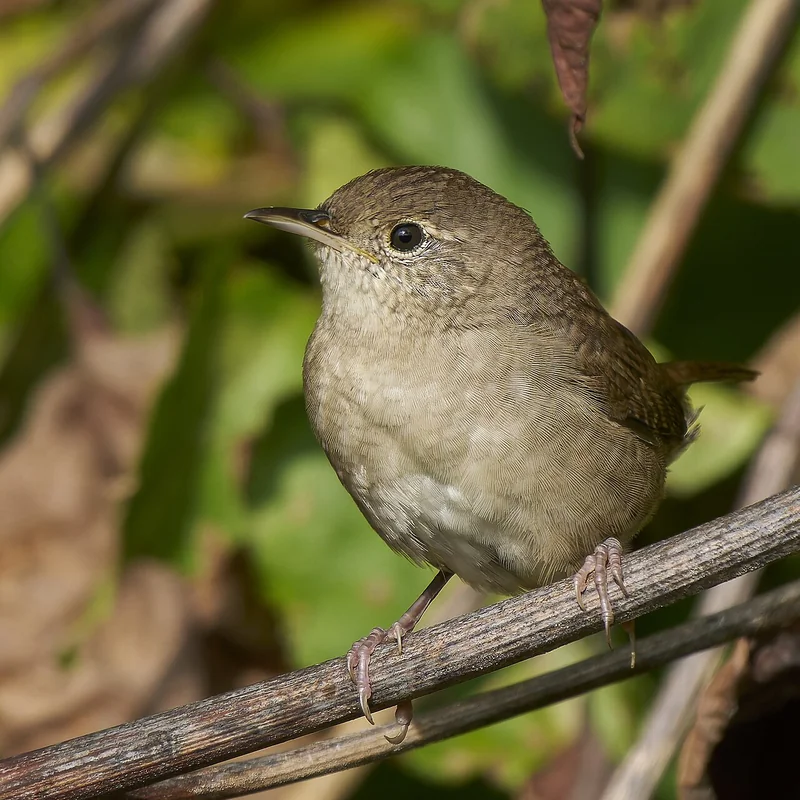 Featured photohouse-wren.jpg
Troglodytes aedon, the house wren, is a small Troglodytidae wren widely distributed across the Americas from Canada south to southern Argentina. Adults are 11 to 13 cm long with a wingspan of 15 cm and weigh 10 to 12 g. The plumage is uniformly drab brown with fine dark barring on the wings and tail and no strong field marks. The IUCN lists the species as Least Concern. Despite the plain appearance, house wrens are vocally loud and fiercely territorial — male wrens routinely destroy other species' eggs to free up nest cavities.
Quick facts
- Habitat
- Open woodland edges, brushy second growth, gardens, and parks. The species is a cavity-nester and adopts almost any small enclosed space, including human-made nest boxes and abandoned hardware.
- Range
- From southern Canada through the United States, Mexico, Central America, and most of South America to southern Argentina — one of the broadest geographic ranges of any New World songbird. Several southern populations were treated as separate species under earlier taxonomies and may again be split.
- Size
- 11–13 cm body · 15 cm wingspan · 10–12 g
- Plumage
- Both sexes are uniformly drab brown — slightly warmer above, paler buff-grey below — with fine darker barring on the wings, flanks, and tail. The supercilium is faint and pale; there is no bold facial pattern. The species' small size, cocked tail, and lack of strong field marks are the most reliable identification cues.
- Song
- A loud bubbling cascade of trills and whistles, accelerating then slowing, delivered from a perch with the head tilted back. The song is one of the most familiar summer voices in suburban backyards across the breeding range.
- Migration
- Northern populations are long-distance migrants wintering in the southern United States and Mexico. Tropical populations are largely resident.
- Conservation
- Least Concern (LC)
Overview
Troglodytes aedon is one of the most widely distributed New World songbirds, with a range from southern Canada to Tierra del Fuego. The genus name Troglodytes is Greek for 'cave dweller', a reference to the species' habit of nesting in any small cavity. The species' wide range and pronounced regional variation have led to taxonomic splits and lumps over the last century, with several southern populations sometimes treated as separate species.
Aggressive territory behaviour
House wrens are unusually aggressive nest-cavity competitors among small songbirds. Males routinely enter the nest cavities of conspecifics and other species (chickadees, titmice, prothonotary warblers) and destroy the eggs by piercing the shells, freeing the cavity for their own use. The behaviour is well-documented in eastern North America and is one reason the species displaces native cavity-nesters in some habitats.
Distribution
The breeding range covers North, Central, and most of South America. Northern populations migrate; tropical populations are resident. Insular and high-elevation populations have differentiated significantly, and several (including the cobb's wren of the Falklands and the Cozumel wren) are now treated as separate species. Further taxonomic splits within the South American complex have been proposed.
Sources & further reading (2)
- iucn-red-list — accessed 2026-04-29
- encyclopedia — accessed 2026-04-29
Frequently asked questions
Why do house wrens destroy other birds' eggs?
Male house wrens are intensely competitive for nest cavities and routinely destroy the eggs of conspecifics and other cavity-nesting species (chickadees, titmice, prothonotary warblers, bluebirds) within their territories. Eggs are pierced, sometimes carried out, freeing the cavity for the wren's own use. The behaviour is consistent with intra-cavity competition theory: cavity sites are limiting, and removing competitors' clutches improves the male's reproductive prospects.
Why is the genus called Troglodytes?
Troglodytes is from Greek troglodytes, 'cave-dweller' — a reference to the species' habit of nesting in small dark cavities. House wrens routinely use natural tree hollows, abandoned woodpecker holes, nest boxes, drainpipes, mailboxes, hanging plant baskets, and any other enclosed space they can squeeze into. Almost any small dark cavity in a wren's territory is a potential nest site.
Are northern and southern house wrens the same species?
Currently treated as one species (Troglodytes aedon) but the broad distribution from Canada to Argentina spans considerable plumage and vocal variation. Several insular populations (Cozumel wren, Cobb's wren) have been split as separate species in recent taxonomies, and further splits within the South American complex have been proposed but not universally adopted.