Larus argentatus
European Herring Gull (Larus argentatus)
 Featured photoherring-gull.jpg
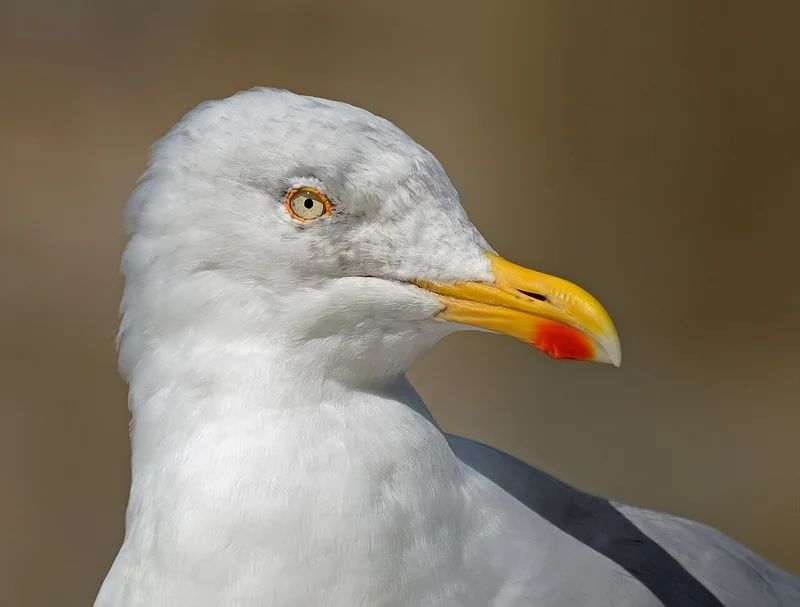
Larus argentatus, the European herring gull, is a large gull of the family Laridae, native to coasts and large inland waters of northern Europe. Adults are 54 to 65 cm long with a wingspan of 138 to 150 cm and weigh 690 to 1,440 g. The plumage shows a pale grey back and wings with black wingtips marked by white spots; the head and underparts are pure white. The IUCN lists the species as Least Concern globally despite documented declines in several northwestern European populations.
Quick facts
- Habitat
- Coastal cliffs, sandy and rocky beaches, harbours, fishing ports, and increasingly inland on rooftops, landfills, and farmland. The species adapted readily to human food sources and now nests in many city centres.
- Range
- Northern Europe — coasts of the British Isles, Iceland, Scandinavia, and the eastern Atlantic. The species' relationship to the herring gulls of North America (Larus smithsonianus) and other Holarctic 'herring gull complex' members has been the subject of decades of taxonomic re-evaluation.
- Size
- 54–65 cm body · 138–150 cm wingspan · 690–1440 g
- Plumage
- Adults show pale grey upperwings and back, white head and underparts, and black wingtips marked with conspicuous white spots ('mirrors'). The bill is yellow with a red spot near the tip; legs are pink. Juveniles are uniformly mottled brown and gain adult plumage gradually over four years through staged moults — the youngest birds are dark brown overall, second-year birds show some grey, and so on.
- Song
- A loud, descending laughing 'aaow-aaow-aaow' delivered both in flight and from a perch — the textbook 'seaside gull' call of European cultural memory. The call also includes long mournful 'mew' notes near the nest.
- Migration
- Partial migrant. Northern populations move south for winter; British and Irish populations are largely resident. Some inland-breeding populations (notably rooftop urban populations) are entirely sedentary year-round.
- Conservation
- Least Concern (LC)
Overview
Larus argentatus is the type species of the genus Larus and is one of the most familiar gulls of European coasts. The species was historically treated as a single circumpolar species spanning the Holarctic; modern taxonomies split that complex into multiple species, with the European herring gull (L. argentatus), American herring gull (L. smithsonianus), Caspian gull (L. cachinnans), and Yellow-legged gull (L. michahellis) all now recognized as separate species.
Population trends
Despite the global Least Concern listing, several long-monitored northwestern European populations have declined substantially over recent decades — notably in coastal Scotland, where breeding numbers fell by half between the 1970s and 2000s. Drivers proposed include reduced fisheries discards (large gulls subsidized by the historical fishing industry's discard policies), avian influenza outbreaks, and predation pressures. Inland and rooftop populations have meanwhile increased and now dominate national totals.
Behaviour
European herring gulls are highly opportunistic feeders and have adapted readily to human food sources. The species' habit of stealing food directly from human hands at seaside resorts has made it a common cultural antagonist in British and Irish coastal towns. Inland and rooftop populations have grown dramatically since the 1970s as the species exploited urban refuse and rooftop nesting sites; some city centres now host larger herring gull populations than nearby seabird colonies.
Sources & further reading (2)
- iucn-red-list — accessed 2026-04-29
- encyclopedia — accessed 2026-04-29
Frequently asked questions
Are European and American herring gulls the same species?
No, not in current taxonomy. The European herring gull (Larus argentatus) was historically lumped with the American herring gull (L. smithsonianus) and several other 'herring gull complex' members into a single circumpolar species. Modern molecular and behavioural evidence has split the complex; American herring gull is now treated as a separate species. Field guides published before about 2010 may still list them together.
Why do British coastal towns regard herring gulls as a problem?
Herring gulls have learned to steal food directly from human hands at British and Irish seaside resorts — a documented and deliberate behaviour with high success rates. Rooftop nesting populations also create noise, mess, and aggressive divebombing during the breeding season. The combination of food theft, inland expansion, and noise has made the species a common cultural antagonist in coastal media coverage, despite the broader population decline at sea.
How long does it take a herring gull to reach adult plumage?
Four years. Juveniles are uniformly mottled brown; over four years of staged moults they gain progressively more grey on the back, more white on the head and tail, more yellow in the bill, and more pink in the legs. The four-year sequence is one of the longest progressions to adult plumage among British and Irish breeding birds and underlies the gull's reputation for difficulty in identification — at any moment, several age classes of slightly-different-looking herring gulls can be found in a single coastal flock.