Numida meleagris
Helmeted Guineafowl (Numida meleagris)
 Featured photohelmeted-guineafowl.jpg
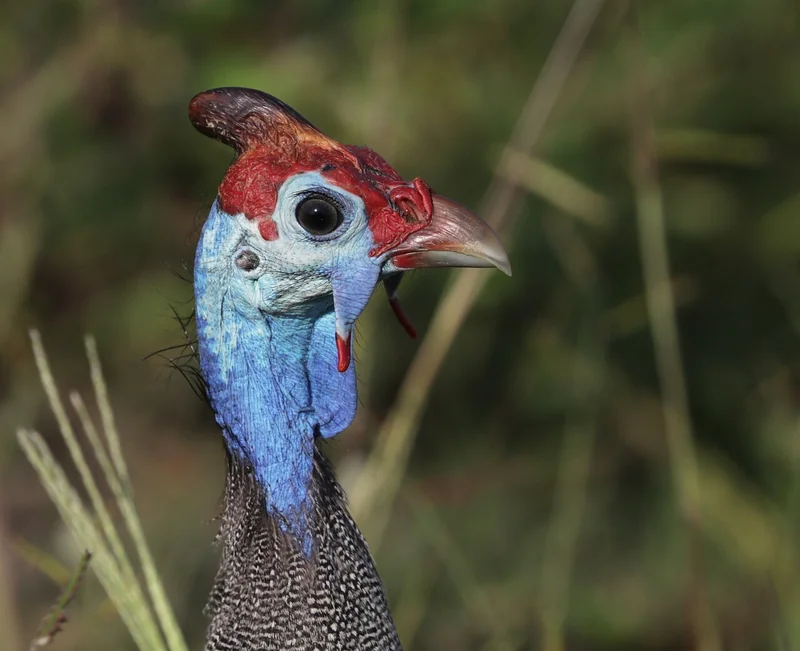
Numida meleagris, the helmeted guineafowl, is a large, ground-dwelling bird of the family Numididae, the most widespread and abundant guineafowl of sub-Saharan Africa. Adults are 53 to 58 cm long with a wingspan of 110 to 145 cm and weigh 1.1 to 1.8 kg. The species is immediately recognised by its grey-blue body densely spotted with white dots, a bare blue-and-red head, and a bony casque on the crown. The IUCN lists the species as Least Concern.
Quick facts
- Habitat
- Open savanna, grassland, dry woodland, thornbush, and agricultural land across sub-Saharan Africa. Highly adaptable — also found on farmland, around villages, and in cultivated areas. Requires open ground for foraging and dense vegetation or trees for roosting.
- Range
- Widespread in sub-Saharan Africa from Senegal and Ethiopia south to South Africa. Introduced and naturalised in Madagascar, the Canary Islands, the Caribbean, Hawaii, and parts of Europe and Australia.
- Size
- 53–58 cm body · 110–145 cm wingspan · 1100–1800 g
- Plumage
- Adults are dark grey overall with a fine, dense pattern of white spots covering the body — one of the most distinctive plumage patterns of any African bird. The head and neck are bare, with blue-grey facial skin, red wattles, and a rounded bony casque (helmet) on the crown that varies in shape and size between subspecies. The bill is short and stout.
- Song
- A loud, repetitive 'kek-kek-kek-kek' or 'buckwheat-buckwheat' call given by females when alarmed or separated from the flock; a lower 'churr-r-r' by males. Flocks produce a constant, far-carrying cackling chorus.
- Migration
- Sedentary. Flocks maintain large home ranges (up to 100 ha) but do not migrate. Local movements track seasonal food and water availability.
- Conservation
- Least Concern (LC)
Overview
Numida meleagris is the sole member of the genus Numida and the type species of the family Numididae, which contains six species all restricted to Africa and Madagascar. The species has been domesticated since antiquity — guineafowl were kept by the ancient Egyptians, Greeks, and Romans and have been domesticated worldwide for centuries. The domestic guineafowl is identical to the wild form; it has not diverged significantly from its wild ancestor in appearance, unlike most domestic poultry. The species name meleagris is the Greek word for guineafowl, derived from a myth involving the Meleagrides — sisters transformed into guineafowl.
Social behaviour and flock dynamics
Helmeted guineafowl are highly social, living in flocks of 10–200 individuals outside the breeding season. Flocks move in cohesive groups across open ground, with individuals in constant vocal contact. The distinctive cackling call accelerates sharply when a predator is detected — serving as an effective alarm system for the entire flock and for other species in the vicinity (antelope, zebra, and other birds respond to guineafowl alarm calls). The species often associates with large herbivores on the savanna, benefiting from insects disturbed by their movement and providing the herbivores with early predator warning.
Tick predation and biosecurity value
Helmeted guineafowl are prolific consumers of ticks — both African tick species and introduced ticks in areas where the bird has been released. A single guineafowl may consume hundreds of ticks per day. This has led to widespread use of guineafowl as a tick-control measure in livestock and game farming operations across southern Africa and in some agricultural systems in Europe and North America, where introduced populations were established specifically for tick management. The species is effective at reducing tick burdens in the areas it patrols regularly.
Sources & further reading (2)
- iucn-red-list — accessed 2026-05-07
- encyclopedia — accessed 2026-05-07
Frequently asked questions
What is the bony helmet (casque) on the head used for?
The bony casque on the helmeted guineafowl's crown is a keratinous or bony protuberance whose function is not fully understood. It may amplify the bird's loud calls, as the casque is internally hollow in some individuals. It also likely plays a role in intraspecific signalling — the size and shape of the casque varies between subspecies and individuals. The casque is not used as a weapon in confrontations.
Are guineafowl effective at controlling ticks?
Yes — helmeted guineafowl are highly effective tick predators. Individual birds consume hundreds of ticks daily in areas they regularly patrol. Studies on livestock farms in southern Africa and game reserves have shown significant reductions in tick burdens in areas grazed by guineafowl compared to control areas. The birds are used as a biological tick-control measure on game farms, poultry operations, and horse stud farms across the region.
How do guineafowl warn other animals of predators?
When a predator (lion, leopard, eagle, or human) is detected, helmeted guineafowl produce a rapid, escalating cackling alarm call that accelerates dramatically in urgency. This call is recognised and responded to by many savanna species — antelope, zebra, impala, and other birds raise their heads and move away in response to guineafowl alarm cackling. The species frequently forages with large herbivores, forming mutualistic associations where guineafowl provide early warning and herbivores disturb insects for the birds.