Coccothraustes coccothraustes
Hawfinch (Coccothraustes coccothraustes)
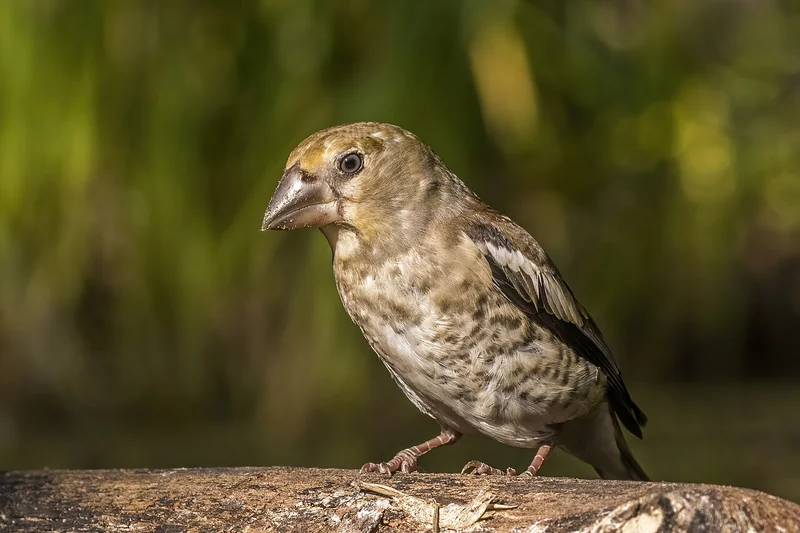 Featured photohawfinch.jpg
Coccothraustes coccothraustes, the hawfinch, is a large finch of the family Fringillidae, distributed across Europe, North Africa, and temperate Asia. Adults are 16.5 to 18 cm long with a wingspan of 29 to 33 cm and weigh 46 to 70 g. The plumage is warm orange-buff with grey neck, black face, and a massive triangular bill. The IUCN lists the species as Least Concern. The hawfinch's bill is the largest relative to body size of any European finch and can deliver a bite force of over 50 kg-force — enough to crack cherry pits and hardest fruit stones.
Quick facts
- Habitat
- Mature deciduous forest, especially with hornbeam, cherry, and elm. The species favours mature forest with abundant hard-shelled tree-fruit crops and is rarely found in young or pure conifer forest.
- Range
- Across most of Europe (excluding Iceland and far northern Scandinavia) and across temperate Asia to Japan. The species is largely sedentary across the western European range; eastern populations make short-distance autumn movements.
- Size
- 16.5–18 cm body · 29–33 cm wingspan · 46–70 g
- Plumage
- Adults show warm orange-buff body plumage, a soft grey collar, a black face mask around the bill and chin, glossy blue-black wings with bold white wing-patches, and a massive triangular pale bill that turns blue-grey in the breeding season. Both sexes are similar; males are slightly more saturated. The bill is so large that the bird's silhouette is dominated by it from any angle.
- Song
- A quiet, hard 'zik' or 'zik-zik' call delivered from a high perch. The species has no loud territorial song; the hard call notes are the species' distinctive vocalization. Hawfinches are notably quiet for their size.
- Migration
- Largely sedentary across the western European range. Eastern populations make short-distance autumn movements south or west. Some irruptive movements occur after seed-crop failures.
- Conservation
- Least Concern (LC)
Overview
Coccothraustes coccothraustes is the type species of the genus Coccothraustes (with two close relatives, the evening grosbeak C. vespertinus of North America and the hooded grosbeak C. abeillei of Mexico). The Latin tautonym 'coccothraustes coccothraustes' is from Greek 'kokkos' (kernel) plus 'thrauō' (to break) — the entire name means 'kernel-breaker', a reference to the species' specialization on hard-shelled fruit stones.
Bite force
The hawfinch's massive triangular bill is one of the most powerful relative to body size of any European bird. Field measurements have estimated the bite force at over 50 kg-force — enough to crack cherry pits, olive stones, and other hard fruit shells that no other European finch can open. The bill is supported by extensive jaw musculature that occupies a substantial portion of the head; the bird's broad-headed silhouette reflects the underlying jaw apparatus.
Behaviour
Hawfinches are notoriously shy and difficult to observe. The species spends most of its time in the high canopy of mature deciduous forest and rarely descends to ground level except briefly to drink. Most field observations are of birds glimpsed in flight or heard through the hard 'zik' call. The species' shyness has supported a folk reputation as one of the most elusive common European birds, despite its broad distribution.
Sources & further reading (2)
- iucn-red-list — accessed 2026-04-30
- encyclopedia — accessed 2026-04-30
Frequently asked questions
How strong is a hawfinch's bite?
Field measurements estimate the hawfinch's bite force at over 50 kg-force — among the most powerful per gram of body mass of any European bird. The massive triangular bill and supporting jaw musculature can crack cherry pits, olive stones, and hawthorn seeds that no other European finch can open. The species' nickname in some European languages translates roughly to 'cherry-stone cracker'.
Why is the species so shy?
Hawfinches spend most of their time in the high canopy of mature deciduous forest, descending to ground level only briefly to drink. The species is naturally cautious and rarely allows close approach. Most observations across Europe are of birds in flight or heard by the hard 'zik' call rather than fully observed at rest. The shyness has produced the species' reputation as one of the most elusive common European birds.
What does the Latin name mean?
The tautonymous binomial 'Coccothraustes coccothraustes' is from Greek 'kokkos' (kernel) plus 'thrauō' (to break) — the entire name means 'kernel-breaker'. The name directly references the species' specialization on hard-shelled tree-fruit stones (cherry pits, olive stones, hornbeam seeds). The same Greek root produced the English 'coccus' (a single bacterial cell, named for the kernel-like shape) and is the source of the family's older English nickname 'gros-beak'.