Anodorhynchus hyacinthinus
Hyacinth Macaw (Anodorhynchus hyacinthinus)
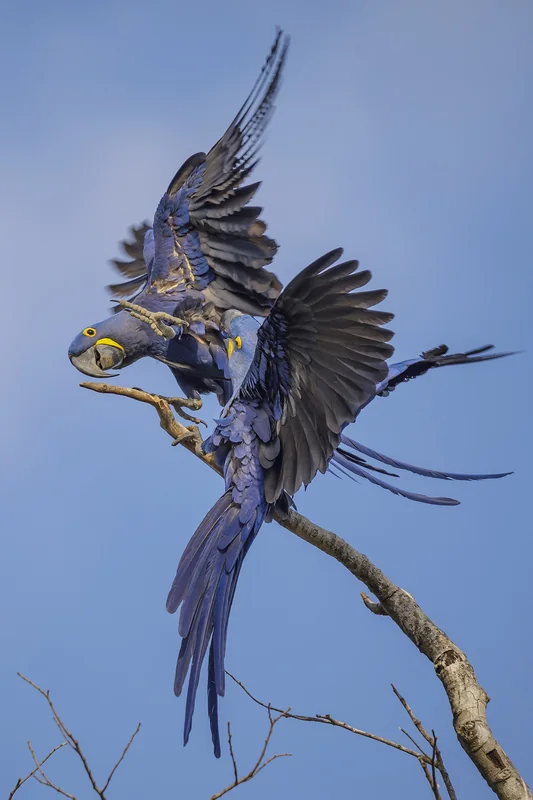 Featured photohyacinth-macaw.jpg
Anodorhynchus hyacinthinus, the hyacinth macaw, is the largest flying parrot in the world. Adults are about 1 m long with a wingspan of 1.2 to 1.5 m and weigh 1.2 to 1.7 kg. The plumage is uniformly deep cobalt-blue with a bright yellow ring of bare skin around the eye and a yellow mark at the base of the lower mandible. The IUCN lists the species as Vulnerable, reflecting major historical declines from habitat loss and the live-bird trade.
Quick facts
- Habitat
- Open palm-rich woodland and savanna with scattered tall trees, particularly in the Pantanal wetland of central Brazil. The species depends on a small number of palm species (acuri and bocaiúva palms) for nuts and on tall hollow trees for nesting cavities.
- Range
- Three discontinuous populations: the Pantanal wetland of central Brazil and adjacent Bolivia and Paraguay; the Cerrado region of eastern Brazil; and a small population in the southern Amazon Basin. The species' total range is small relative to most macaws.
- Size
- 95–105 cm body · 120–150 cm wingspan · 1.2–1.7 kg
- Plumage
- Adults are uniformly deep cobalt-blue throughout the body, wings, and tail; the underwing primaries are slightly darker. A bright yellow ring of bare skin surrounds the eye and a bold yellow mark sits at the base of the lower mandible. The bill is massive, hooked, and entirely black — the largest bill of any flying parrot relative to body size. Both sexes look alike.
- Song
- A loud, deep, harsh squawk delivered both in flight and from a perch. The voice is lower-pitched than the smaller Ara macaws, reflecting the species' larger body size and longer trachea.
- Migration
- Sedentary across the breeding range. Local seasonal movements track palm-nut crop ripening but no long-distance migration.
- Conservation
- Vulnerable (VU)
Overview
Anodorhynchus hyacinthinus is one of three Anodorhynchus macaws — the others (Lear's macaw A. leari and the extinct glaucous macaw A. glaucus) are also large blue species, suggesting a shared ancestral colour and diet specialization. The hyacinth macaw is the largest flying parrot in the world by body length; the much smaller flightless kakapo of New Zealand is heavier but cannot fly. The species is one of the most-traded macaws historically and remains heavily threatened.
Distribution and conservation
The species occurs in three discontinuous populations across central South America, with the Pantanal of central Brazil holding by far the largest. Population declines through the late twentieth century — driven by habitat loss to cattle ranching and intensive trapping for the live-bird trade — reduced numbers to an estimated 2,500 individuals in the wild by 1990. Concerted conservation programmes (artificial nest boxes, landowner cooperation, anti-poaching enforcement) have driven a partial recovery; current population is estimated at over 6,000 wild individuals. The species remains classified as Vulnerable.
Specialized diet
Hyacinth macaws are essentially obligate palm-nut specialists. The species feeds primarily on the nuts of two palm species in the Pantanal — the acuri and the bocaiúva — and the massive black bill is specialized for cracking the rock-hard shells. The bite force is among the highest documented for any bird. Pantanal hyacinth macaws routinely follow grazing cattle and extract palm nuts from manure where the ungulate's digestive system has already partly softened the shells, an unusual case of behavioural commensalism with introduced livestock.
Sources & further reading (2)
- iucn-red-list — accessed 2026-04-30
- encyclopedia — accessed 2026-04-30
Frequently asked questions
Is the hyacinth macaw really the largest parrot?
It is the largest flying parrot — about a metre in body length, considerably larger than the next-largest macaws. The flightless kakapo (Strigops habroptilus) of New Zealand is heavier (up to 4 kg) but is wholly flightless and ground-dwelling. Among parrots that fly, the hyacinth is the longest, and its wingspan of up to 1.5 m exceeds that of any other parrot.
Why did hyacinth macaw populations decline so sharply?
Twentieth-century declines were driven by two combined pressures: habitat loss across the Pantanal, Cerrado, and Amazon to cattle ranching and agriculture; and intensive trapping for the international live-bird trade. By 1990 the wild population had been reduced to an estimated 2,500 individuals. Concerted conservation programmes since — artificial nesting boxes, landowner partnerships, anti-poaching enforcement — have driven a partial recovery to over 6,000 wild birds, but the species remains Vulnerable.
Why do hyacinth macaws follow cattle?
Hyacinth macaws in the Pantanal routinely follow grazing cattle and extract palm nuts from manure where the cattle's digestive system has already partly softened the rock-hard nut shells. The behaviour is an unusual case of behavioural commensalism with introduced livestock — cattle are non-native to South America, but hyacinth macaws have learned to exploit the cattle-mediated softening of palm nuts as a feeding shortcut. The behaviour is documented in detail by Pantanal field biologists.