Histrionicus histrionicus
Harlequin Duck (Histrionicus histrionicus)
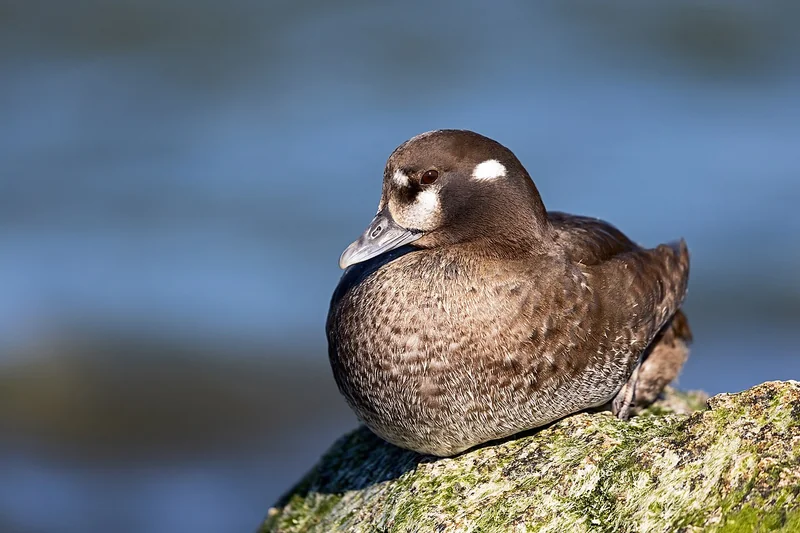 Featured photoharlequin-duck.jpg
Histrionicus histrionicus, the harlequin duck, is a compact sea duck of the family Anatidae, remarkable for breeding on fast-flowing mountain streams and wintering on exposed rocky coasts. Adult males are 38 to 45 cm long with a wingspan of 63 to 67 cm and weigh 500 to 680 g. The male's extravagant blue, chestnut, and white plumage pattern inspired the name 'harlequin' after the commedia dell'arte masked character. The IUCN lists the species as Least Concern.
Quick facts
- Habitat
- Breeds along fast-flowing, boulder-strewn mountain rivers and streams in boreal and subalpine forests. Winters on exposed, wave-washed rocky coasts and headlands, preferring high-energy surf zones with abundant invertebrates in the intertidal.
- Range
- Disjunct distribution: western North America (Alaska south to California mountains and Rocky Mountains), eastern Canada and Greenland, Iceland, and the Russian Far East including Kamchatka and Sakhalin. Winters on Pacific and Atlantic coasts.
- Size
- 38–45 cm body · 63–67 cm wingspan · 500–680 g
- Plumage
- Males in breeding plumage are slate-blue overall with bold white crescents, spots, and patches on the head, neck, back, and flanks, and chestnut flanks and crown stripes — one of the most extravagant patterns of any North American duck. Females are dark brown with three white facial patches. Eclipse males resemble females but retain traces of the white markings.
- Song
- A high, squeaky 'eek-eek' or 'ik-ik' call, often likened to a mouse squeak — unusual for a duck. Males call most frequently near the nest during the breeding season.
- Migration
- Partially migratory. Western North American populations move from mountain streams to the Pacific coast in late summer. Eastern populations winter on the Atlantic coast. Icelandic birds are largely sedentary.
- Conservation
- Least Concern (LC)
Overview
Histrionicus histrionicus is the sole member of its genus; the name references the Latin word for 'actor' (histrio), referring to the gaudy masked appearance of the male. The species has a disjunct Holarctic distribution — two North American populations (Pacific and Atlantic), an Icelandic population, and a Russian Far East population. The disjunct pattern reflects colonisation of suitable fast-river habitat across the Northern Hemisphere during and after the last glacial maximum.
White-water specialist
Harlequin ducks are uniquely adapted for foraging in fast-flowing mountain rivers — a habitat barely used by any other sea duck. The compact, streamlined body, powerful feet, and stiff tail (used as a rudder) allow the birds to swim and dive in turbulent boulder-strewn rapids. To feed on the riverbed, the duck uses its feet and wings to hold position against the current while probing under rocks for aquatic insect larvae. The species can even walk on submerged rocks against strong currents — an adaptation seen in few other waterfowl.
Rocky coast wintering
In winter, harlequin ducks move to exposed, wave-washed rocky coasts — one of the most energetically demanding environments for any seabird. The birds forage in the intertidal surf zone for mussels, barnacles, periwinkles, and other invertebrates attached to rocks. Their compact bodies and powerful dives allow them to navigate breaking waves that would be lethal to larger waterfowl. Injury rates from wave impacts are higher in harlequin ducks than other ducks, evidenced by the high frequency of healed fractures found in museum specimens.
Sources & further reading (2)
- iucn-red-list — accessed 2026-05-07
- encyclopedia — accessed 2026-05-07
Frequently asked questions
Why is it called the harlequin duck?
The name refers to the male's extravagant plumage — a jigsaw of slate-blue, white crescents and spots, and chestnut stripes on the head, neck, and flanks — which resembles the colourful costume of Harlequin, the masked servant character of commedia dell'arte. The scientific name Histrionicus also references this theatrical appearance, from the Latin 'histrio' meaning 'actor'.
How does the harlequin duck survive in fast rivers?
The compact, streamlined body, powerful feet, and stiff tail (used as a rudder) allow harlequin ducks to swim, dive, and forage against strong currents in boulder-strewn rapids. The birds can walk on submerged rocks against fast current while searching under stones for aquatic insect larvae — an ability shared with very few other waterfowl. Their feet are positioned further back on the body than most ducks, improving underwater propulsion.
Where do harlequin ducks nest?
Nests are placed on the ground or in rock cavities and tree hollows close to fast-flowing mountain rivers and streams. The female alone incubates the 5–7 eggs for 27–29 days and raises the ducklings near the river. Males depart to coastal moulting areas before the eggs hatch. The young begin diving in fast water within a few days of hatching.