Chloroceryle americana
Green Kingfisher (Chloroceryle americana)
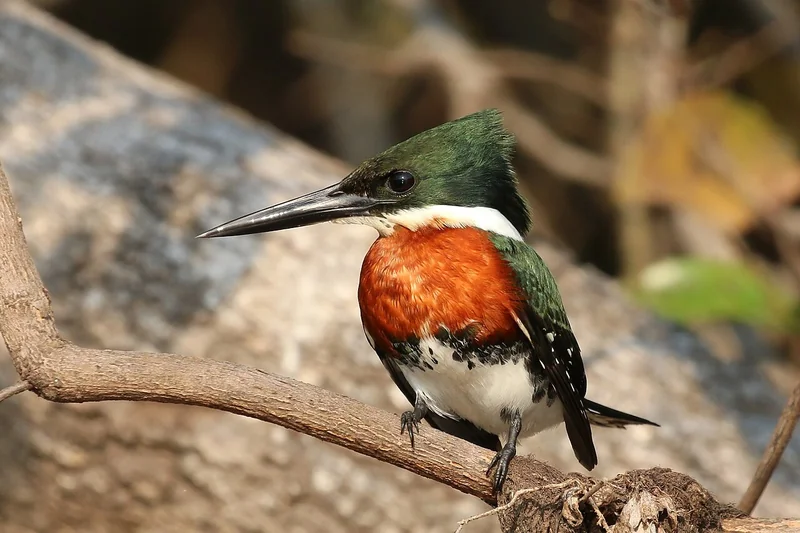 Featured photogreen-kingfisher.jpg
Chloroceryle americana, the green kingfisher, is a small kingfisher of the family Alcedinidae, distributed across the Americas from southern Texas to Argentina. Adults are 19 to 23 cm long with a wingspan of about 28 cm and weigh 25 to 50 g. The plumage is dark glossy green above with white underparts; males show a chestnut breast band, females have one or two darker green breast bands. The IUCN lists the species as Least Concern. The species is one of the smallest American kingfishers and one of the most habitat-faithful — restricted to clear-water streams and small rivers.
Quick facts
- Habitat
- Clear-water streams, small rivers, and freshwater pond edges across the Americas. The species depends on clear water for visibility of fish prey and on overhanging vegetation for perches.
- Range
- Americas from southern Texas south through Mexico, Central America, and most of South America to northern Argentina. The species' range is one of the largest of any New World kingfisher, but local distribution is patchy and tied to clear-water habitat.
- Size
- 19–23 cm body · 28 cm wingspan · 25–50 g
- Plumage
- Adults show dark glossy bottle-green upperparts (head, back, wings, tail) and clean white underparts. Adult males additionally show a broad chestnut breast band; adult females show one or two darker green breast bands instead of chestnut — a clear sex difference visible in the field. Both sexes have a long dagger-like dark bill and a small white spot in front of the eye.
- Song
- A sharp, dry 'tic-tic' or rattling 'tikit-tikit' delivered both in flight and from a perch. The species is much quieter than the larger belted kingfisher of the same family and is often overlooked even where present.
- Migration
- Largely sedentary across the breeding range. Some local seasonal movements within the range occur but no regular migration.
- Conservation
- Least Concern (LC)
Overview
Chloroceryle americana is one of about four Chloroceryle small kingfisher species across the Americas. The species is the smallest American kingfisher and is closely related to the larger Amazon kingfisher (C. amazona) and the green-and-rufous kingfisher (C. inda). The genus Chloroceryle is unique to the Americas and represents an early-branching lineage within the worldwide Alcedinidae family.
Distribution
The breeding range covers the Americas from southern Texas south to northern Argentina. The species' habitat preference for clear-water streams and small rivers makes the local distribution patchy — the bird is absent from cloudy, polluted, or sluggish waters that lack visibility for fish prey. The species is therefore a useful indicator of stream water quality across much of its range.
Sex differences
Green kingfishers show one of the clearest sex-plumage differences in the family Alcedinidae. Adult males have a broad chestnut breast band; adult females have one or two darker green breast bands instead. The difference is visible in the field at moderate distance and is the most reliable way to sex the species. The pattern is shared with several other Chloroceryle species — males chestnut-breasted, females green-banded — and contrasts with the related belted kingfisher in which the female is the more colourful sex.
Sources & further reading (2)
- iucn-red-list — accessed 2026-04-30
- encyclopedia — accessed 2026-04-30
Frequently asked questions
How big is a green kingfisher?
Green kingfishers are the smallest of the New World kingfishers — 19-23 cm long and 25-50 g. The species is roughly half the size of the closely related Amazon kingfisher and substantially smaller than the belted kingfisher of North America. The small size and quiet voice mean the species is often overlooked even where it is locally common.
Where can I find green kingfishers in North America?
The species' North American range is restricted to southern Texas, particularly the lower Rio Grande Valley and the Edwards Plateau streams. The species occurs locally on clear-water streams with overhanging vegetation and is rarely found at urban or polluted sites. The species is essentially absent from the rest of the United States; the bulk of the global range lies in Mexico, Central America, and South America.
How do male and female green kingfishers differ?
Males show a broad chestnut breast band; females show one or two darker green breast bands instead of chestnut. Both sexes share the same dark green upperparts and white underparts. The breast-band colour is the most reliable way to sex the species in the field. The pattern is shared with several other Chloroceryle species and is one of the clearest sex-plumage dimorphisms in the family Alcedinidae.