Butorides virescens
Green Heron (Butorides virescens)
 Featured photogreen-heron.jpg
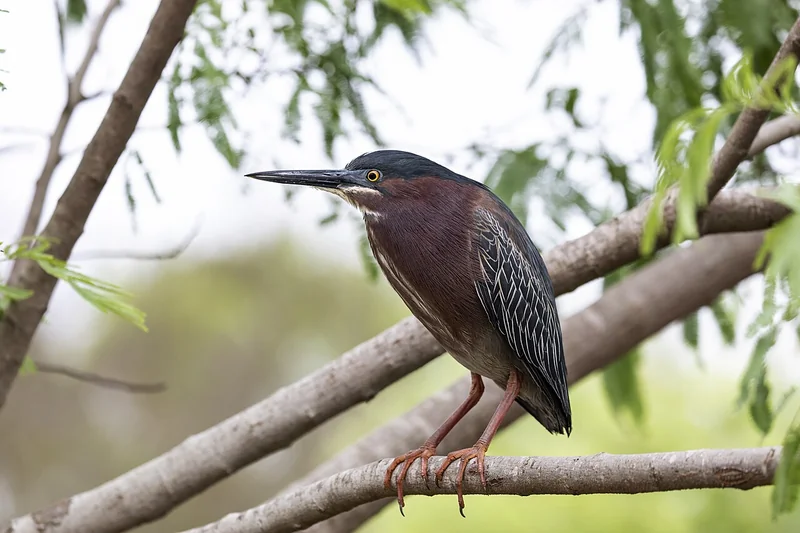
Butorides virescens, the green heron, is a small heron of the family Ardeidae, distributed across most of North America and the Caribbean. Adults are 41 to 46 cm long with a wingspan of 64 to 68 cm and weigh 170 to 245 g. The plumage is dark green-blue above with chestnut neck and white-streaked underparts. The IUCN lists the species as Least Concern. Green herons are one of the few documented tool-using birds — the species drops bread crumbs, insects, or twigs onto water as bait to lure fish within striking distance.
Quick facts
- Habitat
- Freshwater and brackish wetlands — small ponds, marsh edges, slow streams, and mangrove swamps. The species favours small water bodies with abundant cover for foraging.
- Range
- Most of North America from southern Canada south through the United States, Mexico, Central America, and the Caribbean. Winters in the southern United States south through Central America and the Caribbean.
- Size
- 41–46 cm body · 64–68 cm wingspan · 170–245 g
- Plumage
- Adults show dark glossy blue-green upperparts and crown (the colour appears black in poor light), chestnut-rust neck and breast, white-streaked throat, and white-flecked underparts. The legs are bright orange-yellow during the breeding season, duller yellow outside. Both sexes look alike. Juveniles are duller brown overall with heavier streaking.
- Song
- A sharp, explosive 'kyowk' or 'skeow' alarm call delivered when flushed from a perch — one of the most familiar wetland-edge sounds across North America. The species is otherwise mostly silent.
- Migration
- Partial migrant. Northern populations move south for winter; central and southern populations are largely resident. Some long-distance autumn movements occur within the broader range.
- Conservation
- Least Concern (LC)
Overview
Butorides virescens is one of three Butorides heron species worldwide (with the closely related striated heron B. striata of much of the Old World tropics and the Galápagos heron B. sundevalli — the latter often lumped with B. striata). The species is one of the smallest North American herons and is a familiar bird across most of forested freshwater wetland habitats in the eastern half of the continent.
Tool use
Green herons are one of the few documented tool-using birds. Field studies have observed individual birds dropping bread crumbs, insect bodies, twigs, or other small objects onto water as bait — small fish approach to investigate the floating object, and the heron strikes them with the bill. The behaviour is documented across multiple populations and is one of the textbook examples of avian tool use, alongside the New Caledonian crow and several corvid species. The bait-fishing technique is learned and improves with experience; younger birds are less effective bait-fishers than adults.
Distribution
The breeding range covers most of North America east of the Rocky Mountains, plus Pacific coast populations from Washington south to Mexico. The species winters across the southeastern United States, Mexico, Central America, and the Caribbean. Population trends are stable to slightly declining; some local populations have decreased with wetland loss but the broader range remains intact.
Sources & further reading (2)
- iucn-red-list — accessed 2026-04-30
- encyclopedia — accessed 2026-04-30
Frequently asked questions
Do green herons really use tools?
Yes — green herons are one of the few documented tool-using birds. Field studies have observed individual birds dropping bread crumbs, insect bodies, twigs, or other small objects onto water as bait; small fish approach to investigate the floating object, and the heron strikes them with the bill. The behaviour is documented across multiple populations. Younger birds are less effective bait-fishers than adults — the technique is learned, not purely instinctive.
How is green heron different from American bittern?
Both are small dark herons of North American wetlands. Green heron is darker overall (dark blue-green back, chestnut neck), shorter-necked, and behaves more actively (perches in trees, flies frequently). American bittern is lighter brown with bold streaking, longer-necked, and skulks in dense reedbeds with cryptic 'pointing' postures rarely emerging into view. Voice differs — green heron gives sharp 'kyowk', bittern gives the famous 'thunder-pump' booming call.
Why are green herons sometimes called 'shitepokes'?
The folk name 'shitepoke' (or 'shypoke') is an old American English colloquialism for the green heron, derived from the species' habit of defecating during alarm flight after being flushed from a perch. The folk name is somewhat coarse and rarely used in modern bird-watching but remains in regional American vernacular. Several other small herons (American bittern, least bittern) have collected similar folk names from the same defaecation-on-flush behaviour.