Anser albifrons
Greater White-fronted Goose (Anser albifrons)
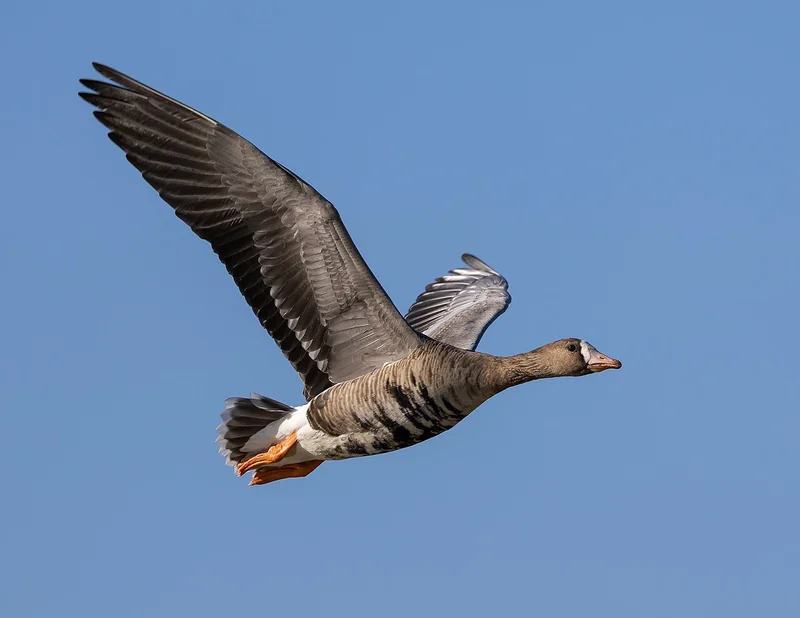 Featured photogreater-white-fronted-goose.jpg
Anser albifrons, the greater white-fronted goose, is a medium-large goose of the family Anatidae, breeding across Holarctic Arctic and subarctic tundra. Adults are 66 to 86 cm long with a wingspan of 130 to 165 cm and weigh 1.7 to 3.3 kg. The species is immediately recognised by its white forehead blaze, orange-pink bill, and black-barred belly in adults. The IUCN lists the species as Least Concern.
Quick facts
- Habitat
- Breeds on open Arctic and subarctic tundra near water, including coastal lowland tundra, river deltas, and lake shores. Winters on agricultural fields, river floodplains, estuaries, and coastal grasslands across temperate regions.
- Range
- Breeds across the circumpolar Arctic from western Alaska through Canada, Greenland, Iceland, Scandinavia, and Russia to Siberia. Winters in western Europe, the Gulf Coast of North America, Mexico, the Caspian Sea region, South and East Asia.
- Size
- 66–86 cm body · 130–165 cm wingspan · 1700–3300 g
- Plumage
- Adults show grey-brown body plumage, a bright white forehead patch extending to the base of the orange-pink bill, and a belly variably barred with irregular black patches — the source of the North American hunting name 'specklebelly'. First-year birds lack the white forehead and black belly barring and are identified by the dull yellow-orange bill and feet. Sexes are similar.
- Song
- A high-pitched, laughing 'kow-lyow' or 'kay-luk' cackle — faster and more laughing in quality than the deeper notes of greylag or bean geese. Flocks are highly vocal in flight.
- Migration
- Long-distance migrant. Arctic breeding populations fly to temperate wintering areas in autumn and return in spring. Western Palearctic populations winter in western Europe; Siberian populations in China and Japan; North American populations on the Gulf Coast and in Mexico.
- Conservation
- Least Concern (LC)
Overview
Anser albifrons is one of the grey goose species in the genus Anser, forming a species group with the lesser white-fronted goose (A. erythropus) — a smaller species with a yellow eye-ring. Several subspecies of the greater white-fronted goose are recognised, differing in size, breeding range, and bill colour: the nominate albifrons of Eurasia, the larger frontalis of Alaska and western Canada, and the critically endangered flavirostris (Greenland white-fronted goose), which winters in Ireland and Scotland and has declined sharply.
Arctic breeding ecology
Greater white-fronted geese arrive on Arctic tundra breeding grounds in late May or June, shortly after snow melt. Nest is a down-lined scrape on open tundra or dry hummocks close to water. Both sexes incubate the 3–6 eggs for 22–27 days. Goslings are precocial, walking and swimming within hours, and are guarded by both parents until fledging at 38–45 days. Arctic Fox predation is a major nest failure cause; in high-fox years, breeding success can fall to near zero in some areas.
Greenland subspecies and conservation concern
The Greenland white-fronted goose (A. a. flavirostris) is the most endangered subspecies, wintering almost entirely in Ireland and western Scotland and breeding in western Greenland. The population declined from ~35,000 in the 1990s to approximately 22,000 in recent years and is classified Near Threatened. Threats include changes in agricultural land management on wintering grounds and hunting pressure. The subspecies is the subject of targeted monitoring programmes in both Ireland and Greenland.
Sources & further reading (2)
- iucn-red-list — accessed 2026-05-07
- encyclopedia — accessed 2026-05-07
Frequently asked questions
What is the white forehead used for?
The white forehead blaze and orange-pink bill are the primary adult recognition marks of the species, distinguishing it from all other grey geese except the smaller lesser white-fronted goose. First-year birds lack both features, making age recognition straightforward in the field. The white forehead is fully developed by the first winter moult in most birds.
Why is it called 'specklebelly'?
The North American hunting name 'specklebelly' refers to the black barring and patches on the belly that are distinctive in adults. First-year birds lack these black belly markings and are sometimes called 'squeakers' in hunting contexts. The barring is individually variable — some adults have extensive black patches, others relatively few.
How many subspecies are there and which is the most threatened?
Several subspecies are recognised depending on the taxonomic authority. The most threatened is the Greenland white-fronted goose (A. a. flavirostris), which winters in Ireland and Scotland and has declined from approximately 35,000 in the 1990s to around 22,000 today. The causes include changes in agricultural land management on wintering grounds and, historically, hunting pressure. The subspecies is monitored with annual counts in Ireland and Scotland.