Geococcyx californianus
Greater Roadrunner (Geococcyx californianus)
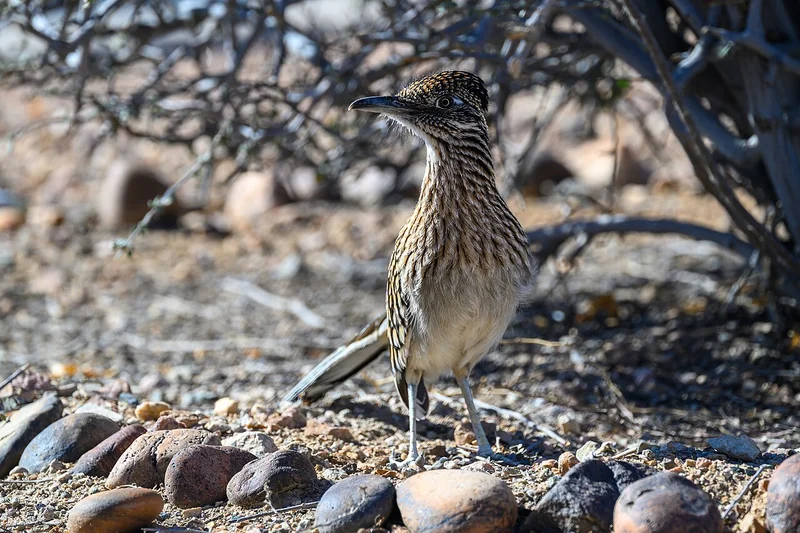 Featured photogreater-roadrunner.jpg
Geococcyx californianus, the greater roadrunner, is a large terrestrial cuckoo of the family Cuculidae, distributed across the southwestern United States and Mexico. Adults are 52 to 62 cm long with a wingspan of 43 to 61 cm and weigh 220 to 540 g. The plumage is mottled brown-and-buff with a long tail and a shaggy crest. The IUCN lists the species as Least Concern. Greater roadrunners run on the ground at sustained speeds up to 32 km/h to pursue lizard, snake, and insect prey, and rarely fly except for short escape distances.
Quick facts
- Habitat
- Arid and semi-arid open country — desert, scrub, grassland, chaparral, and edges of agricultural land. The species favours open ground with scattered low cover and is rarely found in dense forest.
- Range
- Southwestern United States from California east to Louisiana and south through Mexico to central Mexico. The species' range has expanded slightly north and east over recent decades, possibly tracking warming.
- Size
- 52–62 cm body · 43–61 cm wingspan · 220–540 g
- Plumage
- Adults show heavily mottled brown-and-buff upperparts, paler buff-and-white underparts with dark streaking, a long tail with white outer feather tips, a shaggy crest of dark brown feathers, and bare blue-and-orange skin behind each eye. The bill is long, stout, and slightly downcurved. Both sexes look alike. Juveniles are similar but with a paler eye-skin and shorter crest.
- Song
- Adults give a low, descending, mournful 'coo-coo-coo-coo-coo' from a perch — the source of the cartoon 'beep-beep' is the call of an entirely different fictional bird; the actual roadrunner is far more cuckoo-like in voice. The species also gives a clattering bill-rattle by clapping the mandibles together.
- Migration
- Resident year-round throughout the range; no regular migration. Some local seasonal movements within the range occur but are short-distance.
- Conservation
- Least Concern (LC)
Overview
Geococcyx californianus is one of two roadrunner species (with the smaller lesser roadrunner G. velox of southern Mexico). The species is the textbook ground cuckoo — most cuckoos are arboreal, but the genus Geococcyx is fully terrestrial. The greater roadrunner has been an icon of the American Southwest for over a century, and the cartoon 'Road Runner' character (with the famous 'beep-beep' call) is loosely based on the species — though the cartoon's flight speed and call bear no resemblance to the actual bird.
Distribution and behaviour
The species occupies arid open country across the American Southwest from California east to Louisiana and south through Mexico. Roadrunners hunt by running rapidly across open ground in pursuit of lizards, snakes, insects, and small rodents. The bird's pace can reach 32 km/h sustained on level ground. Flight is rare and typically only used to escape predators or to clear obstacles; the species' wings are small relative to body size, optimized for short bursts rather than sustained flight.
Predator of rattlesnakes
Greater roadrunners are among the few bird species that routinely take adult rattlesnakes as prey. The roadrunner's quickness, sharp bill, and ability to manipulate the snake at arm's length combine to enable the take. The bird seizes the snake behind the head, slams it repeatedly against the ground or rocks to subdue it, and swallows it whole — sometimes with the long body protruding from the mouth for hours while digestion proceeds. The behaviour is well-documented and contributes to the species' folk reputation in the Southwest.
Sources & further reading (2)
- iucn-red-list — accessed 2026-04-30
- encyclopedia — accessed 2026-04-30
Frequently asked questions
Can a roadrunner really catch a rattlesnake?
Yes — greater roadrunners are among the few bird species that routinely take adult rattlesnakes as prey. The roadrunner's quickness allows it to seize the snake behind the head before the snake can strike, then slam the snake against the ground or rocks to subdue it. The bird then swallows the snake whole — sometimes with the long body protruding from the mouth for hours while digestion proceeds. The behaviour is well-documented in field studies.
How fast can a roadrunner run?
Sustained running speeds reach about 32 km/h on level ground — fast enough to outpace the human walking speed and to overtake most ground-dwelling lizards. The Looney Tunes cartoon character Road Runner is shown running at jet-engine speeds with a 'beep-beep' call, which has nothing to do with the actual species. The real roadrunner's pace and voice are far more typical of a large ground-bird.
Why is it called a 'roadrunner'?
The English name comes from the species' habit of running along dirt roads — particularly in the early days of automobile travel through the American Southwest, when roadrunners would sprint ahead of slow-moving vehicles for short distances before darting off into the brush. The behaviour is still seen on quiet rural roads in the Southwest. The name has been in English use since the early twentieth century.