Phoenicopterus roseus
Greater Flamingo (Phoenicopterus roseus)
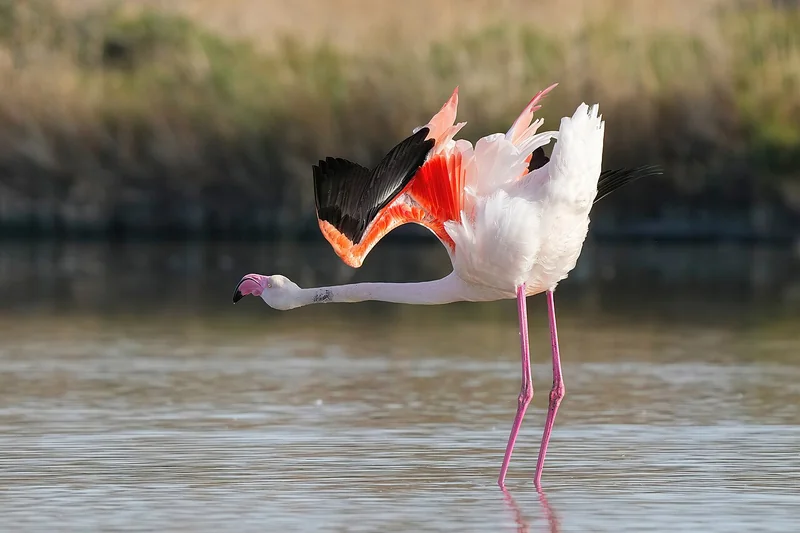 Featured photogreater-flamingo.jpg
Phoenicopterus roseus, the greater flamingo, is the largest of the six flamingo species worldwide. Adults are 1.1 to 1.5 m tall with a wingspan of 1.4 to 1.7 m and weigh 2 to 4 kg. The plumage is pale pink-white throughout the body with vivid pink-and-black wings visible in flight and during display. The IUCN lists the species as Least Concern. The species is the most widely distributed flamingo on Earth, with breeding populations across Africa, southern Europe, the Middle East, central Asia, and the Indian subcontinent.
Quick facts
- Habitat
- Coastal lagoons, hypersaline lakes, salt flats, and inland alkaline lakes. The species favours large open shallow water with abundant brine shrimp and other small crustaceans, and breeds in dense colonies on isolated mudflats.
- Range
- Africa (most of sub-Saharan and northern Africa), southern Europe (Spain, France, Italy, Greece, Turkey), the Middle East, central Asia, and the Indian subcontinent. The species' breeding range covers the entire eastern hemisphere and is by far the largest of any flamingo.
- Size
- 110–150 cm body · 140–170 cm wingspan · 2–4 kg
- Plumage
- Adults are pale pink-white throughout the body and head, with brilliant pink wing coverts and black flight feathers — the wing pattern is far more vivid than the body and is most visible in flight or during synchronized colony displays. The bill is bent downward with a pale base and a black tip; the legs are long and pink. Juveniles are dull grey-white and acquire adult plumage over two to three years.
- Song
- A loud, goose-like honking 'krak-kraak' delivered in flight and from breeding colonies. Synchronized colony displays involve choruses of hundreds to thousands of birds calling in unison.
- Migration
- Partial migrant. Northern populations make short- to medium-distance autumn movements south for winter; tropical populations are largely resident. African populations move regionally between breeding lakes and post-breeding feeding sites.
- Conservation
- Least Concern (LC)
Overview
Phoenicopterus roseus is one of six flamingo species worldwide and is the largest. The species was historically lumped with the American flamingo (P. ruber) as a single circumpolar species; molecular evidence and breeding-plumage colour differences led to the split in the early 2000s. The greater flamingo is paler than the American — the body plumage is closer to white-pink than to vivid pink — but shows brilliant pink-and-black wings during display.
Distribution
The breeding range covers the entire eastern hemisphere — most of Africa (excluding the equatorial rainforest belt), southern Europe (Camargue in France, Doñana in Spain, the Italian Po delta, several Greek and Turkish wetlands), the Middle East, central Asia, and the Indian subcontinent. The Camargue and Doñana populations are among the best-studied flamingo populations in the world; long-running ringing programmes have followed individuals across multi-decade lifespans.
Colony breeding
Greater flamingos breed in dense colonies of thousands to tens of thousands of pairs on isolated mudflats and salt-flat islands. Each pair builds a tall mud-cone nest about thirty centimetres high with a shallow depression at the top, into which a single egg is laid. Both parents incubate, and both parents produce 'crop milk' (a protein-and-lipid-rich secretion from the crop lining) to feed the chick for the first weeks. The crop-milk feeding is shared with pigeons and male emperor penguins as a convergent solution to chick provisioning.
Sources & further reading (2)
- iucn-red-list — accessed 2026-04-30
- encyclopedia — accessed 2026-04-30
Frequently asked questions
Why do flamingos build mud-cone nests?
The tall mud-cone nest — about thirty centimetres high — keeps the egg above the water level when shallow lagoon levels rise unpredictably from rain or tidal changes. The cone shape also reduces predator access compared with a ground nest. Both parents construct the nest cooperatively over several days using bill-loads of mud carried from nearby shallow areas.
How do flamingos feed their chicks?
Both parent flamingos produce 'crop milk' — a protein-and-lipid-rich secretion from the crop lining — and feed it to the chick for the first weeks after hatching. The crop milk is bright red from the carotenoid pigments the parents have accumulated, and the chick is briefly pale pink before its own diet supplies the colour. Crop milk is also produced by pigeons and male emperor penguins and is one of the textbook examples of convergent evolution of chick provisioning across distantly related birds.
Why do flamingos stand on one leg?
The behaviour is well-documented but not fully understood. Two main hypotheses are proposed: the leg-tucked posture reduces heat loss to the cold water by half (since most of the leg surface is exposed to air rather than water) and the resting posture is energetically efficient because the standing leg's tendons lock automatically, eliminating muscular effort. Both factors may apply. Captive flamingos in warm holding pens still stand on one leg, suggesting the energetic explanation is at least part of the answer.