Bubo virginianus
Great Horned Owl (Bubo virginianus)
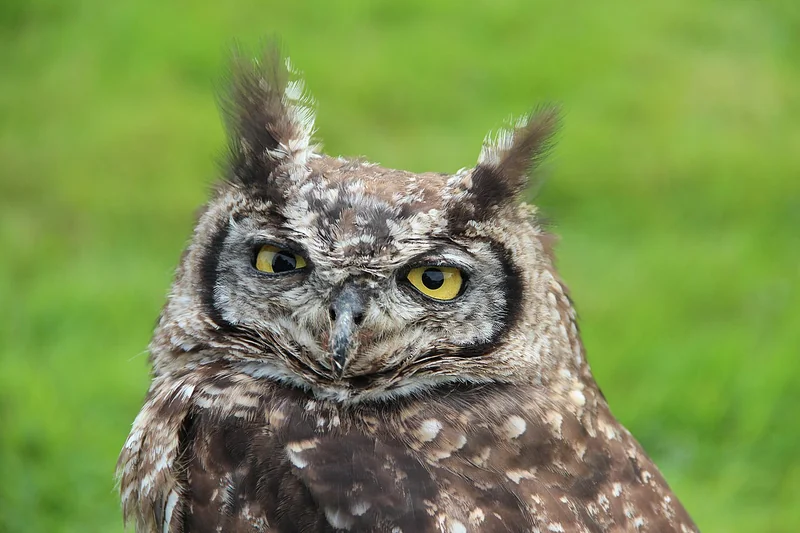 Featured photogreat-horned-owl.jpg
Bubo virginianus, the great horned owl, is one of the largest and most widely distributed owls in the Americas. Adults are 46 to 64 cm long with a wingspan of 91 to 153 cm and weigh 0.7 to 2.5 kg. The plumage is mottled brown-and-buff overall with prominent ear-tufts ('horns'), bright yellow eyes, and a white chin patch. The IUCN lists the species as Least Concern. Great horned owls are among the most powerful nocturnal predators in the Americas and routinely take prey larger than themselves.
Quick facts
- Habitat
- Almost any habitat from arctic tundra to tropical lowlands with at least some tree cover for daytime roosts. Forests, woodlands, deserts, swamps, agricultural areas, and city parks all support populations.
- Range
- Most of the Americas from arctic Canada south through the United States, Mexico, Central America, and most of South America to Tierra del Fuego. The species shows substantial regional plumage and size variation across many recognized subspecies.
- Size
- 46–64 cm body · 91–153 cm wingspan · 0.7–2.5 kg
- Plumage
- Both sexes show mottled brown-and-buff plumage with darker flecking and barring, prominent ear-tufts (the 'horns' of the English name) — actually elongated head feathers unrelated to ears — bright yellow eyes, and a sharp white chin patch. Geographic variation is considerable; arctic populations are pale and heavily white-mottled, desert populations are pale buff, southeastern US populations are darker and more rufous.
- Song
- A deep, rhythmic five-note 'hoo-hoo-HOOO-hoo-hoo' delivered from a high perch — among the most familiar nocturnal voices across the Americas. Pairs sometimes duet with male and female alternating phrases.
- Migration
- Sedentary across nearly all of the range. Northern populations may make short-distance autumn movements when prey collapses, but no regular long-distance migration.
- Conservation
- Least Concern (LC)
Overview
Bubo virginianus is one of about a dozen Bubo eagle-owls worldwide — the largest owls outside the genus Strix. The species' Latin name virginianus reflects the type specimen having been collected in Virginia in the eighteenth century. Great horned owls are among the most powerful nocturnal predators in the Americas; among reported prey are full-grown skunks, woodchucks, geese, and other large owls. The species is the namesake hooter of countless American backyard nights.
Distribution
The breeding range covers nearly the entire western hemisphere from arctic Canada to Tierra del Fuego. Few other large birds match the latitudinal span of this species. Multiple recognized subspecies show local adaptation in plumage tone (paler in arctic and desert populations, darker in northeastern forest populations) and in size (largest in northern populations, smaller in tropical populations) — the textbook Bergmann's rule pattern.
Behaviour
Great horned owls are early breeders — pairs lay eggs in January or February across most of North America, weeks before any other northern raptor. The species takes over the abandoned nests of large hawks, ravens, and herons rather than building its own. Established pairs hold the same territory year-round and pair for life. The deep five-note hoot is delivered both by males (lower-pitched) and females (higher), and pairs sometimes duet across the boundary of their territory.
Sources & further reading (2)
- iucn-red-list — accessed 2026-04-29
- encyclopedia — accessed 2026-04-29
Frequently asked questions
Do owl 'horns' have anything to do with hearing?
No. The 'horns' (ear-tufts) of horned and eagle owls are elongated feathers on top of the head, anatomically unrelated to ears or hearing. The actual external ear openings are on the sides of the head, hidden behind the facial disc. The function of the horns is debated; proposed roles include camouflage (breaking the bird's silhouette against branches) and intra-species signalling. Some closely related Bubo species lack horns entirely.
Why do great horned owls breed so early?
Across most of North America, great horned owls lay eggs in January or February — weeks or months before any other northern raptor. The early start lets the long brood-rearing period (about three months) coincide with peak prey availability in late spring and summer. The owl takes over the abandoned previous-year nests of large hawks, ravens, or herons rather than building its own, which avoids the energetic cost of late-winter nest construction.
Can great horned owls really take prey larger than themselves?
Yes. Documented prey includes full-grown skunks, woodchucks, opossums, herons, geese, and other large owls. The owl strikes from a perch in silent flight (specialized leading-edge feather serrations on the primaries muffle the sound) and uses powerful talons to immobilize prey. Adult body weight up to 2.5 kg sets the species near the upper end of the size range that can be carried in flight, but ground-killed prey can exceed this and is often eaten in place.