Strix nebulosa
Great Grey Owl (Strix nebulosa)
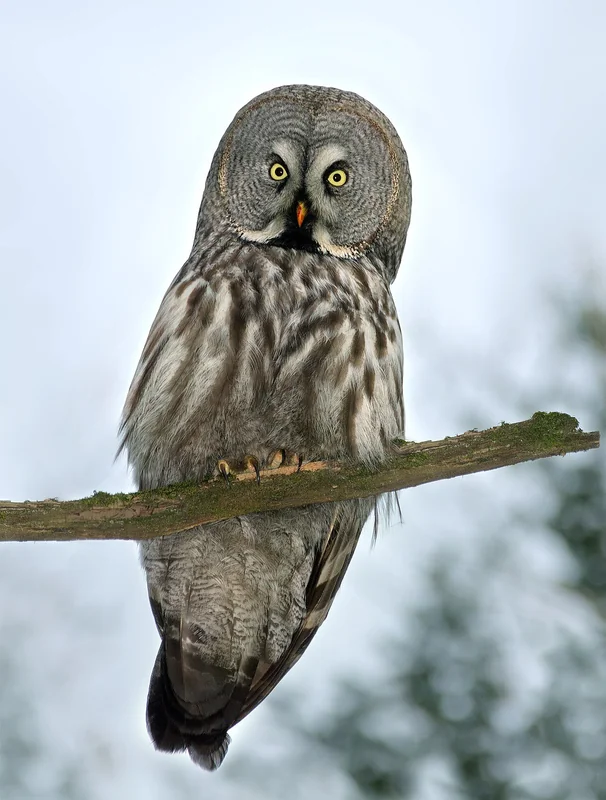 Featured photogreat-grey-owl.jpg
Strix nebulosa, the great grey owl, is one of the largest owls in the world by length and wingspan. Adults are 60 to 84 cm long with a wingspan of 1.42 to 1.52 m and weigh 0.6 to 1.9 kg — surprisingly modest mass for the apparent size. The plumage is uniformly grey-brown with bold dark facial discs and yellow eyes. The IUCN lists the species as Least Concern. The species is one of the most-photographed owls in North American natural-history media but is also one of the least-frequently encountered in the wild.
Quick facts
- Habitat
- Mature boreal coniferous forest with adjacent open meadows or bogs. The species hunts over open ground from forest-edge perches and is rarely found far from intact mature forest.
- Range
- Holarctic boreal zone — across Alaska, Canada, the northern Rocky Mountains, Scandinavia, Finland, and across Russian Siberia to far eastern Russia.
- Size
- 60–84 cm body · 142–152 cm wingspan · 0.6–1.9 kg
- Plumage
- Adults show uniformly mottled grey-brown plumage across the body, head, and wings, with bold concentric dark facial-disc rings, a small white 'bowtie' marking under the chin, and bright yellow eyes. The facial disc is exceptionally large — the largest of any owl species — and serves as a parabolic sound reflector for the species' acoustically guided hunting. Both sexes look alike. The dense feather mass makes the bird appear far larger than its actual body size.
- Song
- A series of low, hollow hooting 'whoo-whoo-whoo' notes delivered from a high perch — slower and lower-pitched than most other Strix owls. The call carries kilometres across still boreal forest air.
- Migration
- Largely sedentary on the breeding range. Some southerly irruptive movements occur during vole-population crashes — major irruptions can bring great grey owls hundreds of kilometres south of typical winter range.
- Conservation
- Least Concern (LC)
Overview
Strix nebulosa is one of about 25 Strix owls worldwide. The Latin epithet 'nebulosa' means 'misty' or 'cloudy', a reference to the species' soft mottled grey plumage. Despite the impressive apparent size, body mass is modest — the dense plumage adds substantially to perceived size without proportional mass. The species' actual flesh-and-bone weight is comparable to a snowy owl or great horned owl, both of which appear much smaller in feather.
Acoustic hunting
Great grey owls hunt primarily by sound. The exceptionally large facial discs (the largest of any owl species) function as parabolic sound reflectors that focus prey-noise onto the asymmetrically positioned ear openings. The bird detects voles moving beneath snow up to 50 cm deep and plunges through the snow surface to seize the prey. Acoustic plunge-hunting at this depth is unique to a small number of owl species; great grey owls can hear vole footsteps that are inaudible to humans even at the snow surface.
Distribution
The breeding range covers the boreal zone of the Northern Hemisphere. North American populations are concentrated in Alaska, the Canadian boreal forest, and the northern Rocky Mountains; Eurasian populations span Scandinavia, Finland, and most of Siberia. Total global population is estimated at 50,000-150,000 mature individuals — small relative to other large owls.
Sources & further reading (2)
- iucn-red-list — accessed 2026-04-30
- encyclopedia — accessed 2026-04-30
Frequently asked questions
Is the great grey owl really the largest owl?
By length and wingspan, yes — adults are 60-84 cm long with a wingspan of 1.42-1.52 m. By body mass, no — Eurasian eagle-owls and Blakiston's fish owls are substantially heavier. The great grey owl's apparent size is exaggerated by exceptionally dense plumage; the actual flesh-and-bone weight is modest. The bird is roughly the same body mass as a snowy owl or great horned owl, both of which appear much smaller in feather.
Can great grey owls really hear voles under snow?
Yes — and the species hunts almost exclusively by sound. The exceptionally large facial discs function as parabolic sound reflectors that focus prey-noise onto the asymmetrically positioned ear openings. Captive experiments have shown the bird can detect prey under snow up to 50 cm deep using sound alone. The owl plunges through the snow surface and seizes the prey beneath.
Why are some winters good for great grey owl observation?
Great grey owls undergo southerly irruptive movements during vole-population crashes on the breeding range. In years when northern vole populations collapse, large numbers of owls move south in search of food — sometimes hundreds of kilometres beyond the typical winter range. Major irruptions (1991-92, 2004-05, 2017-18) brought great grey owls into the northern United States and southern Canada at concentrations not seen in decades.