Ardea alba
Great Egret (Ardea alba)
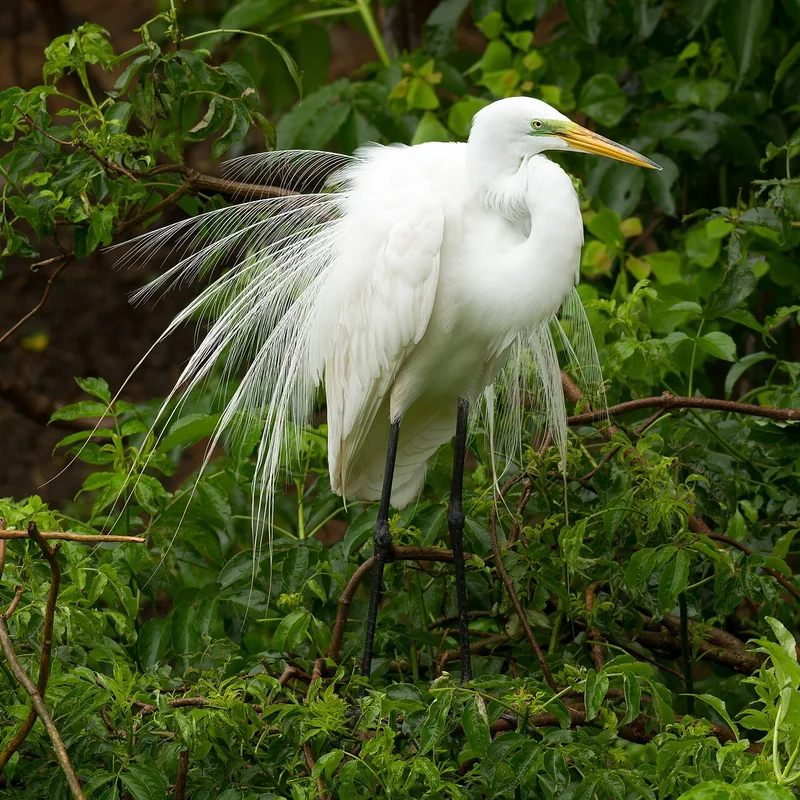 Featured photogreat-egret.jpg
Ardea alba, the great egret, is a large white heron with a near-cosmopolitan distribution across the Americas, Europe, Africa, Asia, and Australia. Adults are 80 to 104 cm long with a wingspan of 1.31 to 1.7 m and weigh 700 g to 1.5 kg. The plumage is pure white with a long yellow bill and black legs. The IUCN lists the species as Least Concern. The great egret was driven near to extinction in late nineteenth-century North America for its elongate breeding plumes; the species' recovery underpins the National Audubon Society's logo and identity.
Quick facts
- Habitat
- Marshes, swamps, mudflats, mangroves, slow rivers, and lake edges. The species occupies a wide range of wetland habitats from the tropics to temperate latitudes.
- Range
- Near-cosmopolitan. Found on every continent except Antarctica, with breeding populations from temperate North America and Europe south to Australia and southern Africa. Several subspecies are recognized across the range.
- Size
- 80–104 cm body · 131–170 cm wingspan · 0.7–1.5 kg
- Plumage
- Adults are uniformly pure white with a long pointed yellow bill, dark legs and feet, and a yellow eye. In the breeding season, both sexes develop long lacy back plumes (aigrettes) that extend beyond the tail in display; the bare facial skin turns lime-green during peak breeding. Outside the breeding season the plumes are absent and the facial skin is yellow.
- Song
- A low, harsh croak 'cuk-cuk-cuk' delivered when disturbed and during territorial display. The species is mostly silent while foraging.
- Migration
- Partial migrant. Northern populations move south for winter; tropical populations are resident year-round. Some populations are nomadic, tracking water levels seasonally.
- Conservation
- Least Concern (LC)
Overview
Ardea alba is the type species of the genus Ardea by some authorities, though the formal type is the grey heron (A. cinerea). The species is one of the most widely distributed herons on Earth and is the bird depicted in flight on the logo of the National Audubon Society — chosen because the species' near-extinction from late nineteenth-century plume-hunting was the founding case for North American bird-protection law.
Plume-hunting and recovery
Great egret populations across North America were reduced by an estimated 95% in the late nineteenth century by hunting for the long lacy breeding plumes (aigrettes) used in fashionable women's hats. The slaughter at breeding colonies was the founding cause of the early-twentieth-century North American bird-protection movement. Florida's protection of breeding rookeries in 1901, the 1900 Lacey Act, and the 1913 Migratory Bird Treaty Act ended the trade. Populations have recovered to abundance across most of the historical range.
Distribution
The species occurs on every continent except Antarctica. Four named subspecies span the range — the New World A. a. egretta, the Eurasian-African A. a. alba, the Eastern Asian A. a. modesta, and the Australian-Indonesian A. a. melanorhynchos. Some authorities have proposed splitting the eastern Asian-Australian populations as a separate species (A. modesta) on molecular grounds; the proposal has not yet been universally adopted.
Sources & further reading (2)
- iucn-red-list — accessed 2026-04-30
- encyclopedia — accessed 2026-04-30
Frequently asked questions
Why is the great egret on the Audubon Society logo?
Great egrets were among the most heavily hunted North American birds in the late nineteenth century, killed at breeding colonies for the long lacy plumes used in fashionable hats. The species' near-extinction was the founding case for North American bird-protection law and for the Audubon movement itself. The logo commemorates both the species and the conservation history that produced the organization.
What is the difference between a heron and an egret?
There is no formal taxonomic distinction. 'Egret' is an English convention applied to herons that are mostly or entirely white. The great egret is in the same genus (Ardea) as the great blue heron, the grey heron, and the goliath heron — all 'herons' in English. The split is purely linguistic and reflects historical interest in the white-plumed species rather than any phylogenetic boundary.
Why do great egrets sometimes have green faces?
During the peak of the breeding season, both sexes develop bright lime-green facial skin, lacy back plumes (aigrettes) that extend past the tail, and orange-pink soft parts at the base of the bill. The colour change is hormonal, peaks for several weeks during pair-bonding and early incubation, and fades as the breeding season progresses. Outside breeding the facial skin is plain yellow.