Ardea herodias
Great Blue Heron (Ardea herodias)
 Featured photogreat-blue-heron.jpg
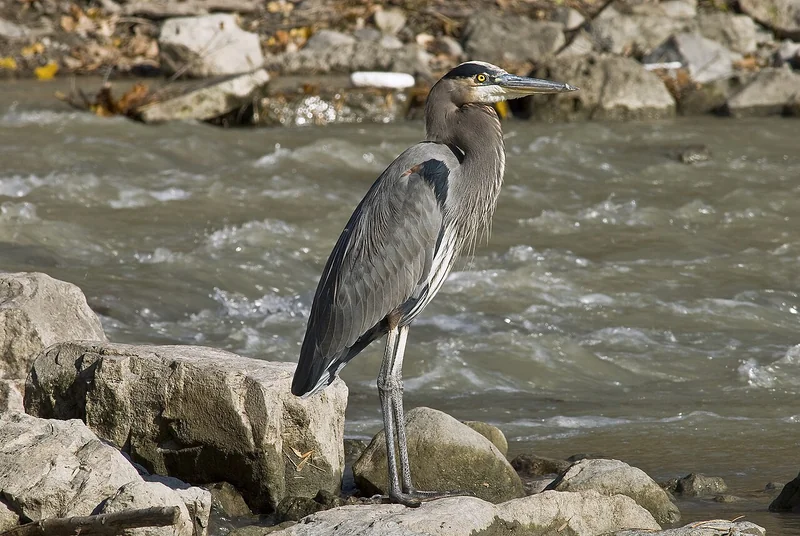
Ardea herodias, the great blue heron, is the largest heron in North America. Adults are 91 to 137 cm long with a wingspan of 1.7 to 2 m and weigh 2 to 3.5 kg. The plumage is mostly blue-grey with a paler head, a black eyestripe extending into a slim plume, and a dagger-like yellow bill. The IUCN lists the species as Least Concern. Great blue herons are common across nearly all of North America and are among the most widely seen large wading birds on the continent.
Quick facts
- Habitat
- Almost any shallow water — freshwater marshes, coastal estuaries, mangrove swamps, lake shores, and slow rivers. The species also forages in flooded fields and occasionally in dry grasslands far from water.
- Range
- Most of North and Central America, plus the Caribbean and the Galápagos Islands. Northern populations migrate; southern populations are largely resident year-round.
- Size
- 91–137 cm body · 170–200 cm wingspan · 2–3.5 kg
- Plumage
- Adults show blue-grey upperparts and wings, a paler grey neck with black-and-white streaking down the front, a black plume extending back from the eye, and a yellow bill. The white-headed Florida 'great white heron' was historically considered a separate species but is now treated as a colour morph of A. herodias. Both sexes look alike.
- Song
- A deep harsh croak 'frahnk' delivered when flushed or in territorial display. The species is mostly silent while foraging.
- Migration
- Partial migrant. Northern populations move south for winter; central and southern populations are largely resident.
- Conservation
- Least Concern (LC)
Overview
Ardea herodias is the largest of the New World Ardea herons. The species' Latin epithet 'herodias' is itself the Greek word for heron, applied to this species by John James Audubon and earlier writers. Despite the dramatic size and wide range, the species is broadly tolerant of human-modified habitats and forages alongside fishing piers, golf-course ponds, and roadside ditches as readily as in remote marshes.
Distribution
The breeding range covers most of North America from southern Alaska and Canada south through the United States, Mexico, Central America, the Caribbean, and the Galápagos. Five recognized subspecies span the range. The Florida-resident 'great white heron' was once treated as a separate species (A. occidentalis) but is now considered a white morph of A. herodias.
Foraging
Great blue herons are stand-and-strike foragers — they wade slowly in shallow water with the neck cocked back, watching for movement, then deliver a fast spear-strike with the bill. Prey ranges from small fish and amphibians up to sizeable bullfrogs, snakes, and even small mammals. Adult herons occasionally choke on prey too large to swallow; the behaviour is well-documented but rarely fatal.
Sources & further reading (2)
- iucn-red-list — accessed 2026-04-30
- encyclopedia — accessed 2026-04-30
Frequently asked questions
Is the white heron in Florida a different species?
Currently no — the all-white 'great white heron' resident in southern Florida and the Caribbean is treated as a colour morph of Ardea herodias rather than a separate species. The bird was named A. occidentalis in the nineteenth century but molecular and ecological evidence shows it interbreeds freely with the typical blue-grey form. Some authorities continue to argue for re-splitting, but the lumped treatment is dominant.
Why is the great blue heron sometimes seen far from water?
Great blue herons routinely forage in dry grasslands, agricultural fields, and even suburban lawns far from any water. The species takes voles, mice, snakes, and large invertebrates from upland habitat as readily as fish from ponds. The behaviour is most conspicuous in winter when shallow water is frozen, but it occurs through the year and reflects the species' broader-than-fish-only diet.
How can a heron's neck strike so fast?
The S-shaped neck of herons is a coiled spring of vertebrae and powerful muscles. When the heron strikes, the neck unfolds along the seventh-and-sixth cervical vertebra hinge, propelling the bill forward in a fraction of a second. Prey rarely has time to escape once the heron has aligned the strike, even though the bird may have stalked motionless for many minutes beforehand.