Larus marinus
Great Black-backed Gull (Larus marinus)
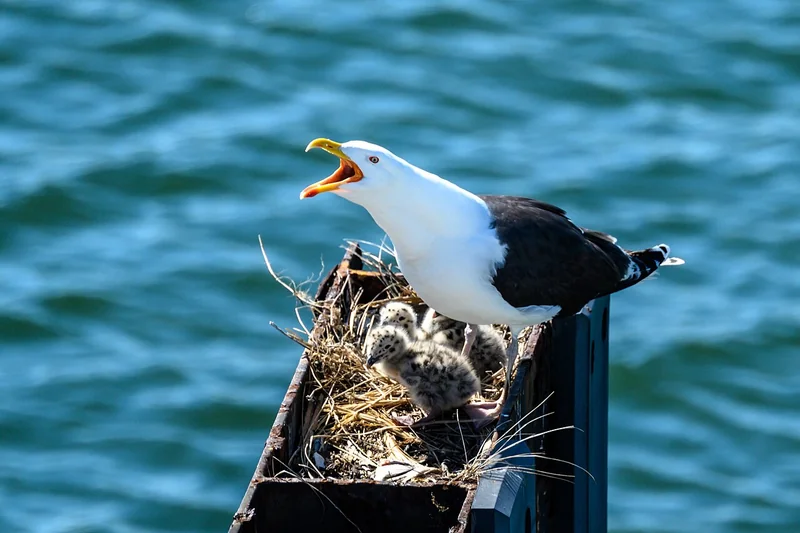 Featured photogreat-black-backed-gull.jpg
Larus marinus, the great black-backed gull, is the largest gull in the world. Adults are 64 to 78 cm long with a wingspan of 1.5 to 1.7 m and weigh 1 to 2.3 kg. Adult plumage shows a stark contrast — jet-black back and upperwings against a pure white head, neck, breast, and belly. The IUCN lists the species as Least Concern. The great black-backed gull is a major predator of other seabird eggs, chicks, and even adults at colonies along the North Atlantic coasts.
Quick facts
- Habitat
- Atlantic coasts, harbours, fishing ports, large coastal lakes, and any open water with abundant food. The species prefers coastal habitats but inland breeding has increased in recent decades.
- Range
- Coasts of the North Atlantic — the British Isles, Iceland, Scandinavia, the eastern coasts of North America from Labrador south to the mid-Atlantic, and adjacent inland waters. The species is widespread along North Atlantic coasts and locally common.
- Size
- 64–78 cm body · 150–170 cm wingspan · 1–2.3 kg
- Plumage
- Adults show jet-black upperwings and back contrasting sharply with a pure white head, neck, breast, and belly. The bill is heavy and yellow with a bright red spot near the tip; legs are pink. The wingtips show small white 'mirrors' on otherwise black primaries. Juveniles take four to five years to reach adult plumage through gradual moults; younger birds are scaly grey-brown overall.
- Song
- A deep, slow, resonant 'aow-aow-aow' or 'kak-kak-kak' delivered both in flight and from a perch. The voice is much deeper than the smaller herring gull's — a useful identification feature in mixed colonies.
- Migration
- Partial migrant. Northern populations move south for winter to ice-free waters; populations in the British Isles and the central North Atlantic are largely resident. Migration is shorter than in many smaller gulls.
- Conservation
- Least Concern (LC)
Overview
Larus marinus is the largest of the world's nearly fifty Larus gull species — a body mass nearly three times that of the common black-headed gull. The species is a top predator at smaller seabird colonies, taking eggs, chicks, and even adult puffins, terns, and smaller gulls. The 'black-backed' English name describes the contrast against the white underparts; the back is genuinely black rather than dark grey as in the closely related lesser black-backed gull.
Distribution
The breeding range covers North Atlantic coasts on both sides of the ocean. Population trends vary by region: British and Irish populations have been generally stable to declining in recent decades, while North American populations have increased substantially since the early twentieth century. The species' ability to exploit human food sources (fishing-boat discards, landfills) helped drive twentieth-century increases that are now being reversed by declining discards and active landfill management.
Predation at colonies
Great black-backed gulls are major predators at smaller seabird colonies. Documented prey at colonies includes puffin eggs and chicks (and adult puffins killed at the burrow entrance), tern eggs and chicks, smaller gull eggs, and the chicks of cormorants and shags. The species' role as a top predator at puffin colonies has led to active culling programmes at some sites where puffin populations are threatened. The dynamics are well-studied in the British Isles.
Sources & further reading (2)
- iucn-red-list — accessed 2026-04-29
- encyclopedia — accessed 2026-04-29
Frequently asked questions
How big is a great black-backed gull?
Wingspan reaches 1.7 metres and body mass approaches 2.3 kilograms — considerably larger than any other gull worldwide. The species is so much larger than the typical herring gull (also a big gull) that the size difference is the easiest field identification when the two are seen together. The large body mass underlies the species' ability to take live prey including adult puffins and other smaller seabirds.
Do great black-backed gulls really eat puffins?
Yes. Documented prey at puffin colonies includes puffin eggs, chicks (taken from burrow entrances), and even adult puffins killed at the burrow entrance during the breeding season. The species is one of the major predators driving population stress at North Atlantic puffin colonies, and active culling programmes have been implemented at sites where puffin populations are threatened. The predator-prey dynamics are intensively studied in the British Isles.
How do great black-backed and lesser black-backed gulls differ?
Great black-backed gull (L. marinus) is substantially larger (wingspan up to 1.7 m vs. 1.2-1.5 m), with a genuinely jet-black back (vs. dark slate-grey in the lesser), pink legs (vs. yellow in the lesser), and a heavier bill. The two are nominally close relatives but show clear morphological and behavioural differentiation; the larger species is also a much more active predator at seabird colonies.