Aquila chrysaetos
Golden Eagle (Aquila chrysaetos)
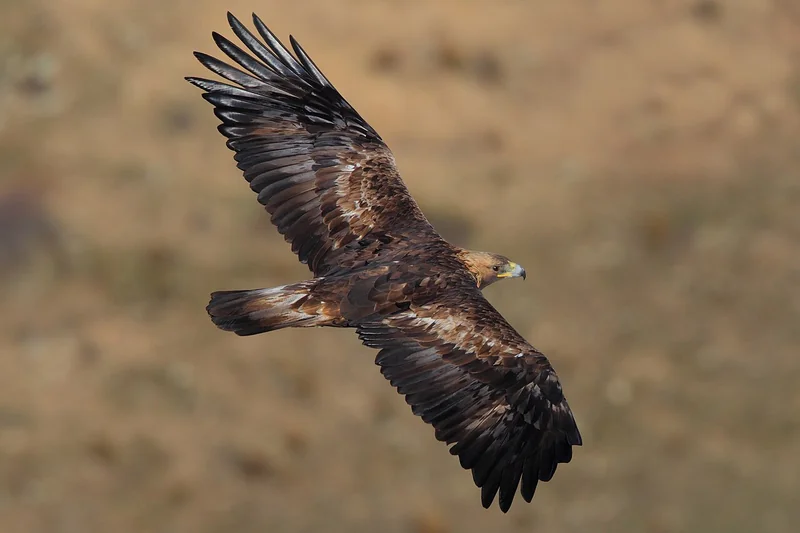 Featured photogolden-eagle.jpg
Aquila chrysaetos, the golden eagle, is one of the largest eagles in the world. Adults are 66 to 102 cm long with a wingspan of 1.8 to 2.34 m and weigh 3 to 6.7 kg. The plumage is uniformly dark brown with golden-buff feathers on the nape giving the species its English name. The IUCN lists the species as Least Concern. The species is one of the most widely distributed eagles in the Northern Hemisphere and one of the most-revered raptors in human cultural history — appearing on the national symbols of numerous countries.
Quick facts
- Habitat
- Open and semi-open mountainous country, alpine tundra, steppe, and desert canyons across the Northern Hemisphere. The species favours large open hunting territory with cliff-faces or tall trees for nesting.
- Range
- Holarctic — most of Europe, North Africa, the Middle East, central Asia, and across temperate North America. The species is one of the most widely distributed large eagles worldwide.
- Size
- 66–102 cm body · 180–234 cm wingspan · 3–6.7 kg
- Plumage
- Adults show uniformly dark chocolate-brown body plumage with golden-buff feathers on the nape and crown — the diagnostic 'golden' nape that gives the species its English name. The legs are feathered to the toes (a useful field mark separating Aquila eagles from the bare-legged sea eagles). Both sexes look alike but females are substantially larger than males. Juveniles show white wing-patches and a white tail base; the adult plumage develops over four to five years through staged moults.
- Song
- A series of high-pitched yelps and whistles delivered both in flight and from a perch — much weaker than the bird's massive size suggests. The species is mostly silent across the year and most observations are visual rather than auditory.
- Migration
- Partial migrant. Northern populations move south for winter; central and southern populations are largely resident. Some long-distance autumn movements bring Arctic Russian breeders to wintering grounds in southern Asia.
- Conservation
- Least Concern (LC)
Overview
Aquila chrysaetos is one of about ten Aquila eagle species worldwide and is the most widely distributed in the Northern Hemisphere. The species is the national bird of several countries (Mexico, Albania, Austria, Germany, Kazakhstan) and appears on the national coat of arms of many more — one of the most-honoured raptors in human cultural history. Six recognized subspecies span the range with measurable size and plumage variation.
Distribution
The breeding range covers most of mountain Europe, the Mediterranean basin, North Africa, the Middle East, central Asia, the Russian Far East, and across mountainous and open North America from Alaska to central Mexico. The species' continental population is estimated at over 200,000 mature individuals worldwide. Population trends are stable across most of the range; some western European populations have recovered substantially over recent decades following earlier persecution.
Cultural significance
The golden eagle has appeared in human cultural symbolism for at least two thousand years. The species was the legionary symbol of imperial Rome, the national symbol of the Holy Roman Empire, and appears today on the national coat of arms of Mexico, Albania, Austria, Germany, Kazakhstan, and many other countries. Mongolian and Kazakh traditional eagle-hunting (using captive-trained female golden eagles to hunt foxes and hares) is one of the oldest continuously practised falconry traditions in the world, dating back at least 4,000 years.
Sources & further reading (2)
- iucn-red-list — accessed 2026-04-30
- encyclopedia — accessed 2026-04-30
Frequently asked questions
Why is it called a 'golden' eagle?
The species has uniformly dark chocolate-brown body plumage with bright golden-buff feathers on the nape and crown — the 'golden' nape that gives the species its English name. The golden colour is most visible in good light against the otherwise dark plumage. The Latin epithet 'chrysaetos' is from Greek 'chrysos' (gold) plus 'aetos' (eagle), directly referencing the same plumage feature.
Can a golden eagle really kill a deer?
Adult golden eagles can take prey several times their own body weight under favourable conditions. Documented prey includes adult roe deer, juvenile reindeer, marmots, large hares, and occasionally domestic livestock (lambs, kid goats). Most predation on deer involves juveniles or sick adults rather than healthy adult deer; the eagle's strike force and powerful talons can immobilize prey up to 5-6 kg, far above the bird's own weight. Heavier prey is typically eaten in place rather than carried.
How do golden eagles differ from bald eagles?
Golden eagles (Aquila chrysaetos) are uniformly dark brown with a golden nape and feathered legs. Bald eagles (Haliaeetus leucocephalus) are dark brown with a brilliant white head and tail (in adults) and bare yellow legs. Both species are similar in size but occupy different ecological niches: golden eagles hunt mammals and birds in open mountainous habitat; bald eagles fish in coastal and inland waters. The two species rarely overlap in habitat preference even where their ranges overlap geographically.