Pygoscelis papua
Gentoo Penguin (Pygoscelis papua)
 Featured photogentoo-penguin.jpg
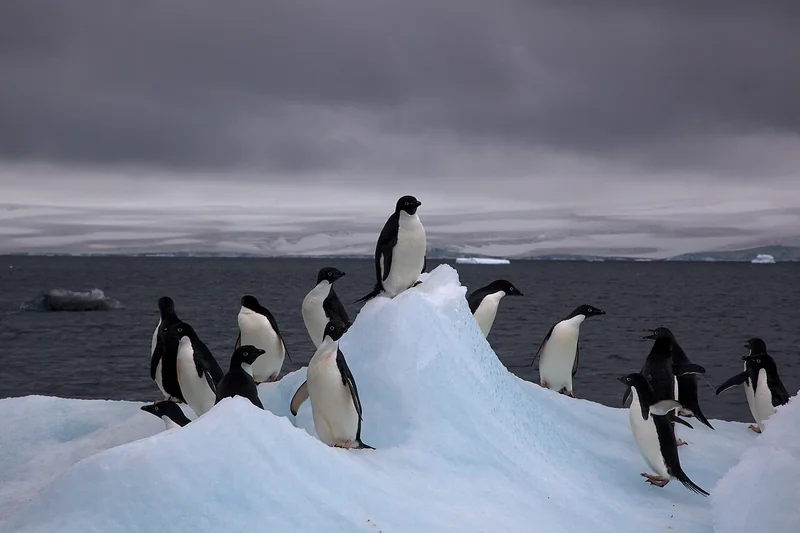
Pygoscelis papua, the gentoo penguin, is a medium-sized penguin distributed across the subantarctic and antarctic peninsula. Adults are 75 to 90 cm tall and weigh 4.5 to 8.5 kg. The plumage shows a glossy black head and back with a distinctive white triangle above each eye joining across the head, plus a bright orange-red bill and orange-pink legs. The IUCN lists the species as Least Concern. Gentoo penguins are the fastest swimmers of any penguin, with documented underwater speeds reaching 36 km/h.
Quick facts
- Habitat
- Subantarctic islands and the antarctic peninsula. Breeding colonies are on flat coastal ground with adjacent ice-free access to the ocean.
- Range
- Subantarctic islands of the Southern Ocean — South Georgia, the Falklands, Crozet, Kerguelen, Heard, Macquarie — plus the antarctic peninsula. Several recognized subspecies span the range, with northern subantarctic populations averaging slightly larger than the antarctic peninsula form.
- Size
- 75–90 cm body · 73–78 cm wingspan · 4.5–8.5 kg
- Plumage
- Adults show a glossy black head and back; the white belly extends up to a clean V-shaped boundary on the throat; a distinctive white triangular patch above each eye extends back and joins across the top of the head — the most reliable field mark separating gentoos from chinstrap and Adélie penguins. The bill is bright orange-red and the legs and feet are orange-pink. Both sexes look alike; chicks are covered in soft grey down.
- Song
- Adults give loud trumpeting and braying calls during display, with synchronized colony vocalizations during the breeding season. Individual recognition between mates and chicks is based on subtle call signatures.
- Migration
- Largely sedentary on the breeding islands. Some local seasonal movements to follow prey but no long-distance migration like emperor penguins.
- Conservation
- Least Concern (LC)
Overview
Pygoscelis papua is one of three Pygoscelis penguins. The species' Latin epithet 'papua' is misleading — gentoos do not occur near Papua New Guinea — and is thought to derive from a confused early-nineteenth-century naming. The English name 'gentoo' may come from the Anglo-Indian word for 'gentile' (a non-Muslim Hindu) but the etymology is uncertain and may reflect early observations on Falkland Islands birds by colonial-era English naval officers.
Distribution
The breeding range covers subantarctic islands and the antarctic peninsula. Northern populations (South Georgia, Falklands) and southern populations (antarctic peninsula) are sometimes split as separate species under recent molecular evidence (P. papua sensu stricto and P. ellsworthi); the lumped treatment remains majority view. Antarctic peninsula gentoo populations have expanded substantially over the last forty years as warming has reduced sea ice in the region — one of the few penguin populations to benefit from regional climate change.
Speed swimming
Gentoo penguins are the fastest swimmers of any penguin, with documented underwater speeds reaching 36 km/h — substantially faster than the larger emperor penguin or any of the other Pygoscelis species. The streamlined body, dense flight-muscle mass, and powerful flipper stroke combine to support the speed. Foraging trips are typically short (returning to the colony each day during chick-rearing) but at high speed, and the species can outpace many of its fish prey through pure pursuit speed.
Sources & further reading (2)
- iucn-red-list — accessed 2026-04-30
- encyclopedia — accessed 2026-04-30
Frequently asked questions
How fast can a gentoo penguin swim?
Documented underwater speeds reach 36 km/h — making the gentoo the fastest swimmer of any penguin. The species' streamlined body and powerful flipper stroke combine to support pursuit-speed foraging on fast-swimming fish prey. Speed records are based on direct measurements with biologging tags and are well-replicated; the gentoo substantially exceeds the swimming speeds of larger emperor penguins.
Are antarctic peninsula gentoos the same species as subantarctic ones?
Currently treated as one species (Pygoscelis papua), but recent molecular and morphological evidence has prompted proposals to split them into two species — northern subantarctic populations as P. papua sensu stricto and antarctic peninsula populations as P. ellsworthi. The split has not been universally adopted. The two populations differ slightly in size, breeding timing, and ecology.
Why are gentoos increasing while other antarctic penguins decline?
Antarctic peninsula gentoo populations have expanded substantially over the last forty years, while sympatric Adélie and chinstrap populations have declined. The pattern reflects differential responses to regional climate warming: gentoo penguins are more flexible in diet (switching between krill and fish), prefer ice-free coast for breeding (which warming has expanded), and forage closer to colonies than emperor or Adélie penguins. The species' adaptability has made it one of the few seabirds to benefit from regional warming.