Coracias garrulus
European Roller (Coracias garrulus)
 Featured photoeuropean-roller.jpg
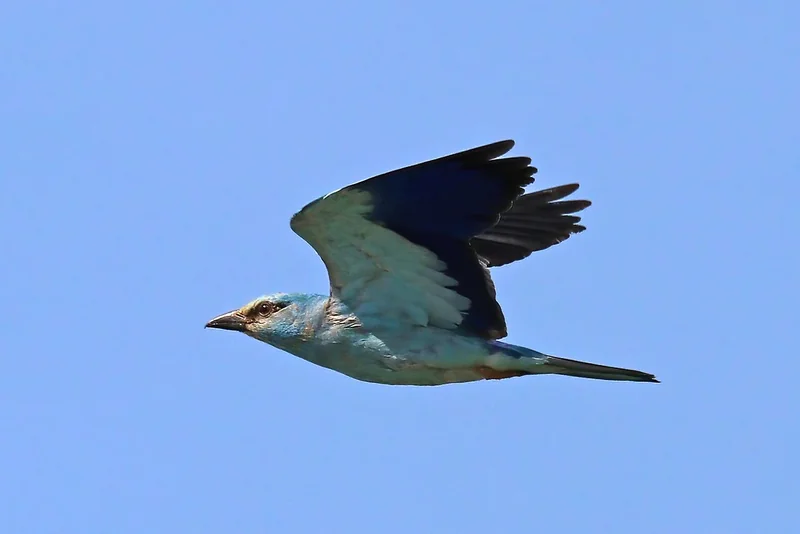
Coracias garrulus, the European roller, is a medium-sized roller of the family Coraciidae, distributed across Europe, North Africa, the Middle East, and central Asia. Adults are 29 to 32 cm long with a wingspan of 52 to 58 cm and weigh 110 to 160 g. The plumage is brilliant turquoise-blue with chestnut back, dark wings, and conspicuous purple wing-patches visible in flight. The IUCN lists the species as Least Concern. The species is named for its dramatic courtship roll-flight, in which the male tumbles through the air with calling.
Quick facts
- Habitat
- Warm open country — pastures, agricultural margins, lightly wooded steppe, and orchards. Cavity nester reliant on natural tree hollows and old woodpecker holes for breeding sites.
- Range
- Southern and central Europe, North Africa, the Middle East, and across central Asia to western China. Winters in sub-Saharan Africa, particularly in the southeastern miombo woodlands. European populations have declined substantially over recent decades.
- Size
- 29–32 cm body · 52–58 cm wingspan · 110–160 g
- Plumage
- Adults show a brilliant turquoise-blue head, breast, belly, and underwings; a chestnut-brown back; dark blue-purple wings with conspicuous bright turquoise wing-patches that flash dramatically in flight; and a dark blue-purple tail. The bill is heavy and black. Both sexes look alike. Juveniles are duller blue-grey with less brilliant wing patches.
- Song
- A loud, harsh, crow-like 'kraak' or 'krak-krak' delivered both in flight and from a perch. The Latin epithet 'garrulus' means 'chattering' or 'noisy', a reference to the loud calls. The species is mostly silent on migration but vocal at the breeding territory.
- Migration
- Long-distance migrant. European and Asian breeders winter in sub-Saharan Africa, particularly in southern and eastern African miombo woodlands. The autumn migration crosses the Sahara on a broad front and is one of the more dramatic European-African migrations.
- Conservation
- Least Concern (LC)
Overview
Coracias garrulus is one of about a dozen Coracias roller species worldwide and the only roller breeding in Europe. The species' English name comes from the male's spectacular courtship roll-flight: ascending high above the breeding territory, the bird tumbles, twists, and rolls back-and-forth through the air while calling. The display is one of the most impressive aerial courtship performances among European birds.
Conservation in Europe
European roller populations across western and central Europe have declined sharply over recent decades — the breeding range has contracted from previous historical occurrence in much of central and northern Europe to a much-reduced southern and eastern distribution today. Drivers include loss of cavity-nest sites with the removal of old standing trees, agricultural intensification reducing insect prey, and pesticide impacts. Several European countries have rolled out nest-box programmes to support remaining populations.
Migration
European rollers undertake a long-distance migration between European or Central Asian breeding grounds and sub-Saharan African wintering grounds, primarily in southeastern Africa's miombo woodlands. Geolocator tracking studies have documented the migration in detail — the autumn passage crosses the Mediterranean and Sahara on a broad front, with most birds reaching the wintering grounds by November and returning to Europe by April-May.
Sources & further reading (2)
- iucn-red-list — accessed 2026-04-30
- encyclopedia — accessed 2026-04-30
Frequently asked questions
Why is it called a 'roller'?
The English name comes from the male's spectacular courtship roll-flight. Ascending high above the breeding territory, the bird tumbles, twists, and rolls back-and-forth through the air while calling loudly. The display is one of the most impressive aerial courtship performances among European birds and is the source of the family name 'Coraciidae' through the Greek 'korax' (raven) — the harsh raven-like calls accompany the rolling display.
Why have European rollers declined?
Western and central European populations have declined sharply over recent decades. The breeding range has contracted from previous historical occurrence in much of central and northern Europe to a much-reduced southern and eastern distribution today. Drivers include loss of cavity-nest sites with the removal of old standing trees, agricultural intensification reducing insect prey availability, and pesticide impacts. Several European countries have rolled out nest-box programmes to support remaining populations.
Where do European rollers spend the winter?
European rollers winter in sub-Saharan Africa, primarily in the southeastern miombo woodlands of Tanzania, Mozambique, Malawi, Zambia, Zimbabwe, and Botswana. Geolocator tracking studies have documented the migration in detail — the autumn passage crosses the Mediterranean and Sahara on a broad front in October-November, and the spring return arrives in Europe in April-May. Total annual round-trip distance is approximately 16,000 kilometres.