Carduelis carduelis
European Goldfinch (Carduelis carduelis)
 Featured photoeuropean-goldfinch.jpg
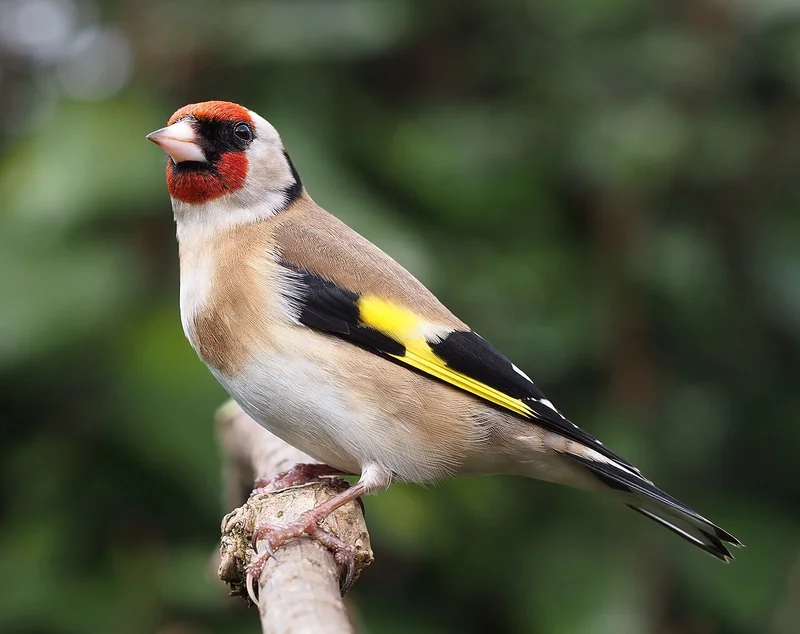
Carduelis carduelis, the European goldfinch, is a small Fringillidae finch distributed across most of Europe, North Africa, and western Asia. Adults are 12 to 13.5 cm long with a wingspan of 21 to 25.5 cm and weigh 14 to 19 g. The plumage shows a brilliant red face, white-and-black head pattern, brown back, and bold golden-yellow wing-patches. The IUCN lists the species as Least Concern. The species was historically heavily trapped for the songbird trade in southern Europe; modern populations are recovering.
Quick facts
- Habitat
- Open and partly wooded country with scattered trees — orchards, gardens, hedgerows, weedy field margins, and parks. The species depends on thistle, dandelion, and other composite-seed crops that thrive in disturbed open ground.
- Range
- Across most of Europe, North Africa, the Middle East, and western and central Asia. Introduced to Australia, New Zealand, and parts of South America. The species is one of the most widely distributed Carduelis finches.
- Size
- 12–13.5 cm body · 21–25.5 cm wingspan · 14–19 g
- Plumage
- Adults of both sexes show a brilliant red face surrounded by black-and-white head bands, a buff-brown back, white belly, and bold golden-yellow patches across the black wings. The bill is sharp and pale. Adult males show slightly more saturated red than females, but the sexes are otherwise nearly identical. Juveniles lack the red face and have streaked underparts; the adult red develops over the first autumn moult.
- Song
- A pleasant tinkling, twittering musical phrase delivered from a high perch — among the most musical of European finch songs. The flight call is a liquid 'tickelit' delivered constantly by foraging flocks.
- Migration
- Partial migrant. Northern European populations move south for winter to the Mediterranean basin and North Africa; southern populations are largely resident. Migration timing tracks seed availability.
- Conservation
- Least Concern (LC)
Overview
Carduelis carduelis is the type species of the genus Carduelis. The Latin name is from 'carduus', the Latin word for thistle — both common and scientific names directly reference the species' near-obligate specialization on thistle seeds. The species is one of the most familiar small finches across Europe and North Africa and has appeared in European art for centuries; Carel Fabritius's 1654 painting 'The Goldfinch' is one of the most famous depictions.
Distribution
The native range covers most of Europe, North Africa, the Middle East, and western and central Asia. Introduced populations are established in Australia (deliberate nineteenth-century releases), New Zealand, and parts of South America. The species' tolerance of human-modified habitat — orchards, gardens, hedgerows — has supported continued population growth across most of Europe even as broader farmland-bird declines have affected related species.
Trapping history and recovery
European goldfinches were historically heavily trapped for the live-bird trade in southern Europe and parts of North Africa, with annual takes in the millions during the nineteenth and early twentieth centuries. EU bird-protection legislation since the 1970s has substantially reduced the trade in regulated countries; some illegal trapping persists in southern Europe. Modern populations have recovered strongly across most of Europe and the species is now broadly stable or increasing.
Sources & further reading (2)
- iucn-red-list — accessed 2026-04-30
- encyclopedia — accessed 2026-04-30
Frequently asked questions
Why does the goldfinch have a red face?
The brilliant red face of the European goldfinch is produced by carotenoid pigments deposited unchanged into the feathers during moult. The colour intensity correlates with diet quality during the moult — birds with access to carotenoid-rich seed and insect prey develop more saturated red. The trait is sexually selected; pair-bonded females tend to choose males with the most saturated red, and bright-faced birds also tend to be the most experienced foragers.
What does 'Carduelis' mean?
The Latin name 'Carduelis' is derived from 'carduus', the Latin word for thistle. Both common name 'goldfinch' (referring to the bright golden wing patches) and scientific name 'Carduelis carduelis' (referring to the species' near-obligate specialization on thistle seeds) reflect the bird's most-distinctive features. The species is widely associated with thistles in European folk tradition and natural-history writing.
How do goldfinches eat thistle seeds?
European goldfinches use their slim sharp bill to extract seeds from the spiny seed-heads of thistles that other birds avoid. The bird hangs upside-down on the seedhead, pries individual seeds out with the bill, and consumes them whole. The technique works on dandelion, teasel, knapweed, and many other composite plants in the same way. Goldfinches are essentially obligate specialists on this foraging niche.