Caprimulgus europaeus
Eurasian Nightjar (Caprimulgus europaeus)
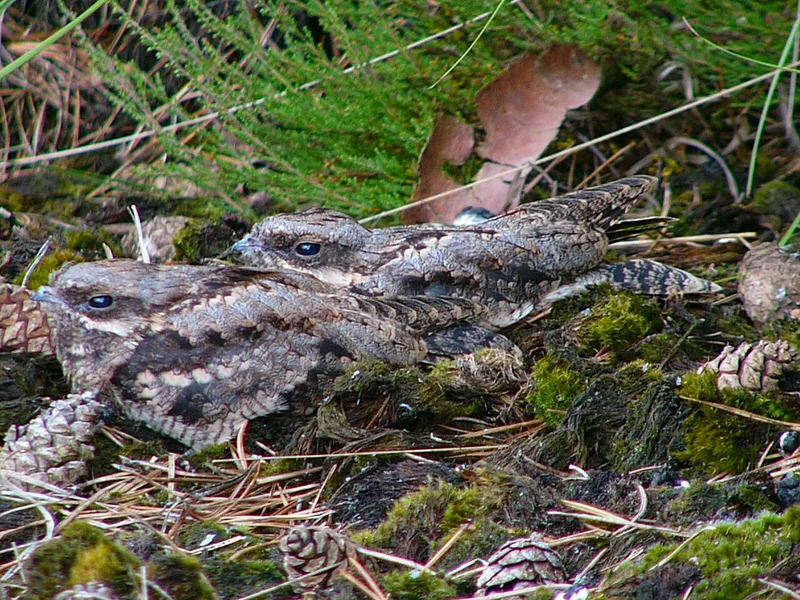 Featured photoeurasian-nightjar.jpg
Caprimulgus europaeus, the European or Eurasian nightjar, is a medium-sized crepuscular bird of the family Caprimulgidae that breeds across temperate Eurasia and winters in sub-Saharan Africa. Adults are 26 to 28 cm long with a wingspan of 54 to 60 cm and weigh 51 to 101 g. The species is cryptically patterned in grey-brown and black and is most often detected by its prolonged mechanical churring call at dusk. The IUCN lists the species as Least Concern.
Quick facts
- Habitat
- Breeds on heathland, open woodland with glades, conifer plantations with open rides, and scrubby areas with bracken and gorse across temperate Europe and Asia. Requires bare or sparsely vegetated ground for nesting and open space for aerial foraging. Winters in open savanna, scrub, and forest edge in sub-Saharan Africa.
- Range
- Breeds from Britain and Portugal east across Europe and central Asia to Mongolia and China. Winters in sub-Saharan Africa, primarily in the dry savannas of East and southern Africa. A long-distance migrant across the full breadth of this range.
- Size
- 26–28 cm body · 54–60 cm wingspan · 51–101 g
- Plumage
- Cryptically patterned in grey, brown, rufous, and black — intricate bark- and leaf-litter camouflage that makes a resting bird almost invisible when pressed against a branch or ground. Males have white spots on the three outer primaries and white corners to the tail; females lack these marks. The large, flat head, huge gaping mouth, and tiny bill are characteristic of the family.
- Song
- A prolonged mechanical churring — a low, sustained 'churrrr' that rises and falls in volume and may continue for several minutes without pause. Given at dusk and throughout the night from a prominent perch. Often the only indication of the species' presence at a site.
- Migration
- Long-distance migrant. Departs European and Asian breeding grounds in August–October and travels to sub-Saharan Africa, returning in May–June. The complete migratory routes cross the Sahara and span several thousand kilometres.
- Conservation
- Least Concern (LC)
Overview
Caprimulgus europaeus is the type species of the genus Caprimulgus and a familiar bird of European heathlands and open woodland, known primarily as a sound rather than a sight — its sustained churring call carries far across heathland on warm summer nights. The family name Caprimulgidae comes from the Latin for 'goatsucker' — a reference to the ancient folk belief that nightjars sucked milk from goats at night, an idea that persisted in European folklore for centuries. The species is sexually dimorphic in the wing and tail markings; females and immatures lack the male's white wing spots, which are displayed prominently in a wing-spreading display toward females.
Camouflage and roosting behaviour
The Eurasian nightjar's plumage is one of the most effective cryptic disguises of any European bird. When roosting on a branch or on the ground, the bird presses its body flat, closes its eyes to slits, and aligns itself lengthwise along the branch or with surrounding vegetation, becoming effectively invisible to a passing observer. The plumage pattern — a complex mixture of grey, brown, rufous, black, and buff — breaks up the outline of the bird and matches the texture of bark and dead leaf litter with extraordinary fidelity. This camouflage is the species' primary defence: nightjars do not flee readily, relying instead on remaining motionless.
Breeding ecology and declining habitats
The Eurasian nightjar nests on the ground with no constructed nest — eggs are laid directly on bare soil or leaf litter in open heathland, bracken scrub, or woodland rides. Clutch size is typically two; incubation is performed by both sexes. The species is closely associated with heathland habitats in Britain and northwest Europe, and has declined significantly where heathland has been lost to agricultural encroachment, afforestation with dense conifers, or succession to closed woodland. Conservation management of heathlands in Britain — including controlled burning and scrub clearance — is conducted partly to maintain suitable nightjar habitat. The species is a wildlife target of heathland SSSI management across England.
Sources & further reading (2)
- iucn-red-list — accessed 2026-05-07
- encyclopedia — accessed 2026-05-07
Frequently asked questions
Why was the nightjar called a 'goatsucker'?
The folk name 'goatsucker' — reflected in the scientific family name Caprimulgidae (from Latin capra, goat, and mulgere, to milk) — arose from the ancient belief that nightjars crept into goat herds at night and sucked milk from the udders, causing the goats' milk to dry up. In reality, nightjars visit livestock herds to catch the flies and insects disturbed by the animals. The belief was widespread across Europe and the Near East and persisted into the 19th century, long after naturalists had identified the birds as insectivores.
How does the churring call of the nightjar work?
The churring call is produced by the syrinx (the avian vocal organ) and is an extremely rapid repetition of sound elements — the churr rate is so fast that the individual elements merge into a continuous mechanical sound. The call is given from a prominent perch such as a dead branch, fence post, or tree top, and the male turns his head slowly from side to side while churring — a movement that causes the call to appear to pan or shift in direction, making it difficult to locate the bird precisely.
Where do European nightjars spend the winter?
Eurasian nightjars cross the Sahara and winter in sub-Saharan Africa, primarily in the dry savannas and open woodland of East Africa (Kenya, Tanzania) and southern Africa (Zambia, Zimbabwe, Mozambique). They cover several thousand kilometres on migration, crossing the Mediterranean and the Sahara Desert in both directions. GPS tagging studies have revealed individual birds wintering in widely separated parts of Africa in consecutive years, with migration routes that include both broad-front and narrow-front passages.