Pica pica
Eurasian Magpie (Pica pica)
 Featured photoeurasian-magpie.jpg
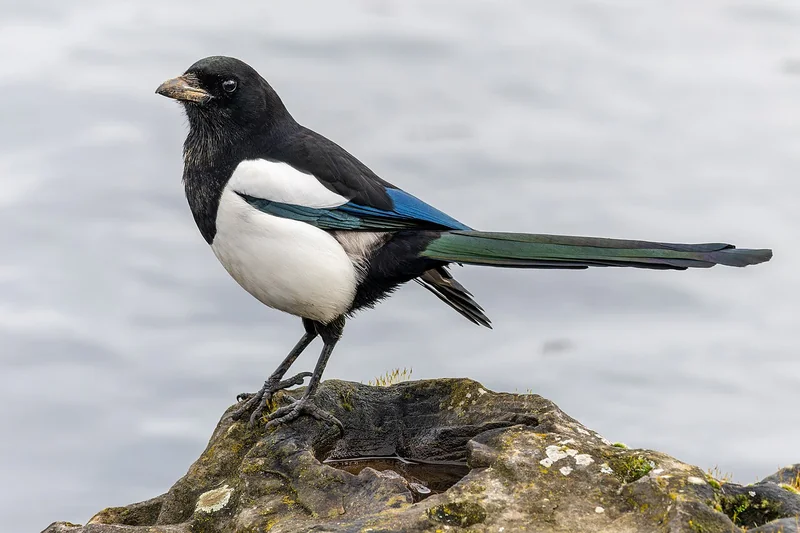
Pica pica, the Eurasian magpie, is a long-tailed black-and-white corvid distributed across most of Europe and temperate Asia. Adults are 44 to 46 cm long (including the long tail) with a wingspan of 52 to 60 cm and weigh 200 to 250 g. The bold pied plumage carries strong iridescent blue and green tones in the wings and tail. The IUCN lists the species as Least Concern. Magpies are among the most cognitively studied songbirds — they are one of the few non-mammals shown to recognize themselves in a mirror.
Quick facts
- Habitat
- Open and partly wooded country, farmland with hedgerows, parkland, and suburbs. Pure dense forest and treeless steppe are largely avoided.
- Range
- Most of Europe, North Africa, the Middle East, and across temperate Asia to Mongolia and northern China. The North American black-billed magpie (Pica hudsonia) was historically lumped with this species but is now treated as a separate species.
- Size
- 44–46 cm body · 52–60 cm wingspan · 200–250 g
- Plumage
- Adults show a glossy black head, breast, back, and long graduated tail; white belly, scapulars, and primary inner webs; and strong iridescent blue and green sheen on the wings and tail. The long tail is approximately as long as the body and is diagnostic in flight.
- Song
- Vocalizations are mostly harsh chattering rattles and chacking calls; magpies are not known for melodious song. Captive birds mimic human speech and other ambient sounds.
- Migration
- Sedentary across the entire range. Local movements occur in response to harsh winters but no regular migration.
- Conservation
- Least Concern (LC)
Overview
Pica pica belongs to the family Corvidae and shows the cognitive sophistication characteristic of the group. Magpies are one of the few non-mammal species — and the first songbird — shown to pass the mirror self-recognition test, suggesting some form of self-awareness. The species also caches food, recovers it later using spatial memory, and engages in social play.
Distribution
The Eurasian magpie occurs across most of Europe, North Africa, the Middle East, and temperate Asia. The species is sedentary and locally common across nearly the entire range, with population trends generally stable or slightly increasing. The closely related North American black-billed magpie was lumped with this species through much of the twentieth century but is now treated as a separate species (Pica hudsonia) on molecular and behavioural grounds.
Cognition
Eurasian magpies are among the most intensively studied non-corvid... actually corvid-cognition models. Captive individuals pass the mirror self-recognition test, modify food-caching behaviour when observed by other birds, and use deceptive caching strategies. Wild magpies hold funerals — gathering around a dead conspecific in apparent mourning — that are documented in multiple field studies.
Sources & further reading (2)
- iucn-red-list — accessed 2026-04-29
- encyclopedia — accessed 2026-04-29
Frequently asked questions
Are magpies really attracted to shiny objects?
The folklore reputation overstates the behaviour. Controlled experiments by the University of Exeter showed that captive magpies are no more attracted to shiny objects than to unshiny ones, and several individuals actively avoided novel objects of any kind. The 'thieving magpie' is a cultural trope, not an established biological tendency.
Are magpies one of the smartest birds?
Yes — Eurasian magpies are among the most cognitively sophisticated non-mammal species studied. They pass the mirror self-recognition test, modify caching strategy when observed by competitors, use deceptive caches to mislead potential thieves, and engage in social play. Corvids more broadly are widely recognized as the most cognitively complex bird family.
Are Eurasian and American magpies the same species?
Until recently they were treated as one species. Modern taxonomies split the North American black-billed magpie (Pica hudsonia) from the Eurasian magpie (Pica pica) on molecular and vocal grounds. The two are sister species with similar ecology but no current contact zone.