Upupa epops
Eurasian Hoopoe (Upupa epops)
 Featured photoeurasian-hoopoe.jpg
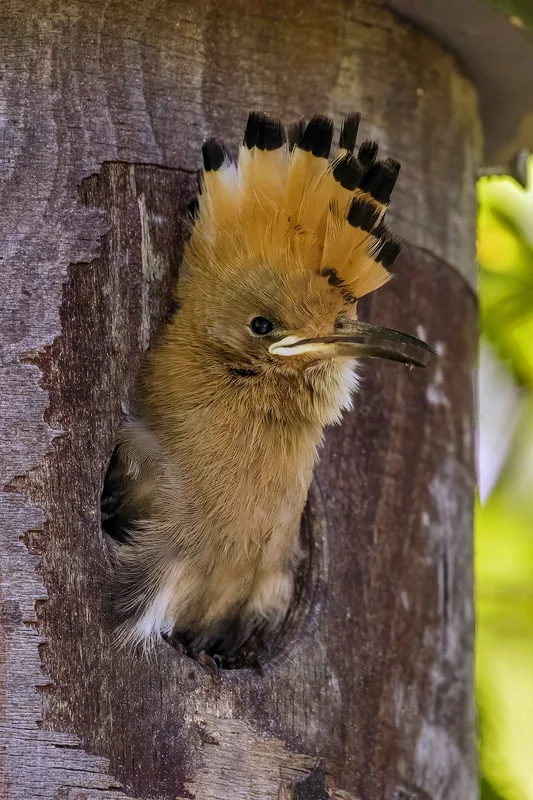
Upupa epops, the Eurasian hoopoe, is a medium-sized bird of the family Upupidae, distributed across Europe, Asia, and Africa. Adults are 25 to 32 cm long with a wingspan of 44 to 48 cm and weigh 46 to 89 g. The plumage shows pinkish-buff body, bold black-and-white wings and tail, and a striking erectile crown of pinkish-orange feathers tipped with black. The IUCN lists the species as Least Concern. The species is one of the most widely distributed birds across the Old World and is the national bird of Israel.
Quick facts
- Habitat
- Open and semi-open country with bare ground for foraging and tree cavities for nesting — pasture, parkland, orchards, and farmland edges. The species is not found in dense forest or treeless steppe.
- Range
- Most of Europe (south of Scandinavia), North Africa, sub-Saharan Africa, the Middle East, and across temperate Asia to Japan. Some northern European populations are migratory; sub-Saharan African populations are resident.
- Size
- 25–32 cm body · 44–48 cm wingspan · 46–89 g
- Plumage
- Adults show a pinkish-buff body and crown, a bold black-and-white striped pattern across the wings and tail (most dramatic in flight), and an erectile crown of pinkish-orange feathers tipped with black that is normally held flat against the head and raised in display or alarm. The bill is long, thin, and slightly downcurved. Both sexes look alike.
- Song
- A soft, three-note, hollow 'oop-oop-oop' delivered repeatedly from a perch — the source of the species' English name and many other languages' words for the bird (hoopoe, huppe, Wiedehopf). The call is one of the most familiar farmland-and-orchard sounds across Europe and the Middle East.
- Migration
- Partial migrant. Northern European populations migrate south to sub-Saharan Africa for winter; central European populations may make shorter movements to the Mediterranean basin; resident populations exist across most of Africa and southern Asia.
- Conservation
- Least Concern (LC)
Overview
Upupa epops is the only extant species in the family Upupidae following the recent split of the African hoopoe (U. africana) and Madagascar hoopoe (U. marginata) as separate species. The species' name in many languages is onomatopoeic from the soft 'oop-oop-oop' call. The hoopoe was the national bird of Israel from 2008 (chosen by public vote) and figures in classical Greek mythology and ancient Egyptian iconography.
Distribution
The native range covers most of Europe (south of Scandinavia), North Africa, sub-Saharan Africa, the Middle East, and across temperate Asia to Japan. Northern European populations declined sharply in the mid-twentieth century from agricultural intensification but have stabilized in recent decades; central European populations have been recovering since 1990. The species is broadly distributed across cultivated and pastoral landscapes.
Defensive secretions
Female and chick hoopoes produce a strong-smelling secretion from the uropygial (preen) gland during the breeding season — a defence against nest predators. The secretion smells strongly of rotting meat and is rubbed onto the chicks and around the nest cavity entrance. Predators (snakes, mustelids) approach the nest reluctantly and may abandon the attempt entirely. Hoopoe chicks also project their faecal stream forcibly out the cavity entrance when threatened, a behaviour shared with several other cavity-nesting species.
Sources & further reading (2)
- iucn-red-list — accessed 2026-04-30
- encyclopedia — accessed 2026-04-30
Frequently asked questions
Why is the hoopoe's call rendered as 'hoo-poe'?
The species' soft three-note 'oop-oop-oop' call has produced onomatopoeic names in many languages — hoopoe (English), huppe (French), Wiedehopf (German), abubilla (Spanish), poupil (Hebrew). The call is one of the most familiar farmland sounds across Europe, the Middle East, and parts of Africa. The vocalization is the source of the species' Latin name 'Upupa epops' as well — both genus and species reflect the same onomatopoeic rendering.
Why does the hoopoe smell bad?
Female and chick hoopoes produce a strong-smelling secretion from the uropygial gland during the breeding season — the secretion smells like rotting meat and is rubbed onto the chicks and around the nest cavity entrance. The secretion is a defence against nest predators (snakes, mustelids, larger birds) that approach the nest reluctantly through the smell. Adult males do not produce the secretion; only females and chicks during the active breeding season.
What does the erectile crown signal?
The crown of pinkish-orange feathers tipped with black is normally held flat against the head and is raised in display, alarm, or excitement. The raised crown serves both as a display signal to conspecifics (territorial males raise the crown when an intruder approaches; pair-bonding males raise it during courtship) and as a startle signal that may briefly distract approaching predators. The trait is one of the most distinctive crown ornaments in any non-passerine bird.