Bubo bubo
Eurasian Eagle-Owl (Bubo bubo)
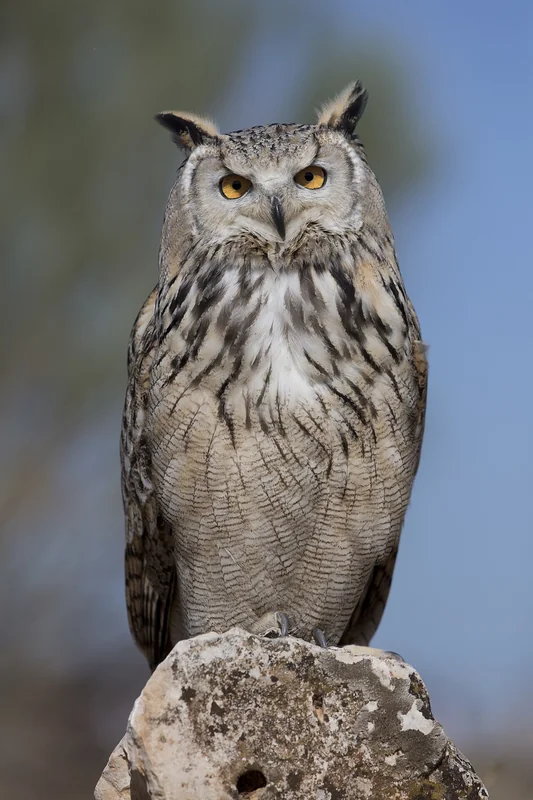 Featured photoeurasian-eagle-owl.jpg
Bubo bubo, the Eurasian eagle-owl, is one of the largest owls in the world. Adults are 56 to 75 cm long with a wingspan of 1.6 to 1.88 m and weigh 1.5 to 4.2 kg. The plumage is heavily mottled brown-and-buff with prominent ear-tufts, large orange-yellow eyes, and a deep barrel chest. The IUCN lists the species as Least Concern. The species is the Eurasian counterpart of the North American great horned owl and one of the most powerful nocturnal predators in the Old World.
Quick facts
- Habitat
- Diverse habitats — mountainous regions, rocky cliffs, forest edges, deserts, and steppe across most of Europe and Asia. The species favours rocky cliff faces for nesting and large open hunting territory adjacent.
- Range
- Most of Europe (excluding the British Isles, where formerly extirpated), North Africa, the Middle East, and across temperate Asia to Japan. The species' range is one of the largest of any owl species worldwide.
- Size
- 56–75 cm body · 160–188 cm wingspan · 1.5–4.2 kg
- Plumage
- Adults show heavily mottled tawny-brown-and-buff plumage above with darker barring on the wings and tail, paler buff underparts heavily streaked dark, prominent erectile ear-tufts (the longest of any European owl), large orange-yellow eyes (one of the most striking eye colours among owls), and a deep barrel chest under the dense plumage. Both sexes look alike but females are substantially larger than males.
- Song
- A deep, far-carrying 'huh-OOh' or 'BU-bo' hooting call delivered from a high cliff perch — the source of the species' Latin tautonym 'Bubo bubo'. The call carries up to 4 km in still mountain air and is one of the most distinctive nocturnal sounds across European mountains.
- Migration
- Sedentary across the entire range. Some local seasonal movements within the range occur but no regular migration.
- Conservation
- Least Concern (LC)
Overview
Bubo bubo is the type species of the genus Bubo, a worldwide group of about a dozen large 'eagle-owl' species. The Latin tautonym is onomatopoeic from the species' deep hooting call. The Eurasian eagle-owl is the Old World counterpart of the great horned owl (Bubo virginianus) — the two are closely related, share much of the apex-nocturnal-predator role, and were historically considered the same species before molecular evidence separated them.
Distribution
The breeding range covers most of Europe, North Africa, the Middle East, and across temperate Asia to Japan. The British population was extirpated in the early twentieth century (the last confirmed UK breeding records are from the 1880s), although recent records of unringed birds may indicate natural recolonization or escapes from captivity. Continental European populations have generally recovered since the mid-twentieth century from earlier persecution.
Apex predator
Eurasian eagle-owls are among the most powerful nocturnal predators across most of the Old World. Documented prey includes adult red foxes, roe deer fawns, common buzzards, herons, other owls (tawny, long-eared, short-eared, even other eagle-owls), and a wide range of smaller mammals and birds. The species can take prey several times its own body weight; the powerful talons and strike force are comparable to those of large diurnal raptors.
Sources & further reading (2)
- iucn-red-list — accessed 2026-04-30
- encyclopedia — accessed 2026-04-30
Frequently asked questions
Is the Eurasian eagle-owl bigger than the great horned owl?
Yes — moderately. Adults are 56-75 cm long with a wingspan of 1.6-1.88 m and weigh 1.5-4.2 kg. The North American great horned owl is 46-64 cm long with a wingspan of 0.91-1.53 m and weighs 0.7-2.5 kg. The Eurasian eagle-owl is therefore substantially larger by both length and mass. Both species are major nocturnal predators in their respective continents.
Why is the species absent from Britain?
The British population was extirpated by direct persecution in the early twentieth century — the last confirmed UK breeding records are from the 1880s. Recent records of unringed adult birds in the UK may indicate natural recolonization (continental populations are nearby and could disperse) or escapes from captivity. Whether and how the species will re-establish in Britain is currently debated by UK ornithological authorities.
What can a Eurasian eagle-owl actually catch and kill?
Documented prey includes adult red foxes, roe deer fawns, common buzzards, herons, other owls (tawny, long-eared, short-eared, even smaller eagle-owls), and a wide range of smaller mammals and birds. The species can take prey several times its own body weight; powerful talons and strike force are comparable to those of large diurnal raptors. Few other predators exceed the eagle-owl in body size or hunting capability across most of its Eurasian range.