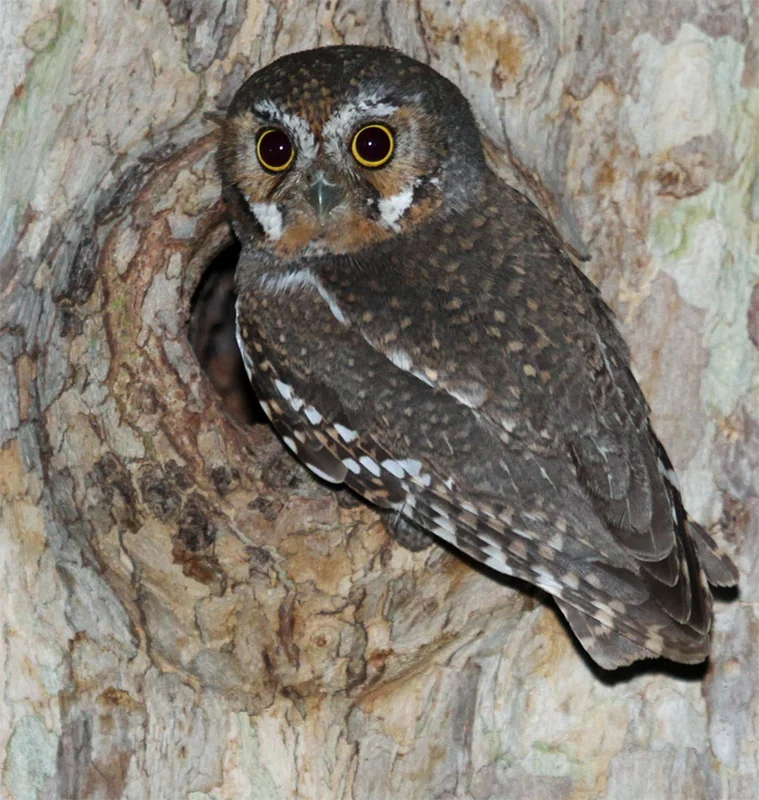
Micrathene whitneyi, the elf owl, is the lightest owl in the world, with adults weighing only 40 to 55 g. Adults are 12.5 to 14 cm long with a wingspan of 27 to 29 cm. Despite its tiny size, the elf owl is a capable nocturnal predator of insects, scorpions, and other invertebrates in the deserts and foothill woodlands of the southwestern United States and Mexico. The IUCN lists the species as Least Concern.
Quick facts
- Habitat
- Desert scrub, saguaro cactus forest, riparian woodland, and oak-sycamore canyons in the Sonoran and Chihuahuan deserts. Breeds in tree cavities — particularly abandoned woodpecker holes in saguaro cacti, cottonwoods, and oaks. Winters in western Mexico.
- Range
- Breeds in the southwestern United States (southern Arizona, New Mexico, and extreme west Texas) and northwestern Mexico (Baja California, Sonora). Winters in Mexico south to Guerrero and Oaxaca.
- Size
- 12–14 cm body · 27–29 cm wingspan · 40–55 g
- Plumage
- Adults are streaky brown and buff-grey overall with a small, rounded head and short tail — the lack of ear tufts and short tail distinguish the elf owl from any other small North American owl. The facial disc is brown with white superciliary stripes. The eyes are pale lemon-yellow. The body shows fine brown streaking on buff-white underparts, providing effective camouflage against tree bark and dry desert vegetation.
- Song
- A rapid, excited series of high-pitched 'yips' — sometimes transcribed as 'whi-whi-whi-whi' or 'chi-chi-chi' — delivered in bursts. The call carries surprisingly well in the still desert night. Also produces a soft, wavering 'seeeuw' contact call.
- Migration
- Migratory. Withdraws from the United States entirely in autumn, wintering in Mexico from Sonora to Oaxaca. Returns to breeding territories in southern Arizona from late February to March.
- Conservation
- Least Concern (LC)
Overview
Micrathene whitneyi is the sole member of its genus and is classified among the smallest raptors in the world — lighter than many large sparrows. Despite its diminutive size, it is a highly effective nocturnal predator. The genus name Micrathene means 'small Athena' — a reference to the owl goddess of ancient Greece and the basis for the genus name of the related small owls. The species name whitneyi honours Josiah Dwight Whitney, the American geologist who directed the geological survey of California in the 1860s.
Saguaro cactus nesting
The elf owl's most iconic nesting habitat is the Sonoran Desert, where it adopts abandoned woodpecker cavities — particularly those excavated by Gila woodpeckers and gilded flickers — in the columnar saguaro cactus (Carnegiea gigantea). These pre-made cavities provide insulation against the extreme desert temperatures, protection from predators, and a stable, dry microenvironment unavailable anywhere else in the open desert. The dependence on woodpecker cavities makes the elf owl a secondary cavity nester — entirely reliant on the prior excavation work of other species. The relationship between saguaro cacti, woodpeckers, and elf owls is one of the defining ecological interactions of the Sonoran Desert.
Scorpion specialist
Elf owls are among the few vertebrates that regularly eat scorpions — a prey item avoided by most birds because of the venomous sting. The elf owl has developed a technique of rubbing a captured scorpion against its perch to remove or disable the stinger before swallowing the prey. Observations show that the elf owl performs this disabling behaviour consistently with dangerous prey items but not with harmless insects — suggesting a learned or innate recognition of the risk. Scorpions are a particularly valuable prey item in the Sonoran Desert's dry season when other invertebrates are scarce.
Sources & further reading (2)
- iucn-red-list — accessed 2026-05-07
- encyclopedia — accessed 2026-05-07
Frequently asked questions
Is the elf owl really the world's smallest owl?
The elf owl holds the title for the lightest owl in the world, with adults weighing 40–55 g — lighter than many large sparrows. By body length it overlaps with the least pygmy-owl and others, but by mass it is the clear record-holder. Despite this tiny size, elf owls are effective nocturnal predators of insects, scorpions, and small invertebrates in the Sonoran and Chihuahuan desert ecosystems.
How does the elf owl handle scorpion stings?
Elf owls regularly capture scorpions and have been observed rubbing the captured prey against a perch to disable or remove the stinger before eating. This behaviour appears to be specific to dangerous prey — elf owls do not perform the same action on harmless insects. The venom of most desert scorpions is not immediately lethal to a bird the size of an elf owl, but stings to the mouth or digestive tract could be harmful, making the stinger-removal behaviour an important safety step.
Why does the elf owl nest in saguaro cactus?
The saguaro cactus provides pre-made cavities (excavated by Gila woodpeckers and gilded flickers) that offer insulation from extreme desert temperatures, protection from predators, and a stable microenvironment unavailable in the open desert. The thick walls of the saguaro maintain a relatively cool interior even during Sonoran Desert summer heat. The elf owl cannot excavate its own cavity and is entirely dependent on these woodpecker-made holes — making the saguaro-woodpecker-elf owl relationship one of the key ecological chains of the Sonoran Desert.