Eclectus roratus
Eclectus Parrot (Eclectus roratus)
 Featured photoeclectus-parrot.jpg
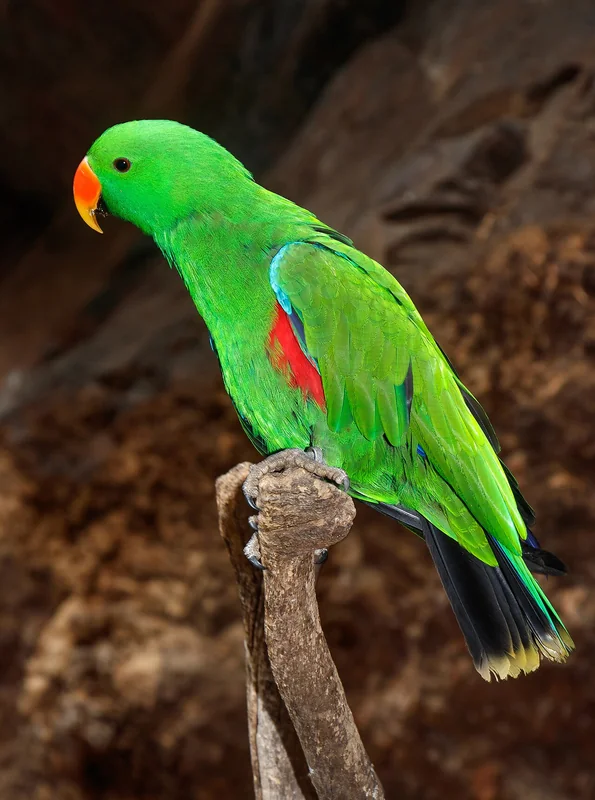
Eclectus roratus, the eclectus parrot, is a large parrot of the family Psittacidae, found across the Australasian and Oriental regions. Adults are 35 to 42 cm long with a wingspan of 67 to 80 cm and weigh 395 to 500 g. The species shows the most extreme sexual dichromatism of any parrot — males are vivid green with orange-red bills, females are brilliant scarlet-and-blue with black bills. The IUCN lists the species as Least Concern.
Quick facts
- Habitat
- Lowland and foothill tropical rainforest, gallery forest, woodland edges, and coastal mangroves. Strongly associated with tall forest with abundant fruiting trees and hollow trees for nesting. In New Guinea, occurs from sea level to about 1,900 m.
- Range
- From the Moluccas (Indonesia) through New Guinea and the Solomon Islands to northeastern Australia (Cape York Peninsula). Ten or more subspecies across this range. The largest populations are in New Guinea.
- Size
- 35–42 cm body · 67–80 cm wingspan · 395–500 g
- Plumage
- Males are brilliant emerald-green overall with scarlet-red flanks and under-wing coverts, a coral-orange upper bill, and a dark lower bill. Females are brilliant scarlet-red on the head and mantle, royal-blue on the breast, belly, and wings, and entirely black-billed. The dimorphism is so extreme that the two sexes were classified as separate species for nearly a century by early European naturalists.
- Song
- A loud, resonant 'arr-arr' contact call and a rolling 'chow-chow' given in flight. Also produces a variety of whistles, clicks, and soft chattering in social contexts.
- Migration
- Largely sedentary. Pairs maintain year-round territories centred on a nest hollow. Some local movements track seasonal fruit availability across the landscape.
- Conservation
- Least Concern (LC)
Overview
Eclectus roratus is placed in the monotypic genus Eclectus within the family Psittacidae. The genus name and common name derive from the Latin 'eclecticus' — 'selective' — perhaps a reference to the selectivity of the diet or the species' choosy nesting requirements. The species shows the most extreme sexual dichromatism of any parrot and one of the most extreme in any bird — the two sexes are so different in plumage that early European ornithologists classified them as separate species, a confusion that persisted in some works until the 1870s.
Sexual dichromatism and nest competition
The extraordinary colour difference between male and female eclectus parrots is thought to reflect the different selective pressures on each sex. Females compete intensively for nest hollows in large trees, which are scarce in rainforest — a female's bright red-and-blue plumage may signal dominance to competing females at a nest hollow. Males compete for access to females at the nest and need to be identifiable at long range within the green forest canopy — the vivid green camouflages them in the canopy when foraging and the scarlet flash under the wing signals identity in flight. The different selection pressures have driven the sexes to opposite plumage extremes.
Polyandrous breeding system
Female eclectus parrots in New Guinea have been documented adopting a polyandrous mating system — a single female may accept food and mating from multiple males, all of whom contribute to feeding her and the nestlings at the nest hollow. The male parrots invest heavily in courtship feeding without gaining exclusive mating rights. The female maintains control of the nest hollow, which she may use for up to 20 years. This unusual system is driven by the extreme scarcity of suitable nest hollows — the female's control of the hollow is the primary limiting resource, making it worth males' investment to maintain access to a territory.
Sources & further reading (2)
- iucn-red-list — accessed 2026-05-07
- encyclopedia — accessed 2026-05-07
Frequently asked questions
Why were male and female eclectus parrots thought to be different species?
Early European naturalists observing museum specimens of male (brilliant green) and female (scarlet-and-blue) eclectus parrots assumed the two wildly different plumages represented different species. The misidentification persisted for over a century because the species is arboreal and not easily observed in the wild. It was not until naturalists observed the two sexes together at nest hollows and documented mating behaviour that the single-species reality was established definitively in the 19th century.
What is the female's colour for?
The female's brilliant red-and-blue plumage is thought to reflect female-female competition for nest hollows — one of the rarest and most valuable resources in rainforest. A bright, distinctive plumage may signal dominance to competing females at a nest hollow entrance, helping the resident female deter rivals. It is one of the few cases in birds where females are more brightly coloured than males, driven by intense female-female competition rather than male-female mate choice.
Do eclectus parrots practice polygamy?
Yes — female eclectus parrots in wild populations in New Guinea have been documented as polyandrous (mating with multiple males). Multiple males court-feed the female and gain mating access without holding an exclusive territory. The female's control of the scarce nest hollow is the key resource — males compete to maintain access to a territory-holding female. This polyandrous system is unusual among parrots and is driven by the scarcity of large hollow trees suitable for nesting.