Pipilo erythrophthalmus
Eastern Towhee (Pipilo erythrophthalmus)
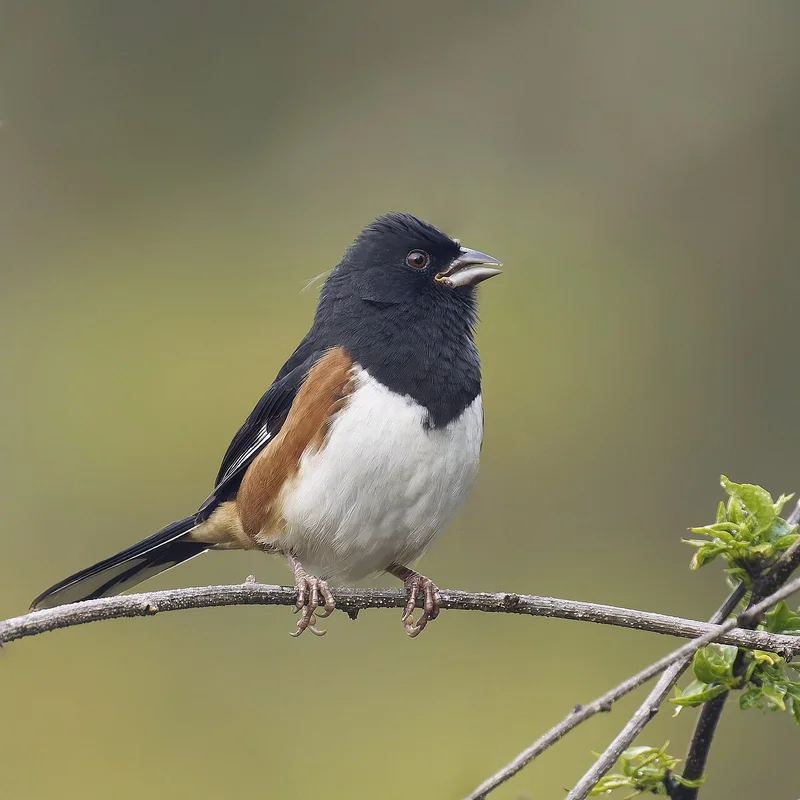 Featured photoeastern-towhee.jpg
Pipilo erythrophthalmus, the eastern towhee, is a large New World sparrow of the family Passerellidae, distributed across the eastern half of the United States. Adults are 17 to 23 cm long with a wingspan of 20 to 28 cm and weigh 32 to 52 g. Adult males show a glossy black head and back with chestnut flanks and a white belly; females are similar but warm brown replaces the male's black. The IUCN lists the species as Least Concern. Eastern towhees are skulkers of dense thickets, identified more often by their distinctive scratch-and-shuffle leaf-litter foraging than by direct sighting.
Quick facts
- Habitat
- Dense brushy thickets, woodland edges, second-growth scrub, and overgrown hedgerows. The species requires dense low cover for foraging and rarely emerges into open habitat.
- Range
- Eastern half of the United States from southern New England west to the Great Plains and south through Florida and the Gulf Coast. Northern populations migrate; southern populations are largely resident.
- Size
- 17–23 cm body · 20–28 cm wingspan · 32–52 g
- Plumage
- Adult males show a glossy black head, breast, back, and wings; chestnut flanks; pure white belly and undertail; and a long black tail with white outer-feather tips visible in flight. Adult females show the same pattern but with warm brown replacing the male's black. The eye is bright red across most of the range — the source of the species' Latin epithet 'erythrophthalmus' ('red-eyed'). The Florida subspecies has a paler yellow eye.
- Song
- Males give a clear three-note 'drink-your-TEA' or 'drink-tea' phrase from a perch — the textbook eastern towhee song. The call is a sharp 'chewink' or 'tow-hee' that gives the species its English name.
- Migration
- Partial migrant. Northern populations move south for winter to the southeastern United States; central and southern populations are largely resident.
- Conservation
- Least Concern (LC)
Overview
Pipilo erythrophthalmus is one of two Pipilo towhee species in the eastern United States (with the closely related spotted towhee P. maculatus of the West, lumped with this species through much of the twentieth century but split as a separate species in 1995). The English name 'towhee' is onomatopoeic from the species' sharp two-note call; folk names include 'chewink' from another rendering of the same call.
Distribution
The breeding range covers the eastern half of the United States. Northern populations migrate south for winter to the southeastern United States; central and southern populations are largely resident. Northern populations have declined modestly over recent decades from habitat changes (loss of brushy edges as second-growth forests mature into closed-canopy woodland), but the species remains widespread and locally common across the southeastern range.
Foraging behaviour
Eastern towhees are textbook leaf-litter scratchers. The species forages on the ground in dense thickets by performing a distinctive double-foot backward scratch — both feet kick backward simultaneously, exposing seeds and arthropods in the leaf litter that the bird then picks up. The action is louder than the bird itself and often identifies the species before it is seen. The same behaviour is shared with several other Pipilo and related Passerellidae genera.
Sources & further reading (2)
- iucn-red-list — accessed 2026-04-30
- encyclopedia — accessed 2026-04-30
Frequently asked questions
Why is it called a 'towhee'?
The English name is onomatopoeic from the species' sharp two-note call — variously rendered 'tow-hee', 'chewink', or 'cheee-wink' — that the bird gives frequently from cover. The call announces the bird's presence even when the bird is hidden in dense thickets, and is one of the most reliable identification cues for the species. The folk name 'chewink' from the same call is still used in parts of the southeastern US.
Are eastern and spotted towhees the same species?
No, not since 1995. The eastern towhee (Pipilo erythrophthalmus) and spotted towhee (P. maculatus) of the West were lumped as 'rufous-sided towhee' for much of the twentieth century. Molecular evidence and limited interbreeding in the central Great Plains contact zone showed the two retain reproductive isolation despite the lumped treatment, and they were split as separate species in 1995. The spotted towhee shows white spotting on the back and wings absent from the eastern.
Why do towhees scratch the leaf litter?
Eastern towhees forage by performing a distinctive double-foot backward scratch — both feet kick backward simultaneously, exposing seeds and arthropods hidden in the leaf litter. The action is louder than the bird itself and the rhythmic shuffle-scratch sound often identifies the species in dense thickets before it is visually observed. The behaviour is shared with several other Pipilo and Passerellidae genera and is a textbook example of double-scratch leaf-litter foraging in birds.