Sialia sialis
Eastern Bluebird (Sialia sialis)
 Featured photoeastern-bluebird.jpg
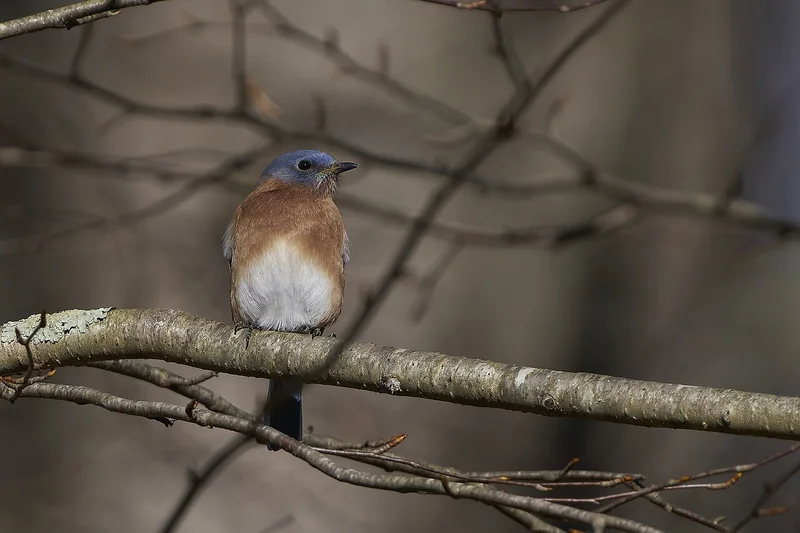
Sialia sialis, the eastern bluebird, is a small thrush of the family Turdidae, distributed across the eastern half of North America and into Central America. Adults are 16 to 21 cm long with a wingspan of 25 to 32 cm and weigh 27 to 34 g. Adult males show a brilliant sky-blue back, head, and tail; bright rusty-red breast and throat; and a white belly. Females are duller — pale blue-grey above with a paler buff breast. The IUCN lists the species as Least Concern. The species recovered strongly from a mid-twentieth-century population low after concerted nest-box conservation efforts.
Quick facts
- Habitat
- Open and semi-open country with scattered trees — pastures, orchards, golf courses, parks, and woodland edges. Cavity-nester reliant on natural tree hollows, old woodpecker holes, or human-made nest boxes.
- Range
- Eastern half of North America from southern Canada south through the eastern United States and into Mexico and Central America. Northern populations migrate; southern populations are largely resident.
- Size
- 16–21 cm body · 25–32 cm wingspan · 27–34 g
- Plumage
- Adult males show a bright sky-blue back, head, wings, and tail with a chestnut breast and throat and a white belly and undertail. Adult females are pale grey-blue above with a slightly paler buff breast and white belly. The blue colour is structural, produced by feather microstructure scattering light, so a damaged or wet feather appears dull grey-brown.
- Song
- A soft, mellow warble of two- or three-note phrases delivered from an exposed perch. The song is gentler than most thrushes' and is among the more peaceful voices of open eastern landscapes in spring.
- Migration
- Partial migrant. Northern populations move south for winter; populations in the southeastern United States are largely resident year-round.
- Conservation
- Least Concern (LC)
Overview
Sialia sialis is one of three Sialia bluebirds in North America (with the western bluebird S. mexicana and the mountain bluebird S. currucoides). The species is the state bird of Missouri and New York. Its bright plumage and association with open countryside have made it one of the most beloved garden birds across the eastern half of the United States.
Conservation history
Eastern bluebird populations declined sharply through the mid-twentieth century, dropping by an estimated ninety per cent across portions of the range. The drivers were habitat loss, introduced cavity-competitors (house sparrow, European starling), and pesticide impacts on insect prey. Concerted nest-box installation programmes from the 1970s onward — including the formation of the North American Bluebird Society — drove a strong recovery, and the species is now broadly stable or increasing across its range.
Behaviour
Eastern bluebirds are cavity nesters — they require pre-existing holes (natural tree hollows, old woodpecker excavations, or human-made boxes). Pairs may produce two or three broods per season across the southern range. Foraging is typically from a low perch, dropping to the ground to seize insects in a short fluttering attack — the textbook 'fly-down' foraging strategy of small thrushes.
Sources & further reading (2)
- iucn-red-list — accessed 2026-04-29
- encyclopedia — accessed 2026-04-29
Frequently asked questions
Why did eastern bluebird populations decline?
Mid-twentieth-century declines reflected combined drivers: loss of open-country with scattered trees as farms consolidated and exurbs developed, competition for nest cavities from introduced house sparrows and European starlings, and pesticide impacts on insect prey. By the 1970s populations across much of the range had declined by ninety per cent. Concerted nest-box programmes since reversed the trend, and the species is now broadly stable.
Why does the male bluebird's blue colour look different in different light?
The blue colour is structural, not pigmentary — produced by light scattering in feather microstructure. The wavelengths reflected to the eye depend on the angle of incoming light and the angle of viewing, so the same male appears bright sky-blue in direct overhead light, deeper navy from below, and dull grey-brown when wet or backlit. The same physics applies to most blue-coloured birds.
Why are bluebirds so reliant on nest boxes?
Eastern bluebirds are obligate cavity nesters but cannot excavate their own — they require a pre-existing hole. Natural tree hollows are scarce in modern open country with planted ornamental trees and aggressive removal of dead snags. Introduced house sparrows and European starlings out-compete bluebirds for the few cavities that remain. Human-supplied nest boxes (with size and entrance dimensions designed to admit bluebirds but exclude starlings) reverse the cavity shortage and have driven the species' recovery.