Calidris alpina
Dunlin (Calidris alpina)
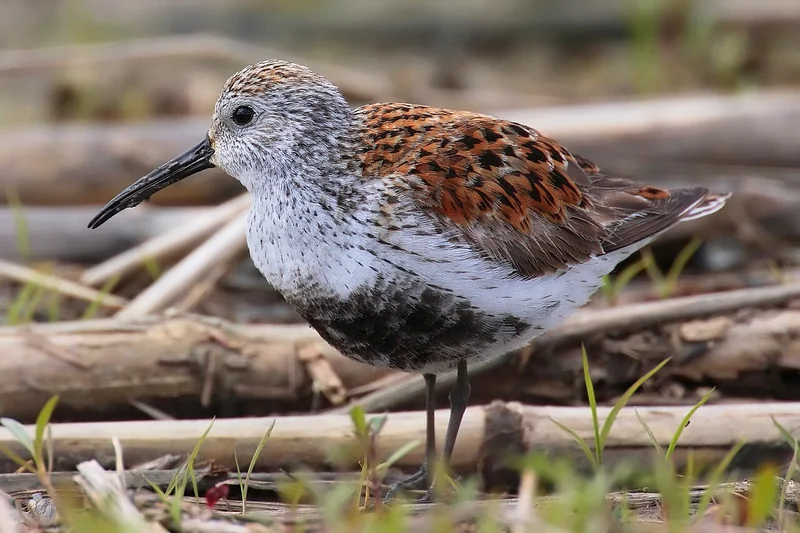 Featured photodunlin.jpg
Calidris alpina, the dunlin, is a small sandpiper of the family Scolopacidae and the most numerous small Calidris sandpiper of the Northern Hemisphere. Adults are 16 to 22 cm long with a wingspan of 36 to 46 cm and weigh 40 to 70 g. In breeding plumage the species shows a distinctive black belly patch unique among Palearctic sandpipers. The IUCN lists the species as Least Concern. Dunlins winter in enormous flocks on coastal mudflats and estuaries across temperate and subtropical latitudes.
Quick facts
- Habitat
- Breeds on Arctic and subarctic tundra and moorland near pools. Winters on coastal mudflats, estuaries, salt marshes, and sandy beaches. Occasionally found on inland muddy margins during migration.
- Range
- Breeds across the Holarctic Arctic and subarctic from Alaska and northern Canada through Greenland, Iceland, Scandinavia, and Russia to eastern Siberia. Winters on temperate and subtropical coasts worldwide.
- Size
- 16–22 cm body · 36–46 cm wingspan · 40–70 g
- Plumage
- Breeding adults have rufous-chestnut upperparts, white underparts with a prominent black belly patch, and a grey-brown head with dark streaking. The bill droops slightly at the tip — a useful field mark. Non-breeding adults are plain grey above and white below, losing the black belly. Juveniles show scaly brown upperparts and buffy breast streaking.
- Song
- A low, purring 'kreee' or 'prrt' flight call, often given by flock members. The territorial song on the breeding grounds is a sustained, buzzing trill delivered in a sky-dancing display flight.
- Migration
- Long-distance migrant. Arctic breeders travel to temperate and subtropical coasts in autumn; some populations log over 5,000 km between breeding and wintering areas. Migrates in dense flocks performing spectacular aerial murmurations over estuaries.
- Conservation
- Least Concern (LC)
Overview
Calidris alpina is placed in the diverse sandpiper genus Calidris and is considered the most abundant small wader of the Northern Hemisphere, with a global population estimated at 4–6 million individuals. Multiple subspecies are recognised across the Holarctic, differing subtly in size, bill length, and breeding-plumage intensity. The species is named for the alpine or arctic habitat association — the Latin 'alpina' means 'of the mountains' (used loosely for high or northern habitats).
Estuary murmurations
Wintering dunlins concentrate on temperate coastal estuaries in flocks of tens of thousands, performing tight aerial murmurations that appear as dark ribbons undulating over mudflats. The synchronised turning behaviour is thought to confuse aerial predators such as peregrine falcons. Individual birds within the flock respond to their nearest neighbours in under 70 milliseconds — faster than their visual reaction time, implying a wave-like information cascade through the flock. Dunlin murmurations over estuaries such as the Wash (UK) or Wadden Sea are among the most spectacular shorebird displays in the world.
Breeding biology
Dunlins arrive on Arctic breeding grounds from late May and establish territories on open tundra near shallow pools. The nest is a shallow grass-lined scrape hidden in low vegetation. Both sexes share incubation of 4 eggs for 21–22 days. Chick-rearing is often left to the male, with the female departing after the chicks hatch — an unusual system among sandpipers. Chicks are precocial and fledge at 19–21 days.
Sources & further reading (2)
- iucn-red-list — accessed 2026-05-07
- encyclopedia — accessed 2026-05-07
Frequently asked questions
How do dunlins find food on mudflats?
Dunlins use a combination of visual and tactile hunting — probing rapidly into soft mud with the slightly drooped bill tip. The bill contains mechanoreceptors (Herbst corpuscles) that detect vibrations and pressure changes from invertebrates buried in the substrate, allowing the bird to locate and capture prey without seeing it directly. This 'remote touch' system is shared with snipe and woodcocks.
What is the black belly patch in dunlin breeding plumage?
The large, sharply defined black belly patch is unique among Palearctic Calidris sandpipers and is the easiest field mark for breeding-plumage adults. It appears from April onward and fades after the breeding season as the bird moults into the uniform grey-and-white non-breeding plumage. The patch is thought to play a role in mate recognition on the breeding grounds, though its precise function is not fully understood.
Do dunlins really perform murmurations like starlings?
Yes — wintering dunlin flocks over estuaries perform tight aerial murmurations comparable to starling murmurations. Flocks of thousands to tens of thousands of birds turn and bank in synchrony, often in response to a peregrine falcon attack. Studies show that information about a directional change propagates through the flock in under 70 milliseconds per bird — faster than individual visual reaction time — suggesting a wave-like cascade rather than each bird independently watching the falcon.