Dryobates pubescens
Downy Woodpecker (Dryobates pubescens)
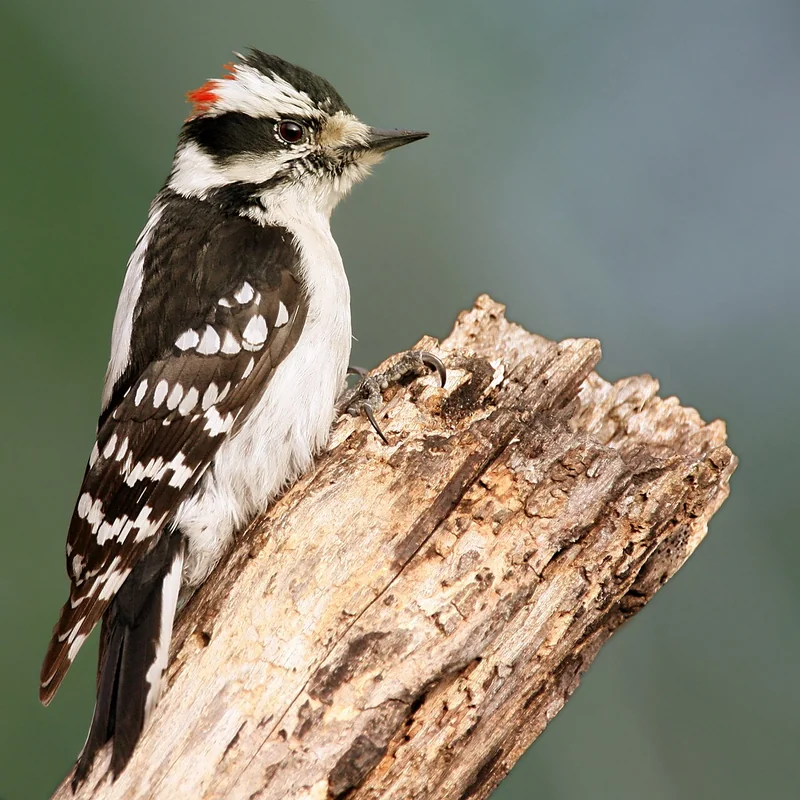 Featured photodowny-woodpecker.jpg
Dryobates pubescens, the downy woodpecker, is the smallest woodpecker in North America. Adults are 14 to 17 cm long with a wingspan of 25 to 31 cm and weigh 21 to 28 g. The plumage is sharply pied — black above with a white back-stripe, white underparts, and a bold black-and-white head pattern. The IUCN lists the species as Least Concern. The downy is among the most familiar feeder visitors across North American forests, and its small size and trusting behaviour make it a textbook backyard woodpecker.
Quick facts
- Habitat
- Mixed and deciduous woodland, woodland edges, suburbs, and city parks. The species is one of the most adaptable woodpeckers in North America and tolerates much smaller wooded patches than its larger relatives.
- Range
- Most of forested North America from southern Alaska and Canada south through the contiguous United States. The species is resident year-round across nearly the entire range. Several recognized regional subspecies show subtle plumage variation but the species' field appearance is consistent.
- Size
- 14–17 cm body · 25–31 cm wingspan · 21–28 g
- Plumage
- Adults show a black back with a clean white central back-stripe, white underparts, black wings spotted white, and a bold black-and-white striped head pattern. Adult males show a small bright red patch at the back of the crown; females lack the red and have a clean white nape. The bill is short and straight — much shorter than the closely similar but larger hairy woodpecker's bill, the easiest field separating mark.
- Song
- A high descending whinny — a rapid descending series of notes. Calls also include a sharp 'pik' or 'pic' note. The drumming is fast and quiet compared with larger woodpeckers'.
- Migration
- Resident year-round throughout the range. Local movements occur but no regular migration.
- Conservation
- Least Concern (LC)
Overview
Dryobates pubescens is the smallest woodpecker in North America and one of the most familiar feeder-visiting woodpeckers across the continent. The species was previously placed in Picoides; molecular phylogeny moved it to Dryobates with several other small woodpeckers in 2018. The English name 'downy' refers to the soft white feathers covering the white back patch — a feature absent in the otherwise very similar but larger hairy woodpecker.
Distribution
The breeding range covers most of forested North America. The species' adaptability — tolerating small wooded patches, suburban trees, and even city parks — has produced a continental population estimated by Partners in Flight at over fourteen million. Bird feeders, especially suet feeders, support large local populations through cold winters. The species is among the most-banded small forest birds in North America.
Hairy vs. downy
The downy woodpecker is sometimes called 'the small white-backed pied woodpecker'; the visually similar but much larger hairy woodpecker (Dryobates villosus) is its 'large' counterpart. The two species' co-existence across most of forested North America has long been a textbook example of size-based ecological niche partitioning — the small downy gleans bark surface and probes thin twigs, while the larger hairy excavates deeper wood. Distinguishing the two in the field is a near-universal task for anyone learning North American woodpeckers.
Sources & further reading (2)
- iucn-red-list — accessed 2026-04-29
- encyclopedia — accessed 2026-04-29
Frequently asked questions
How can I tell a downy from a hairy woodpecker?
Both are crisp black-and-white woodpeckers with a similar pattern but several reliable features separate them. Bill length is the most reliable: downy bill is much shorter than the head's depth, hairy bill is about the same length as head depth. Body size: downy is roughly sparrow-sized (14-17 cm), hairy is robin-sized (23-26 cm). The downy's outer tail feathers show small black spots; the hairy's outer tail feathers are clean white. With both species at the same feeder, the size difference is striking.
Why is it called 'downy'?
The English name refers to the soft white feathers covering the white back patch — a 'downy' feel to the breast and back compared with the harder, more bristle-textured feathers of the closely similar but larger hairy woodpecker. The naming convention has nothing to do with the bird being especially soft-feathered overall; it specifically distinguishes it from its larger counterpart.
Why do downy woodpeckers love suet feeders?
Suet (rendered animal fat, often with embedded seeds or insects) is energy-dense and broadly similar to the bark-extracted invertebrate fat the species naturally seeks. The suet block also provides a vertical surface to cling to, mimicking the bird's natural tree-trunk foraging position. Downy woodpeckers have learned to use suet feeders heavily across most of North America, particularly during cold winters when natural insect prey is scarce.