Nannopterum auritum
Double-crested Cormorant (Nannopterum auritum)
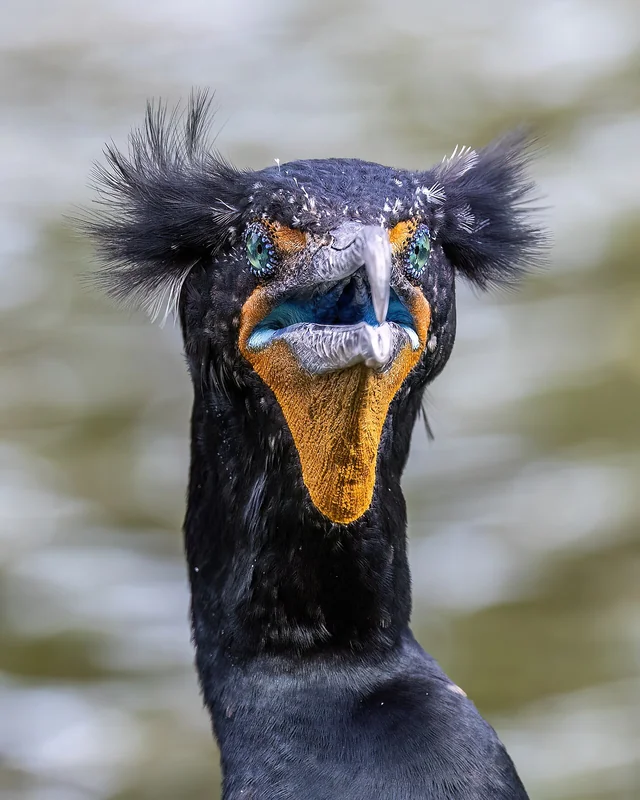 Featured photodouble-crested-cormorant.jpg
Nannopterum auritum, the double-crested cormorant, is a large waterbird of the family Phalacrocoracidae, and the most widespread cormorant of North America. Adults are 70 to 90 cm long with a wingspan of 114 to 123 cm and weigh 1.2 to 2.5 kg. The species is named for the small double crest present briefly during the breeding season. The IUCN lists the species as Least Concern. The population increased dramatically after DDT restrictions were lifted in the 1970s.
Quick facts
- Habitat
- Inland lakes, rivers, estuaries, coastal harbours, and rocky islets across North America. Highly adaptable — breeds on both freshwater and marine sites, nesting colonially in trees, on cliff ledges, or on the ground on predator-free islands.
- Range
- Breeds throughout North America from Alaska and Canada south to Mexico and the Caribbean, on both Atlantic and Pacific coasts and extensively inland. Winters on all coastlines south to Central America and the Gulf of Mexico.
- Size
- 70–90 cm body · 114–123 cm wingspan · 1200–2500 g
- Plumage
- Adults are entirely glossy black with a bright orange-yellow throat pouch (gular sac) and vivid turquoise-green eyes — both most intense during the breeding season. The diagnostic double crest of black and white curling feathers on the crown is visible only briefly in early spring and quickly shed. Juveniles are dark brown with a pale breast and duller gular sac.
- Song
- A deep, guttural grunting 'ugh-ugh-ugh' or a low croaking, used at the colony. Otherwise largely silent.
- Migration
- Partially migratory. Northern inland populations move to coasts and southern areas in winter. Coastal and southern populations are largely sedentary. Some individuals travel hundreds of kilometres between breeding and wintering areas.
- Conservation
- Least Concern (LC)
Overview
Nannopterum auritum was long placed in the large genus Phalacrocorax before molecular phylogenies supported splitting the group. The double-crested cormorant is the most abundant cormorant in North America, with a population estimated at approximately 1.5 million breeding pairs — a figure that has grown substantially since the DDT era. The species' adaptability to both freshwater and marine environments and its use of artificial habitats (docks, buoys, power-line towers) make it highly visible across the continent.
Population recovery and controversy
Double-crested cormorant populations collapsed in the mid-20th century due to DDT-induced egg-shell thinning and direct persecution. After DDT restrictions took effect in the early 1970s, the population rebounded dramatically — growing by over 3,000% in some regions. This recovery generated conflict with fisheries and aquaculture interests, as large colonies can affect fish populations in enclosed water bodies. Management actions including egg oiling and culling have been implemented in some areas, generating ongoing debate about coexistence between cormorant recovery and aquaculture protection.
Wing-spreading behaviour
Double-crested cormorants are frequently observed standing with wings spread wide in a crucifix pose — a characteristic behaviour also shown by anhingas and some other diving birds. Unlike most waterfowl, cormorant feathers are only partially waterproof, which reduces buoyancy and aids underwater manoeuvrability during diving, but means the birds must dry their wings after each diving bout. The wing-spreading posture facilitates rapid drying and may also play a thermoregulatory role.
Sources & further reading (2)
- iucn-red-list — accessed 2026-05-07
- encyclopedia — accessed 2026-05-07
Frequently asked questions
Why does the cormorant stand with wings spread?
Double-crested cormorants (and other cormorant species) partially wet their feathers to reduce buoyancy and improve underwater diving efficiency. Unlike most waterbirds, their feathers are only partially waterproof, so the birds must dry them after diving. The characteristic wing-spreading posture — sometimes called the 'spread-eagle' or 'crucifix' pose — facilitates evaporative and radiative drying. Cormorants may also hold the pose for thermoregulation.
What is the 'double crest' the species is named for?
In early spring, breeding adults briefly develop two small tufts of curling feathers on the top of the head — one tuft of white feathers and one of black feathers. This diagnostic double crest is visible only for a few weeks before the breeding season and is quickly shed, leaving the plain black crown seen in non-breeding adults. Most field encounters are with birds lacking the crest.
Is the double-crested cormorant harmful to fish populations?
At large breeding colonies near enclosed water bodies such as fish farms or small lakes, local fish populations can be significantly affected by cormorant predation. However, at larger scales the impact on wild fish populations is generally considered to be within natural variation. Management has been implemented at specific conflict sites, including egg oiling and lethal control, though these actions remain controversial among conservation biologists.