Grus virgo
Demoiselle Crane (Grus virgo)
 Featured photodemoiselle-crane.jpg
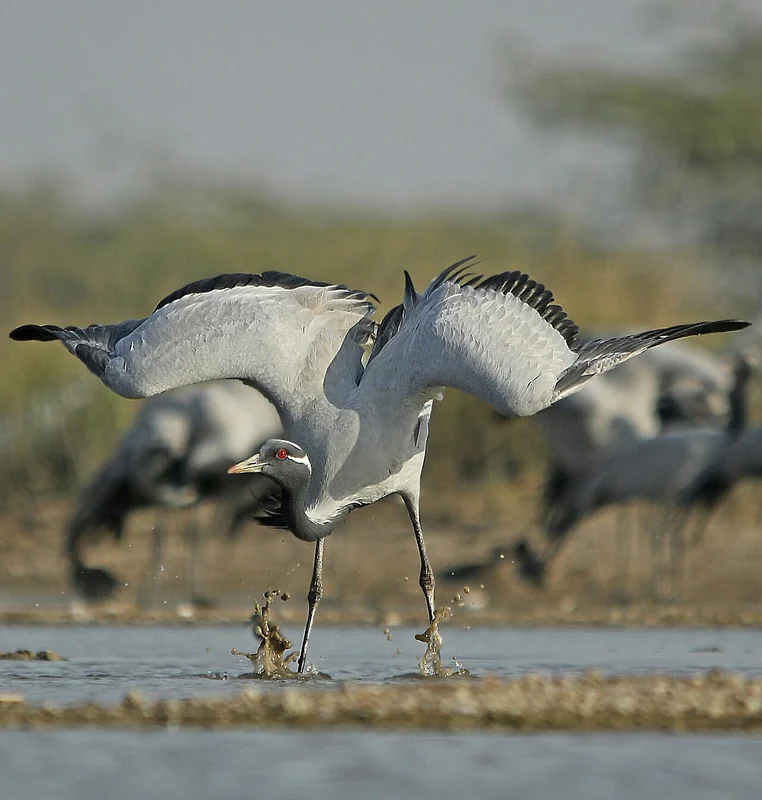
Grus virgo (formerly Anthropoides virgo), the demoiselle crane, is the smallest of the 15 crane species, breeding across the steppes of the Palearctic from Turkey to Mongolia. Adults are 85 to 100 cm long with a wingspan of 155 to 180 cm and weigh 2.2 to 2.7 kg. The species is celebrated for its graceful appearance — inspiring the French name 'demoiselle' (young lady) — and for its extraordinary migration over the Himalayan passes to winter in India. The IUCN lists the species as Least Concern.
Quick facts
- Habitat
- Breeds on dry open steppe, grassland, semi-desert, and high-altitude plateaus from sea level to 5,000 m in central Asia. Winters in dry open country, agricultural plains, and river floodplains of India, Pakistan, Sudan, and Ethiopia.
- Range
- Breeds from Turkey, Romania, and Ukraine east through Russia, Kazakhstan, Mongolia, and northern China. Winters primarily in India (particularly Rajasthan and Gujarat), Pakistan, Sudan, Ethiopia, and the Sahel. Populations also in North Africa.
- Size
- 85–100 cm body · 155–180 cm wingspan · 2200–2700 g
- Plumage
- Adults are blue-grey overall with a black head and breast, long white ear-tufts extending behind the eye, and elongated black breast plumes hanging from the lower neck. The elongated inner tertials form a tail-like drape. The eye is red. Juveniles are grey without the black head and breast ornaments, which develop gradually. Sexes are similar; males are slightly larger.
- Song
- A higher-pitched, more bugling call than the common crane — a 'krr-krr-krr' or 'garoo' given in flight and at rest. Less resonant than the common crane but still far-carrying in open steppe.
- Migration
- Long-distance migrant. Central Asian breeding populations fly south over the Himalayas to India — crossing passes at altitudes exceeding 5,000 m. The Himalayan crossing is the most extreme altitude migration of any crane.
- Conservation
- Least Concern (LC)
Overview
Grus virgo — formerly placed in the separate genus Anthropoides — is the smallest and most graceful of the world's fifteen crane species. The French naturalist Buffon gave the bird its popular name 'demoiselle' (meaning 'young lady' or 'damselfly') in 1781, inspired by its refined, balletic appearance compared with the larger common crane. The species is the most abundant crane in Asia, with the global population estimated at 200,000–240,000 individuals. The Rajasthani village of Khichan in western India hosts a famous wintering concentration of up to 30,000 demoiselle cranes annually.
Himalayan migration
The demoiselle crane's migration between Central Asian breeding grounds and Indian wintering areas is one of the most arduous known migrations of any bird — involving the crossing of the main Himalayan range at altitudes above 5,000 m, with recorded crossings over passes reaching 5,400 m. At such altitudes the air is less than half as dense as at sea level, and oxygen partial pressure requires the birds to fly harder for the same lift. Radio-tracking studies have documented individual birds completing the Himalayan crossing without stopping in a single flight of 7–8 hours. The species is thought to avoid the high-altitude crossing until autumn cold drives it south and spring warmth is established in the north.
Conservation and cultural significance
Demoiselle cranes have a long relationship with human cultures across their range. In India, the wintering birds (called 'kurja' in Rajasthani) are sacred in some communities and are deliberately fed at Khichan village by local people — creating one of the most extraordinary crane-human coexistence examples in the world. In Central Asian cultures the crane is a symbol of longevity and good fortune. The species is currently Least Concern, but pressure from agricultural intensification, wetland drainage, and power-line collisions is monitored as potential future threats to breeding populations.
Sources & further reading (2)
- iucn-red-list — accessed 2026-05-07
- encyclopedia — accessed 2026-05-07
Frequently asked questions
Why is it called a demoiselle?
The French name 'demoiselle' (meaning 'young lady' or 'damsel') was given to the species in 1781 by the naturalist Buffon to distinguish its refined, graceful appearance from the larger, stockier common crane. The name became the standard English name for the species. The combination of a slender body, long ornamental white ear-tufts, and elegant elongated black breast feathers gives the bird a particularly delicate, 'genteel' appearance compared with other cranes.
How do demoiselle cranes survive the Himalayan crossing?
Demoiselle cranes cross the main Himalayan range at altitudes of 5,000–5,400 m — conditions where oxygen partial pressure is less than half that at sea level. They fly in V-formation, which allows each bird (except the leader) to benefit from the upwash of the bird ahead — reducing the energy expenditure for followers. The birds also take advantage of updrafts on the southern slopes of passes. Radio-tracking has shown individual cranes completing the high-altitude crossing non-stop in 7–8 hours.
Where is the best place to see wintering demoiselle cranes?
The village of Khichan in Rajasthan, India, is the most famous site for demoiselle cranes in the world. Local families have been feeding the wintering cranes for generations, and up to 30,000 cranes may gather in the fields around the village from October to March. The birds are fed grain and are completely habituated to human presence, providing extraordinary close-up viewing. The site is widely considered one of the greatest wildlife spectacles in South Asia.