Junco hyemalis
Dark-eyed Junco (Junco hyemalis)
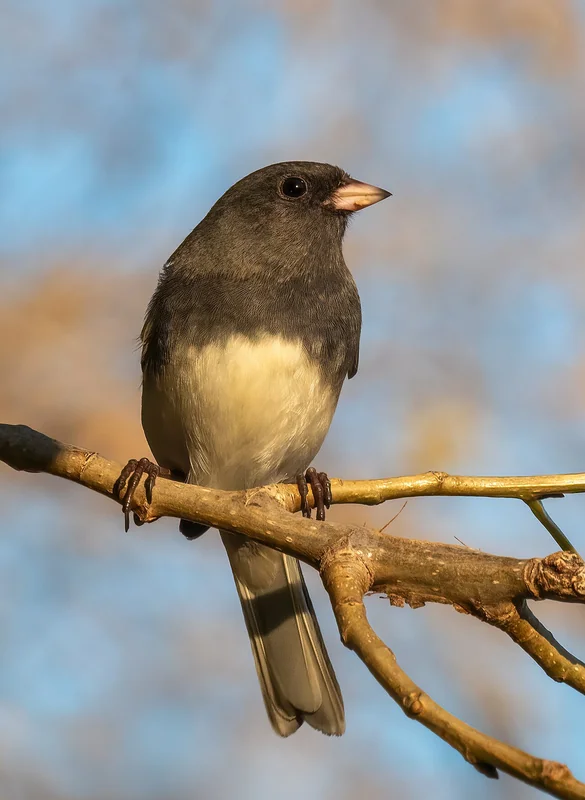 Featured photodark-eyed-junco.jpg
Junco hyemalis, the dark-eyed junco, is a small New World sparrow of the family Passerellidae, distributed across most of North America. Adults are 13 to 17.5 cm long with a wingspan of 18 to 25 cm and weigh 18 to 30 g. The species shows striking geographic variation across regional plumage groups (slate-coloured, Oregon, white-winged, grey-headed, pink-sided, red-backed) historically treated as separate species. The IUCN lists the species as Least Concern. Junco hyemalis is one of the most numerous and familiar winter feeder visitors across temperate North America.
Quick facts
- Habitat
- Coniferous and mixed forest, forest edges, and during winter a wide range of brushy and suburban habitats. Breeds in northern boreal and montane forests; winters across most of the temperate United States.
- Range
- Breeds across boreal Canada, Alaska, and montane western North America. Winters across most of the contiguous United States and into northern Mexico. The species' winter range expansion southward each autumn is one of the most predictable seasonal arrivals at North American feeders.
- Size
- 13–17.5 cm body · 18–25 cm wingspan · 18–30 g
- Plumage
- Highly variable across regional forms. The eastern slate-coloured group is uniformly dark slate-grey above and on the breast, with a white belly and white outer tail feathers. The western Oregon group has a brown back and pink flanks against the same grey hood. All groups share white outer tail feathers — a striking flash visible when the bird flies away.
- Song
- A simple, even-pitched musical trill of about two seconds, often delivered from a high perch in conifers. The trill resembles that of the chipping sparrow but is more musical and less mechanical.
- Migration
- Partial migrant. Most northern breeders move south for winter; populations in the western mountains and along the Pacific coast are largely resident.
- Conservation
- Least Concern (LC)
Overview
Junco hyemalis is the most widespread of the Junco sparrows. The species shows extraordinary geographic plumage variation: the slate-coloured (eastern), Oregon (Pacific coastal), pink-sided (Rocky Mountain), grey-headed (Great Basin), red-backed (southwestern), and white-winged (Black Hills) groups were historically treated as separate species and were lumped into a single species (J. hyemalis) only in the 1970s. The current taxonomy may yet be revised again.
Distribution
The breeding range covers boreal Canada, Alaska, and the high western mountains. The winter range covers most of the contiguous United States and northern Mexico — the species' autumn arrival at lower-elevation feeders is one of the most predictable seasonal events on the North American bird-watching calendar. Christmas Bird Counts often record juncos as the most numerous species of any.
Behaviour
Wintering juncos form loose flocks that forage on the ground beneath dense cover, scratching leaf litter for seeds. The species shows a stable winter dominance hierarchy within flocks; older birds and males typically rank above younger and female birds. The white outer tail feathers flash conspicuously when a junco flies — likely a flock-coordination signal that helps maintain group cohesion in dense vegetation.
Sources & further reading (2)
- iucn-red-list — accessed 2026-04-29
- encyclopedia — accessed 2026-04-29
Frequently asked questions
Why are dark-eyed juncos called 'snowbirds'?
The species' autumn arrival at lower-elevation feeders coincides with the first snowfalls across most of the temperate United States, and the dark slate plumage stands out vividly against snow. The folk name 'snowbird' has been recorded in American English since the early nineteenth century. The bird is among the most reliable seasonal arrivals on the North American Christmas Bird Counts.
Are the regional plumage groups separate species?
Currently no — the slate-coloured (eastern), Oregon (Pacific), pink-sided, grey-headed, red-backed, and white-winged groups are all treated as subspecies of Junco hyemalis. Until the 1970s many were ranked as separate species. Molecular and behavioural data suggest the lumped treatment is reasonable but not unambiguous, and a future split into two or more species (with at least 'Oregon junco' as a distinct species) remains plausible.
What do the white outer tail feathers do?
The white outer tail feathers flash conspicuously when a junco flies, especially as a wintering flock disperses from a feeder. The flash likely serves as a flock-coordination signal — birds tracking the white flash can maintain group cohesion in dense brush and snow. White outer tail feathers occur in several other small ground-foraging songbirds (vespers sparrow, eastern meadowlark) where similar functions are inferred.