Priotelus temnurus
Cuban Trogon (Priotelus temnurus)
 Featured photocuban-trogon.jpg
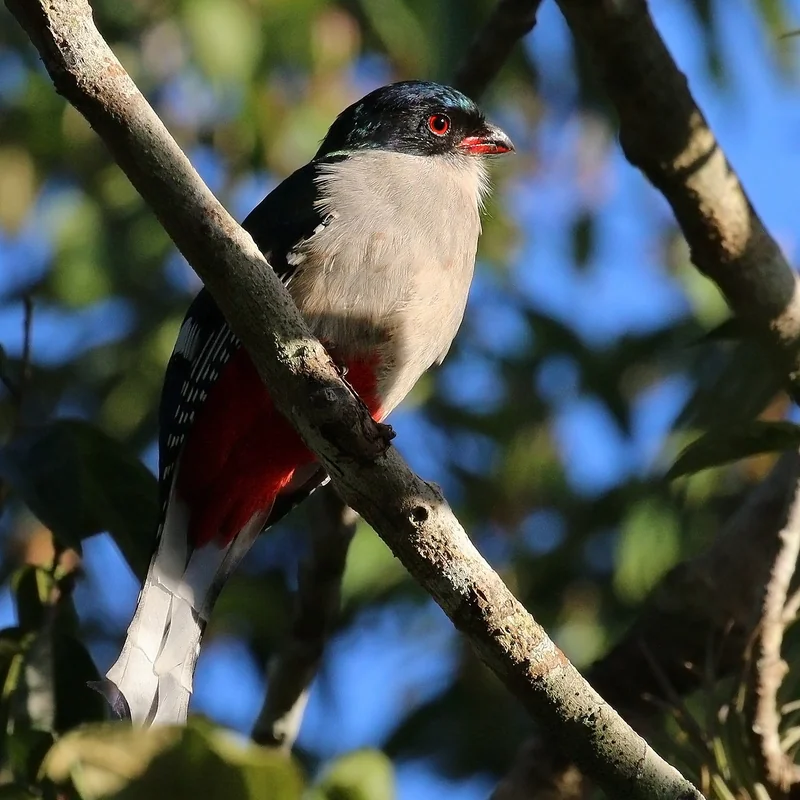
Priotelus temnurus, the Cuban trogon, is a medium-sized trogon of the family Trogonidae, endemic to Cuba and the Isle of Youth. Adults are 25 to 28 cm long with a wingspan of 30 to 35 cm and weigh 44 to 70 g. The species combines a metallic blue-green head and upperparts, white chest, and vivid crimson-red belly — the colours of the Cuban flag — making it one of the most patriotically symbolic national birds in the world. The IUCN lists the species as Least Concern.
Quick facts
- Habitat
- Humid montane and lowland forests, semi-deciduous forest, and dense woodland across Cuba. Strongly associated with mature forest with closed canopy. Found from sea level to the highest elevations of the Sierra Maestra. Also occurs in coffee and cacao plantations with shade trees.
- Range
- Endemic to Cuba (including Isle of Youth and surrounding small cays). Does not occur naturally anywhere outside Cuba. One of Cuba's two endemic trogons (the other is the Cuban tody, a related family).
- Size
- 25–28 cm body · 30–35 cm wingspan · 44–70 g
- Plumage
- Adults have an iridescent violet-blue head and nape, metallic blue-green back and wings, white chin and upper breast, a broad purplish-violet breast band, and vivid red-crimson lower breast and belly. The tail is blue-green above and white below with unusual frayed, comb-like tail-tip feathers unique to the genus Priotelus. The bill is short and broad with a serrated cutting edge.
- Song
- A repeated soft 'toco-toco-tocoro-tocoro' — a rhythmic call that gave the bird its Cuban popular name 'tocororo'. Also gives a louder 'tocororo' call used in territorial contexts. The call is one of the most recognisable sounds of Cuban forest.
- Migration
- Sedentary. The species is entirely resident in Cuba and does not migrate.
- Conservation
- Least Concern (LC)
Overview
Priotelus temnurus is one of two species in the genus Priotelus — the other being the Hispaniolan trogon (P. roseigaster) of Hispaniola. Both are endemic to Caribbean island groups and represent the Caribbean branch of the trogon family Trogonidae, which is otherwise dominated by Neotropical and Afrotropical genera. The Cuban trogon has been the national bird of Cuba since 1981. It was chosen partly for its symbolic colour combination and partly because, like the Cuban flag, it cannot be kept in captivity — the species reportedly refuses to eat in captivity and dies, making it an emblem of Cuban independence and freedom.
The Cuban flag in feathers
The Cuban trogon is the only bird whose plumage explicitly mirrors the colours of its country's national flag — red, white, and blue, the colours of the Cuban flag since 1849. The crimson-red belly, white chest, and metallic blue-green head combine in a vertical arrangement that directly echoes the flag's design. This colour correspondence, combined with the species' endemism and the legend of its refusal to survive in captivity, made the tocororo an irresistible national symbol. The bird features on Cuban postage stamps and is referenced in Cuban poetry and art.
Trogon family characteristics
Trogons (family Trogonidae) are pantropical birds characterised by brilliant plumage, short legs with the unusual heterodactyl toe arrangement (two toes facing forward, two facing backward — unique among birds), and a long tail. All trogons are cavity-nesters — they excavate nesting holes in rotten wood or termite mounds. The Cuban trogon nests in natural tree cavities or woodpecker holes rather than actively excavating. Like all trogons, the species sits motionless for long periods in dense vegetation, making it easily overlooked despite its brilliant plumage.
Sources & further reading (2)
- iucn-red-list — accessed 2026-05-07
- encyclopedia — accessed 2026-05-07
Frequently asked questions
Why is the Cuban trogon Cuba's national bird?
The Cuban trogon was designated Cuba's national bird in 1981. The primary reason is its plumage — red, white, and blue in a vertical arrangement that mirrors the colours of the Cuban flag (adopted 1849). A secondary reason is the popular belief that the tocororo refuses to survive in captivity and dies if caged — making it a symbol of Cuban freedom and independence that cannot be owned. The story of its 'uncageable' nature is deeply embedded in Cuban cultural identity.
What is the frayed tail of the Cuban trogon for?
The Cuban trogon and its close relative the Hispaniolan trogon (genus Priotelus) are unique among trogons in having distinctive frayed or comb-like feather tips on the tail — an unusual modification not found in any other trogon genera. The function is not fully understood but may play a role in display or be related to the different selective pressures on an island-endemic species compared to continental trogons with many competing species.
Is the tocororo really impossible to keep in captivity?
The popular belief that the Cuban trogon cannot survive in captivity is well established in Cuban culture but not comprehensively verified by scientific study. Like most trogons, the species is difficult to maintain in captivity because it is a specialist frugivore and insectivore that rarely habituates to captive feeding regimes. Historical and anecdotal accounts of captive birds declining rapidly contributed to the cultural narrative. Most captive attempts with trogons globally have been unsuccessful, making the Cuban trogon's reputation broadly consistent with trogon biology.