Aethopyga siparaja
Crimson Sunbird (Aethopyga siparaja)
 Featured photocrimson-sunbird.jpg
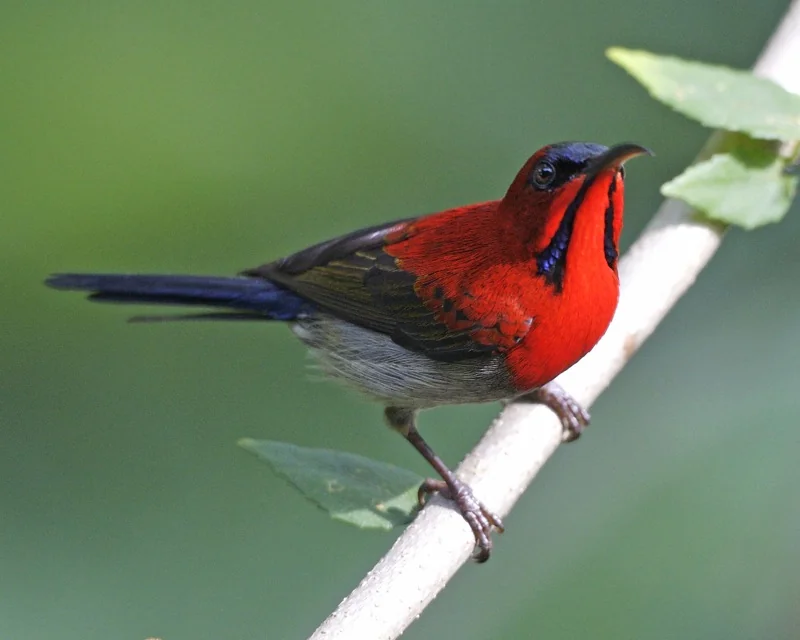
Aethopyga siparaja, the crimson sunbird, is a small nectarivorous passerine of the family Nectariniidae, widespread across South and Southeast Asia. Adult males are 11 to 12 cm long with a wingspan of 11 to 13 cm and weigh 5 to 9 g. Males display brilliant crimson upperparts and throat with yellow underparts and a metallic green crown and tail. The IUCN lists the species as Least Concern. It is the national bird of Singapore.
Quick facts
- Habitat
- Tropical and subtropical forest edges, secondary growth, mangroves, gardens, and plantations across South and Southeast Asia. Strongly associated with flowering trees and shrubs that provide nectar, particularly in forest edge and disturbed habitats.
- Range
- South and Southeast Asia — from northeastern India and Bangladesh through Myanmar, Thailand, Malaysia, Singapore, Indonesia (Sumatra, Java, Borneo), and the Philippines north to southern China and Taiwan.
- Size
- 11–12 cm body · 11–13 cm wingspan · 5–9 g
- Plumage
- Males have a brilliant crimson head, throat, upper back, and rump with iridescent metallic green crown and long central tail feathers, and a bright yellow belly and lower breast. Females are olive-green above and pale yellowish-olive below without the red or green iridescence. The long, decurved bill is characteristic of all sunbirds.
- Song
- A rapid, sharp 'tseep' or 'chi-chi-chi' call and a fast, high-pitched warbling song delivered from a perch. Males call persistently to advertise territory around flowering trees.
- Migration
- Sedentary to locally nomadic, following seasonal flowering patterns. No regular long-distance migration.
- Conservation
- Least Concern (LC)
Overview
Aethopyga siparaja is one of the most widespread species in the genus Aethopyga — a group of small sunbirds restricted to Asia. The genus includes some of the most brilliantly coloured small birds in the world, paralleling the hummingbirds of the Americas in ecological role (nectarivory) and plumage intensity. The crimson sunbird was designated the national bird of Singapore in 2023 by the Nature Society Singapore and is one of the most frequently photographed birds in urban gardens across Southeast Asia.
Nectarivory and pollination
Crimson sunbirds are important pollinators across their range, visiting flowers of many tree and shrub species and transferring pollen on their heads and bills between flowers. Unlike hummingbirds, sunbirds do not hover while feeding — they perch on or near flowers and probe with the long decurved bill, or pierce the base of long-tubed flowers to access nectar (nectar-robbing) without entering the correct pollination position. The interaction between sunbirds and their floral hosts across South and Southeast Asia is a major driver of plant-pollinator coevolution in the region.
National bird of Singapore
The crimson sunbird was selected as Singapore's national bird in 2023 through a public poll organised by the Nature Society Singapore — the first time Singapore had formally designated a national bird. The species received 45% of more than 52,000 votes, ahead of the oriental magpie-robin and other candidates. The selection reflects the crimson sunbird's abundance in Singapore's urban gardens and parks, its striking appearance, and its role as a symbol of tropical nature thriving in a highly urbanised environment. The choice also recognised the bird's ability to adapt to human-modified landscapes while remaining wild.
Sources & further reading (2)
- iucn-red-list — accessed 2026-05-07
- encyclopedia — accessed 2026-05-07
Frequently asked questions
Is the crimson sunbird the Asian equivalent of a hummingbird?
In ecological terms, yes — sunbirds occupy the nectarivore pollinator niche in the Old World tropics in much the same way hummingbirds do in the Americas. However, sunbirds and hummingbirds are not closely related: sunbirds are passerines (family Nectariniidae) and hummingbirds belong to the order Apodiformes. The similarities in long decurved bills, iridescent plumage, and floral foraging are convergent evolution driven by the same ecological pressures.
Why is it Singapore's national bird?
The crimson sunbird was selected as Singapore's national bird in 2023 following a public poll in which it received 45% of over 52,000 votes. The species is abundant in Singapore's urban parks and gardens and is widely recognized as a symbol of tropical nature adapting to urban environments. Its brilliant plumage, small size, and frequent appearance at garden flowers made it the popular choice.
What is nectar-robbing?
Nectar-robbing occurs when a bird pierces the base of a flower tube — bypassing the flower's legitimate pollen-transfer pathway — to access the nectar without picking up or depositing pollen. The plant gets no pollination service in exchange for its nectar. Crimson sunbirds practice nectar-robbing on long-tubed flowers whose nectar is otherwise inaccessible. On short-tubed flowers the same bird acts as a legitimate pollinator, so individual birds can be both pollinators and robbers depending on the flower species.