Lophophanes cristatus
European Crested Tit (Lophophanes cristatus)
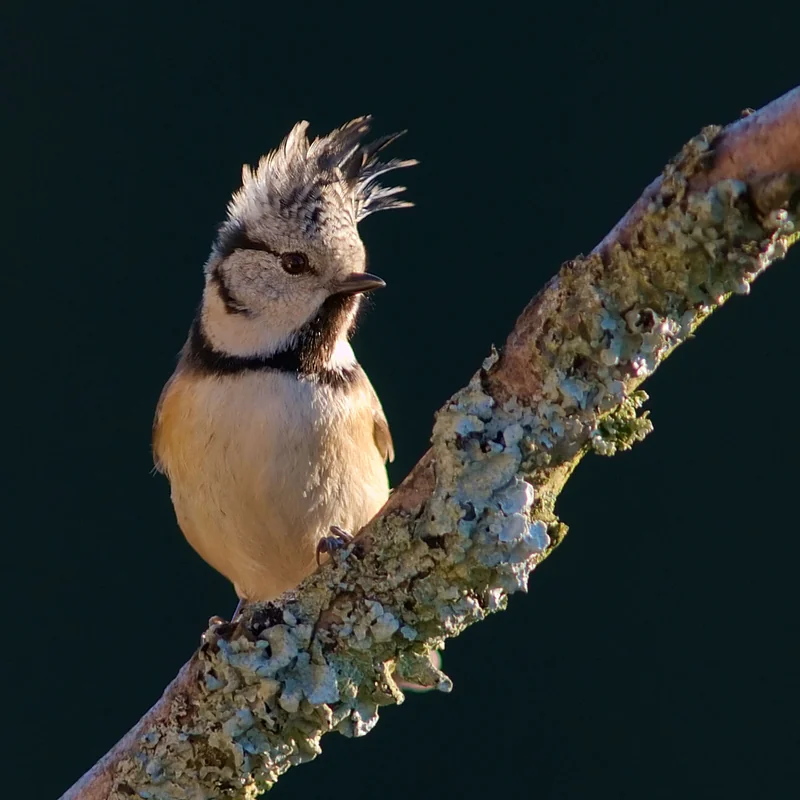 Featured photocrested-tit.jpg
Lophophanes cristatus, the European crested tit, is a small Paridae of mature pine forest across most of Europe. Adults are 10.5 to 12 cm long with a wingspan of 17 to 20 cm and weigh 9 to 13 g. The plumage is grey-brown above and pale buff below, with a striking pointed crest of black-and-white speckled feathers. The IUCN lists the species as Least Concern. The species is one of the most-faithful pine-forest specialists in the European tit family.
Quick facts
- Habitat
- Mature coniferous forest, especially Scots pine and other older pines. The species occasionally uses mixed conifer-and-deciduous forest but rarely uses pure deciduous habitat.
- Range
- Across most of Europe from Iberia and Britain east to western Russia and the Urals. The British population is restricted to the Caledonian pinewoods of the Scottish Highlands and is morphologically distinct from continental populations.
- Size
- 10.5–12 cm body · 17–20 cm wingspan · 9–13 g
- Plumage
- Both sexes show a striking pointed crest of black-and-white speckled feathers — the diagnostic field mark. The face is white with a thin black bib and a black-and-white patterned cheek; the upperparts are warm grey-brown, the underparts pale buff. Both sexes look alike. The crest is held flat against the head when the bird is at rest and raised in display or alarm.
- Song
- A trilling 'pirrr-pirrr-pirrr' delivered from a high pine perch. The call is shorter and higher-pitched than the songs of most other European Paridae and is a useful identification cue in mixed-tit feeding flocks.
- Migration
- Sedentary year-round. Local movements between adjacent pine stands occur but no regular migration. The species is one of the most habitat-faithful European Paridae.
- Conservation
- Least Concern (LC)
Overview
Lophophanes cristatus is one of two Lophophanes crested-tit species (with the grey crested tit L. dichrous of the Himalayas). The genus was split out of Parus in 2005 on molecular evidence; older field guides will list this species as Parus cristatus. The British population in the Scottish Highlands is morphologically and vocally distinct from continental populations and has occasionally been proposed as a separate subspecies (or species), but the lumped treatment remains majority view.
Distribution
The breeding range covers most of mainland Europe from Iberia north to Scandinavia and east to the Urals. The British Isles population is restricted to the remnant Caledonian pinewoods of the Scottish Highlands; the species is absent from Ireland and from most of England. The British population is one of the indicator species of high-quality native pine forest and is a major target of woodland conservation programmes in Scotland.
Pine specialization
Crested tits are among the most pine-faithful European Paridae. The species uses pine bark for foraging, pine cones for cached and harvested seeds, and old or dying pine trees for nesting cavities. Younger plantation pine forest with no dead-tree component supports much lower densities than mature mixed-age pine forest. The species is therefore a useful indicator of high-quality intact pine habitat across its European range.
Sources & further reading (2)
- iucn-red-list — accessed 2026-04-30
- encyclopedia — accessed 2026-04-30
Frequently asked questions
Why is the crest black-and-white speckled?
The European crested tit's pointed crest is composed of long modified head feathers showing a striking black-and-white speckled pattern. The crest is held flat against the head at rest and raised in display or alarm. The pattern is sexually selected and is also a species-recognition signal in mixed-flock feeding aggregations. Unlike most tit species, both sexes share the same conspicuous crest pattern.
Are British crested tits a separate species?
Currently no — British and continental crested tits are treated as one species (Lophophanes cristatus). The Scottish Highland population is morphologically and vocally distinct, and proposals to elevate it to a subspecies or full species have been advanced but not adopted. The British population's restricted range (Caledonian pinewoods only) and conservation focus mean it receives substantial monitoring effort regardless of taxonomic treatment.
Why is the species absent from Ireland?
The Ireland-Britain Pleistocene separation occurred before the Caledonian pinewoods that support crested tits in Scotland could re-establish across both islands, and Ireland's native pine forest never recovered to the extent that supports a sustainable crested-tit population. The species' high pine-faithfulness means that habitat alone determines its presence — and Ireland's pine-forest history has not provided suitable habitat at any point in the post-glacial era.