Astur cooperii
Cooper's Hawk (Astur cooperii)
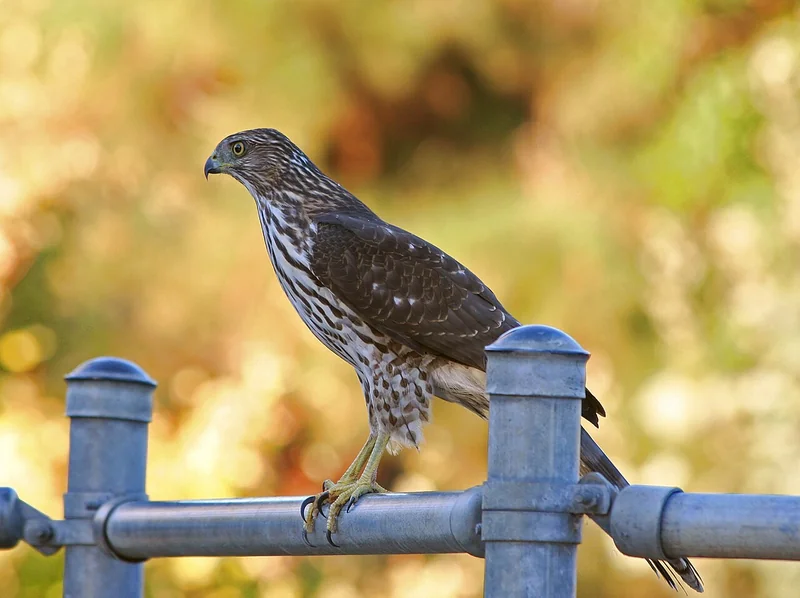 Featured photocoopers-hawk.jpg
Astur cooperii, Cooper's hawk, is a medium-sized accipiter of the family Accipitridae, distributed across most of North America. Adults are 35 to 50 cm long with a wingspan of 62 to 90 cm and weigh 215 to 678 g. Adults show slate-blue upperparts and rusty-barred underparts; juveniles are brown above with streaked underparts. The IUCN lists the species as Least Concern. Cooper's hawks have shifted strongly into urban and suburban habitats over the last forty years and are now among the most commonly observed raptors at backyard feeders.
Quick facts
- Habitat
- Mixed and deciduous woodland, forest edges, suburbs with mature trees, and city parks. The species is unusual among accipiters in adapting strongly to urban habitats; modern populations are heavily urban across most of the United States.
- Range
- Most of North America from southern Canada south through the contiguous United States to Mexico and Central America. The species was placed in Astur in 2024 — taxonomies through 2023 still listed it as Accipiter cooperii.
- Size
- 35–50 cm body · 62–90 cm wingspan · 215–678 g
- Plumage
- Adults show slate-blue-grey upperparts including the dark crown; the underparts are pale with fine rust-red horizontal barring; the long tail has dark grey bars and a clean white terminal band. The eye is bright red in adults, yellow in juveniles. Juveniles show brown upperparts and streaky white-and-brown underparts; the streaking gradually shifts to barring over the first two years.
- Song
- A rapid kak-kak-kak-kak series, especially during territorial display and near the nest. The call is sharper and faster than the closely related sharp-shinned hawk's similar series.
- Migration
- Partial migrant. Northern populations move south for winter; central and southern populations are largely resident. Urban populations are predominantly resident year-round.
- Conservation
- Least Concern (LC)
Overview
Astur cooperii (formerly Accipiter cooperii — the genus was split in 2024) is one of three North American accipiters (with the smaller sharp-shinned hawk A. striatus and the larger northern goshawk A. atricapillus). The species was named by Charles Bonaparte in 1828 after the American naturalist William Cooper, father of the more famous biographer of the same name. Cooper's hawks were historically considered uncommon woodland raptors; modern populations are heavily urban.
Urban shift
Cooper's hawk populations have shifted strongly into urban and suburban habitats over the last forty years. Christmas Bird Counts and Project FeederWatch data both show steady increases in suburban and urban occurrence since the 1980s. Drivers include the abundance of feeder-attracted prey (house sparrows, mourning doves), reduced human persecution, and warmer urban microclimates. Some North American cities now host year-round resident populations at densities far above any forested baseline.
Hunting strategy
Cooper's hawks are short-burst sprint hunters. The species' broad wings and long tail are the classic accipiter body plan, optimized for fast manoeuvring through dense vegetation and around obstacles. Attacks typically come from cover at full speed, often along walls and hedges; the prey is seized in the talons mid-air. Suburban populations attack house-sparrow and dove flocks at feeders with high success rates.
Sources & further reading (2)
- iucn-red-list — accessed 2026-04-29
- encyclopedia — accessed 2026-04-29
Frequently asked questions
How can I tell Cooper's hawk from sharp-shinned hawk?
Both are similar slate-and-rust accipiters, but Cooper's is larger (35-50 cm vs. 24-34 cm), with a relatively larger head, longer tail with a cleaner white terminal band, and more rounded wing tips. The head projects further beyond the wing's leading edge in soaring Cooper's hawks. The size difference between sharp-shinned and Cooper's overlaps slightly between female sharp-shinneds and male Cooper's, making the distinction tricky in mixed-sex comparisons.
Why are Cooper's hawks so common at bird feeders?
Cooper's hawks specialize on small to medium birds, and bird feeders concentrate prey species (house sparrows, mourning doves, starlings, juncos) into a predictable location. Hunting from cover near a feeder is a high-yield strategy with a low energy cost. Feeders therefore become reliable hunting stations, and many suburban Cooper's hawks include several feeder territories in their daily patrol route.
Did the genus name really change recently?
Yes. The American Ornithological Society's 65th supplement in 2024 split Astur from the broader Accipiter genus, moving Cooper's hawk and the northern goshawk into Astur while leaving the sharp-shinned hawk in Accipiter. The split reflects molecular phylogeny showing that the larger New World accipiters form a distinct lineage. Field guides and apps were widely updated in 2024-2025; older guides will still list the species as Accipiter cooperii.