Geothlypis trichas
Common Yellowthroat (Geothlypis trichas)
 Featured photocommon-yellowthroat.jpg
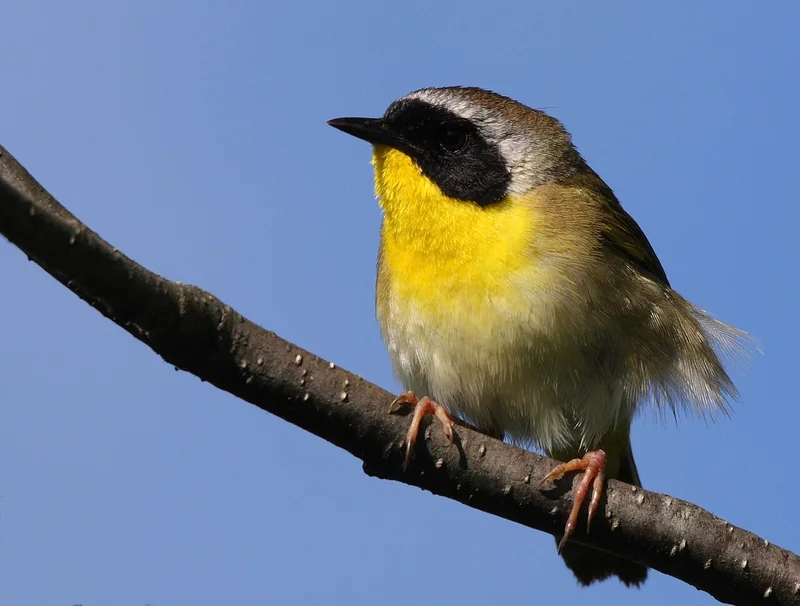
Geothlypis trichas, the common yellowthroat, is a small Parulidae warbler distributed across most of North America. Adults are 11 to 13 cm long with a wingspan of 15 to 19 cm and weigh 9 to 10 g. The plumage shows bright lemon-yellow underparts and olive-green upperparts; adult males additionally carry a striking black face mask edged above with white. The IUCN lists the species as Least Concern. The common yellowthroat is one of the most numerous Parulidae warblers in North America and one of the most successful in human-modified habitats.
Quick facts
- Habitat
- Wet thickets, cattail marshes, brushy old fields, hedgerows, and dense low cover near water. The species is among the most marsh-faithful North American warblers and is rarely found in dense forest.
- Range
- Breeds across most of North America from southern Alaska and Canada south through the United States to central Mexico. Winters from the southern United States south through Mexico, Central America, and the Caribbean to Panama.
- Size
- 11–13 cm body · 15–19 cm wingspan · 9–10 g
- Plumage
- Adult males in breeding plumage show a striking black face mask running from the forehead through the eye and down the side of the throat, edged above with a thin white-grey band, plus bright lemon-yellow throat, breast, and undertail and olive-green upperparts. Females are duller, lacking the black mask, with a uniformly olive-green head and a paler yellow throat. First-year males develop the mask through their second autumn moult.
- Song
- A clear, accented 'witchety-witchety-witchety' delivered from a low marsh-edge perch — the textbook common yellowthroat song and one of the most familiar wetland-edge warbler voices across North America.
- Migration
- Partial migrant. Northern populations move south for winter to the southern US, Mexico, Central America, and the Caribbean. Some southern US populations are largely resident.
- Conservation
- Least Concern (LC)
Overview
Geothlypis trichas is one of about a dozen Geothlypis species across the New World — most of the genus is Neotropical, but the common yellowthroat reaches further north than any other Geothlypis. The species is one of the most numerous Parulidae warblers in North America, with a continental population estimated by Partners in Flight at over thirty million. The Linnaean Latin epithet 'trichas' is from a Greek word meaning 'thrush' — a misleading name applied early in the species' description history that has stuck despite the bird's clear warbler classification.
Distribution and human-modified habitat
The breeding range covers nearly all of forested and edge habitat across North America. The common yellowthroat is one of the most successful Parulidae warblers in human-modified habitats — old fields, brushy field margins, suburban hedgerows, and freshwater marshes alongside roads and farmland all support breeding populations. The species' adaptability has driven a stable-to-increasing continental population while many other warbler species have declined.
Behaviour
Common yellowthroats are skulkers of dense low cover. The species rarely emerges fully into open view; instead, males sing from partly-concealed perches in cattail tops, hedge tops, or low brush. The sharp 'chip' alarm call and the distinctive 'witchety' song are often the first identification cues. Outside the breeding season, the species joins mixed-species flocks that work through wet thickets and marsh edges.
Sources & further reading (2)
- iucn-red-list — accessed 2026-04-30
- encyclopedia — accessed 2026-04-30
Frequently asked questions
Why does the male yellowthroat have a black mask?
Adult males in breeding plumage show a bold black face mask running from the forehead through the eye and down the side of the throat. The mask is sexually selected — males with broader and more saturated black masks have higher mate-attraction success. The mask probably also functions in male-male territorial signalling. Females are unmasked and are typically more cryptic in dense low cover.
Why is it called 'yellowthroat' when most of the underparts are yellow?
The English name dates from the eighteenth century when 'throat' could refer to the entire upper underbody including the chin, breast, and belly. Modern usage of 'throat' is narrower (chin and upper neck only), but the bird's name preserves the older usage. The bright yellow extends across the entire underbody in both sexes — chin, throat, breast, belly, and undertail.
Why are common yellowthroats so common in roadside ditches?
Common yellowthroats favour dense low cover in damp habitat — exactly the microhabitat that roadside ditches, agricultural margins, and small wetlands provide across most of North America. The species' adaptability to human-modified habitats has driven a stable-to-increasing population while many other Parulidae warblers have declined sharply over the same period. The bird's resilience is partly a function of its happiness in degraded edge habitat.