Estrilda astrild
Common Waxbill (Estrilda astrild)
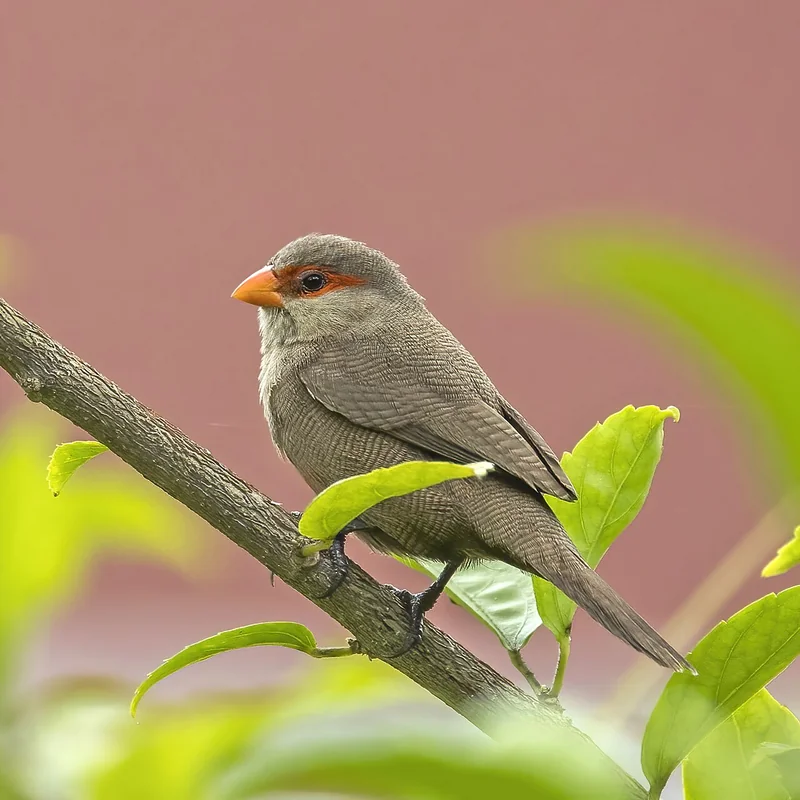 Featured photocommon-waxbill.jpg
Estrilda astrild, the common waxbill, is a small passerine of the family Estrildidae, native to sub-Saharan Africa and one of the world's most successfully introduced birds. Adults are 11 to 13 cm long with a wingspan of 12 to 14 cm and weigh 7 to 10 g. The species is named for the bill — bright red, resembling red sealing wax — and is characterised by fine brown-and-white barring, a red face mask and belly flush, and a long graduated tail. The IUCN lists the species as Least Concern.
Quick facts
- Habitat
- Moist tall-grass habitats — rank grassland, wetland margins, rice paddies, sugarcane plantations, roadside grass, and open farmland with long grass. Strongly associated with seeding grass and reed-beds for nesting. Highly adaptable to disturbed and agricultural habitats.
- Range
- Native throughout sub-Saharan Africa from Senegal and Ethiopia south to South Africa. Introduced and established in Portugal, Spain, Brazil, Hawaii, Bermuda, St. Helena, Réunion, Mauritius, New Caledonia, and several other islands worldwide.
- Size
- 11–13 cm body · 12–14 cm wingspan · 7–10 g
- Plumage
- Adults show finely barred brown-and-white upperparts and underparts giving a scaly or vermiculated appearance, a bold red bill and broad red mask through the eye, and a rosy-pink to red wash on the belly and flanks. The long, narrow tail is dark brown. The red bill and mask are the key field marks; the fine barring is unique among commonly encountered grassland finches.
- Song
- A soft, buzzy 'zzzt' contact call and a wheezing 'seee-seee' note. The song is a quiet, rapid series of high-pitched buzzy notes. The species calls frequently in flocks and the contact call is one of the key sounds of African grassland.
- Migration
- Sedentary. The species is resident throughout its range and does not migrate. Locally nomadic in response to seasonal grass seeding.
- Conservation
- Least Concern (LC)
Overview
Estrilda astrild is one of approximately ten waxbill species in the genus Estrilda, all native to Africa. The common waxbill is one of the most studied estrildid finches and is frequently kept as an aviary bird worldwide — a practice that has led to the establishment of feral populations on every inhabited continent except Antarctica. In Portugal and the Azores, the species is a well-established feral bird that has been present since the 18th century. In Brazil, the introduced population (called 'bico-de-lacre') is now widely established across coastal and interior grasslands.
Grass-seed specialist
Common waxbills are highly specialised grass-seed feeders. The compact, strong bill and small body size allow the bird to cling to the tips of seeding grass stems — bending them under its weight — and pick seeds directly from the stem. The species shows strong preferences for particular grass genera (especially Eragrostis, Panicum, and Brachiaria) and tracks seasonal seed availability with nomadic local movements. Flocks of dozens to hundreds of birds form at productive seeding grassland, often mixing with other estrildid finches and queleas.
Introduced populations
The common waxbill is one of the most successfully established introduced birds in the world, with self-sustaining feral populations in Portugal, Spain, the Azores, Madeira, Brazil, Hawaii, Bermuda, Réunion, Mauritius, and several other locations. Introductions resulted from intentional or accidental releases of aviary birds. In most introduced areas the species is considered ecologically benign, occupying disturbed grassland and agricultural habitats with minimal impact on native birds. However, in some island ecosystems its impacts on native grass-seed feeders are under monitoring.
Sources & further reading (2)
- iucn-red-list — accessed 2026-05-07
- encyclopedia — accessed 2026-05-07
Frequently asked questions
Why is it called a 'waxbill'?
The name 'waxbill' refers to the bill colour — in the common waxbill, the bill is brilliant red, resembling the colour of red sealing wax used historically to seal letters and documents. The name applies to the entire genus Estrilda and several related genera with similarly coloured bills. The colour of the bill also varies by subspecies and individual condition.
Why is the common waxbill established in so many countries?
The common waxbill has been widely kept as an aviary bird for centuries, and escapees or deliberate releases have established feral populations in Europe, South America, the Pacific, and various islands. The species thrives wherever tall grasses and weeds provide seed — a habitat created by human agriculture and disturbance globally. Its small size, adaptability, and tolerance of disturbed habitats make it a successful coloniser of tropical and subtropical grassland worldwide.
How does the common waxbill eat from grass stems?
Common waxbills are adapted for clinging to the flexible tips of seeding grass stems. The bird lands near the top of a seeding stem, grips the stem with its feet, and uses its weight to bend the stem downward into a reachable position. It then picks seeds directly from the seed head with the compact red bill, sometimes hovering briefly at very flexible stems. Flocks of waxbills at a productive seeding patch create a distinctive bending-and-bouncing pattern across a stand of tall grass.