Apus apus
Common Swift (Apus apus)
 Featured photocommon-swift.jpg
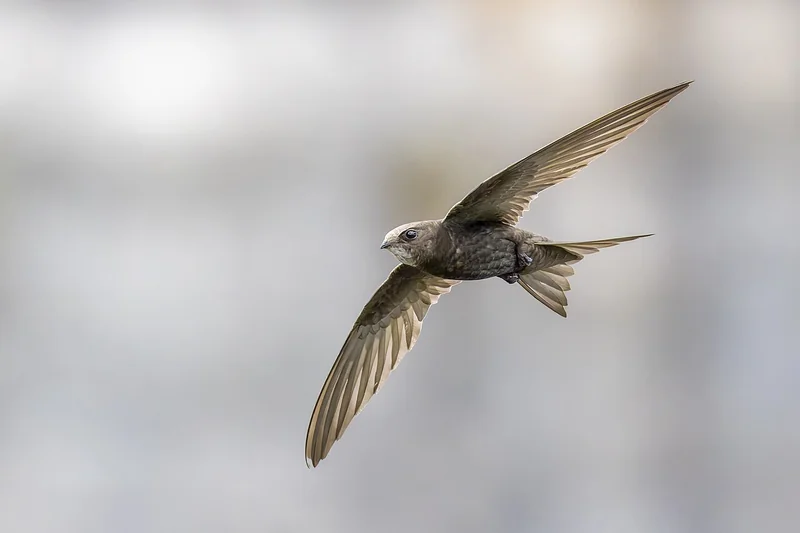
Apus apus, the common swift, is a medium-small swift of the family Apodidae, distributed across Europe, Asia, and North Africa. Adults are 16 to 17 cm long with a wingspan of 42 to 48 cm and weigh 36 to 50 g. The plumage is uniformly sooty brown-black with a small pale throat patch and the diagnostic scythe-shaped wings. The IUCN lists the species as Least Concern. Common swifts are the most aerial of any bird — individuals can spend up to ten months continuously on the wing without ever landing.
Quick facts
- Habitat
- Open skies above any habitat across the breeding range; the species nests in cavities of buildings, cliffs, and (rarely) trees. Modern populations are heavily dependent on building cavities for nesting.
- Range
- Breeds across most of Europe, North Africa, and across temperate Asia to Mongolia and northern China. Winters across sub-Saharan Africa from Senegal to Mozambique and South Africa. The annual migration is one of the longer Old World songbird movements.
- Size
- 16–17 cm body · 42–48 cm wingspan · 36–50 g
- Plumage
- Adults are uniformly sooty brown-black throughout the body, head, and wings — almost no plumage variation across the species' range. The scythe-shaped wings are long, narrow, and pointed; the tail is short and forked. A small pale throat patch is visible at close range. Both sexes look alike. Juveniles are marginally paler than adults.
- Song
- A loud screaming 'srreee' delivered by flying flocks over breeding-area rooftops — the textbook 'screaming swift' summer-evening sound across European cities. The species is generally silent at sea or during migration, but breeding-area screams are unmistakable.
- Migration
- Long-distance migrant. European and Asian breeders winter across most of sub-Saharan Africa. The non-breeding-period flight may continue for up to ten months without ever landing — an extraordinary continuous-flight record for any bird.
- Conservation
- Least Concern (LC)
Overview
Apus apus is the type species of the genus Apus. The species' Latin tautonym derives from the Greek 'apous' meaning 'without feet' — early observers thought the species had no feet because the birds were almost never seen on the ground. The actual feet are tiny, cling-and-perch only (the bird cannot walk in the typical bird sense), and are used briefly only at nesting cavities.
Continuous flight
Common swifts are the most aerial bird species in the world. Geolocator and accelerometer tracking studies have shown that non-breeding individuals can spend up to ten months continuously on the wing without landing — feeding, drinking, mating, and even sleeping in flight. The species' nearly-uninterrupted flight record is one of the most extraordinary in the animal kingdom and is supported by physiological adaptations including unihemispheric sleep (one half of the brain at a time).
Distribution and population trends
The breeding range covers Europe, North Africa, and most of temperate Asia. European populations have declined modestly over recent decades — drivers include the loss of nesting cavities in modern building stock (older eaves and roof spaces are sealed during renovation), reduction in flying-insect populations, and broad agricultural intensification reducing prey. Several European countries have rolled out swift-brick programmes that incorporate purpose-built nesting cavities into new construction.
Sources & further reading (2)
- iucn-red-list — accessed 2026-04-30
- encyclopedia — accessed 2026-04-30
Frequently asked questions
How long can a swift fly without landing?
Geolocator and accelerometer tracking studies have shown that non-breeding common swifts can spend up to ten months continuously on the wing without landing — feeding, drinking, mating, and even sleeping in flight. The species' nearly-uninterrupted flight record is one of the most extraordinary in the animal kingdom. Breeding birds land briefly at nest cavities; non-breeding birds may land for only a few weeks per year, if at all.
How does a swift sleep in flight?
Common swifts (and many other migratory birds) use unihemispheric slow-wave sleep — one half of the brain sleeps while the other half remains awake and controls flight. Brain-recording studies of wild swifts have confirmed the pattern. The technique allows the bird to maintain continuous flight for months at a time without losing consciousness; the active half of the brain handles flight control, the sleeping half rests, and the two alternate continuously.
Why are swifts called 'apus' (without feet)?
Early observers noted that swifts were almost never seen on the ground and concluded the species had no feet. The Greek 'apous' (without feet) became the genus name. The actual feet are tiny — a fraction of a typical songbird's foot size — and are used only for clinging vertically at nesting cavities. Common swifts cannot walk in the typical bird sense; if they accidentally land on the ground, the small feet and long wings make taking off again very difficult.